How Voice AI Agents in Healthcare Bring Patients Back
Five event-triggered calls and one receptionist agent that keep patients in care, without adding front-desk staff.
Voice AI agents in healthcare are AI systems that phone patients and answer their calls in a natural voice. Their most valuable work is the calls clinics rarely get to: rebooking missed visits, offering refill consultations, booking follow-ups, recalling lapsed patients and filling cancelled slots. Staff still approve anything; the agent should not decide alone.
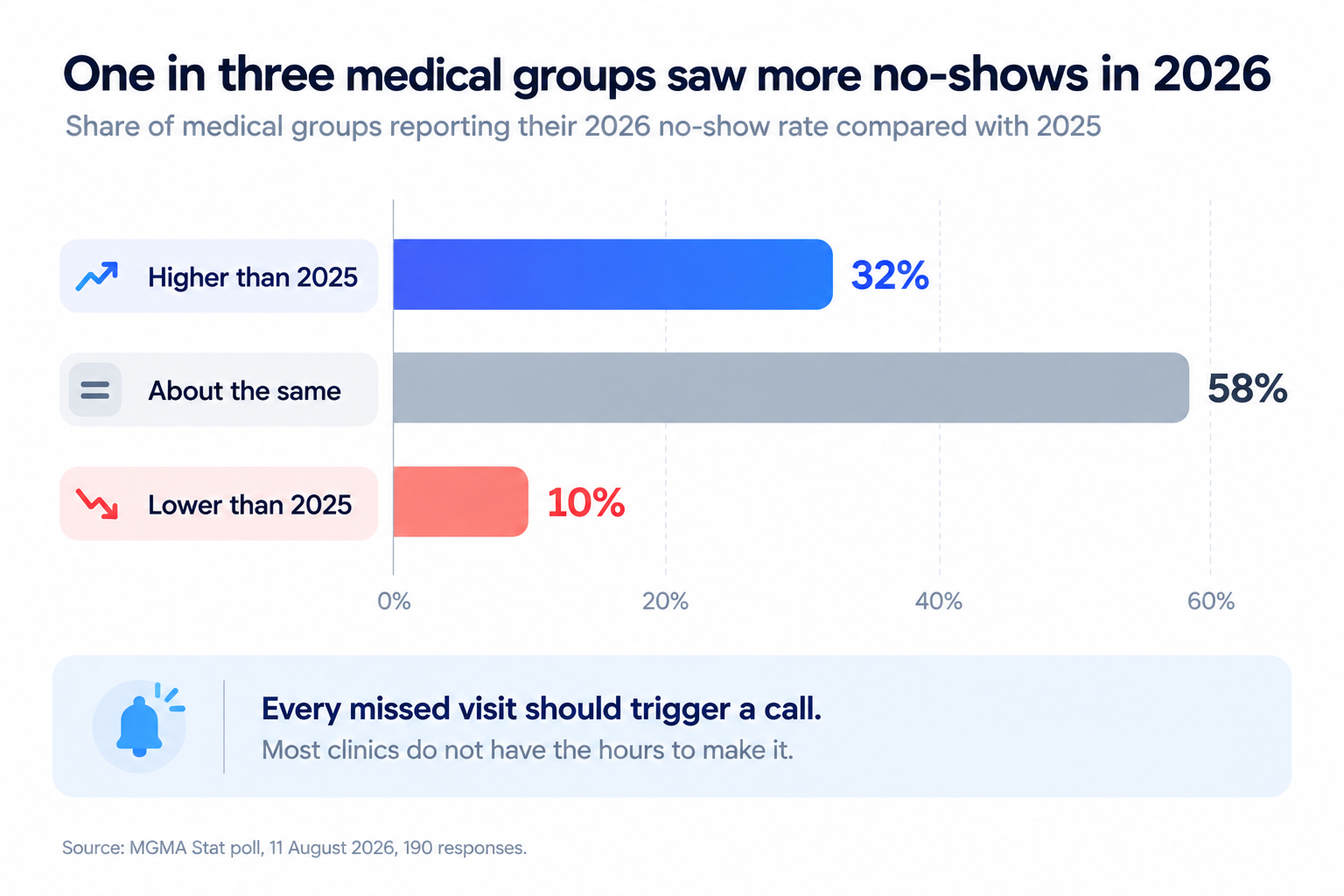
Each skipped call is a lost visit and a patient drifting out of care. In an August 2026 MGMA poll, 32% of medical groups said no-shows had risen since 2025. A busy front desk answers the phone that rings, not the calls that would bring patients back.
In this post, we cover:
- What Are Voice AI Agents in Healthcare?
- Which Patient Calls Should Your Voice Agent Make First?
- How Do You Launch a Voice Agent Safely?
What Are Voice AI Agents in Healthcare?
Think of it as a colleague who makes every call on the list, every day.
1.1 Beyond the Phone Menu: What a Voice Agent Really Does
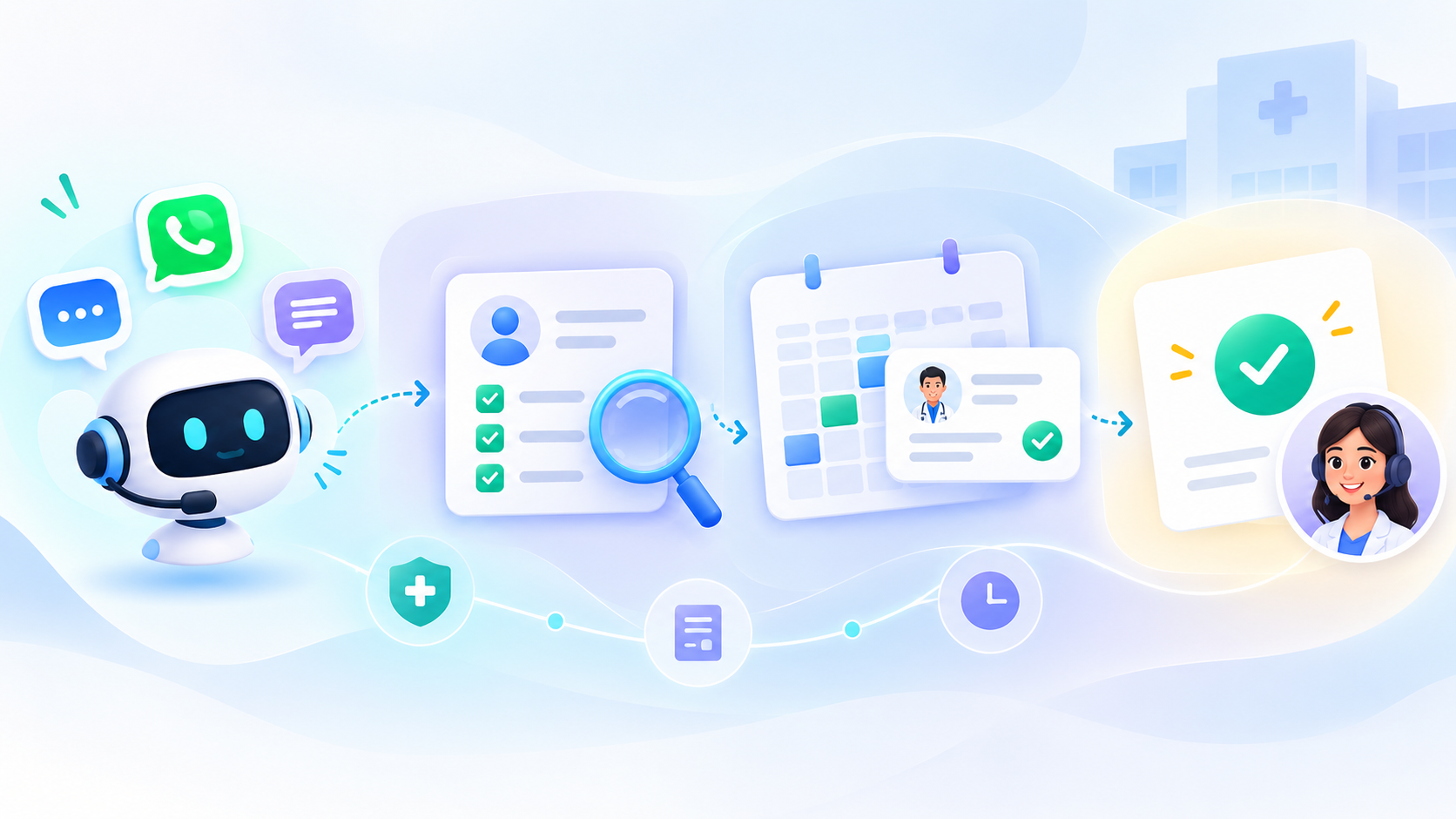
A voice AI agent holds a real phone conversation. Speech-to-text hears the patient, intent detection works out what they want, and a connection to your EHR or EMR lets it book a real slot and confirm it out loud. No buttons, no menus. Our guide to real-time voice AI agent architecture covers the technical side.
1.2 The Hidden Leak: Calls Nobody Has Time to Make
Most clinics start with inbound calls, which our post on AI patient scheduling agents covers. The bigger gap is the calls your clinic keeps missing; the ones nobody has time to make. A 2018 health policy review put the average no-show rate at about 23%. Every missed visit, cancelled slot and refill coming due should trigger a call. Staff simply run out of hours.
1.3 From Pilot to Practice: Health Systems Are Already Calling Out
In September 2026, MobiHealthNews reported that Luma Health added outbound voice calls to rebook missed visits and close care gaps, with clinical questions routed to staff. Patients accept these calls when they are done well.
Which Patient Calls Should Your Voice Agent Make First?
Each call starts from an event in your system, not from someone remembering to dial.
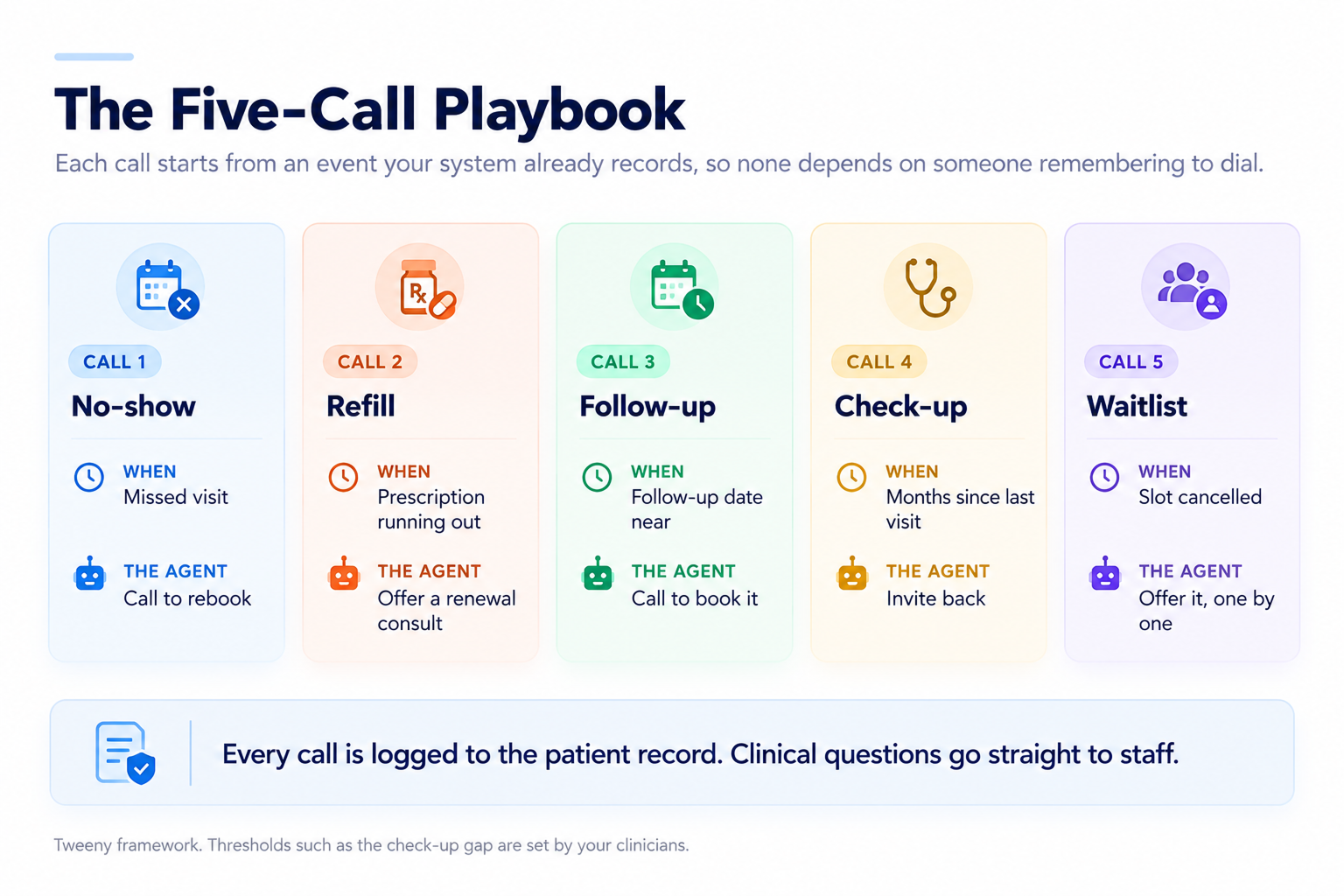
Start with five calls, each triggered by something your schedule or records already capture. We call this the Tweeny Five-Call Playbook. Each one recovers a lost visit or a patient about to drift away. Together, they are the calls that brings the patient back.
2.1 The No-Show Call: Turning a Missed Visit Into a Booked One
Shortly after a missed appointment, the agent calls to rebook. It recovers revenue, and the patient stays in care after one miss. Call the same day so it feels like help, not a reprimand.
2.2 The Refill Reminder: No Patient Runs Out of Medicine
A few days before a prescription runs out, the agent offers a renewal consultation. That means repeat visits and better adherence. Citing CDC research, AJMC reported in May 2026 that about half of filled prescriptions are taken incorrectly. The agent books the consultation. The clinician decides whether to renew.
2.3 The Follow-Up Call: Making the Care Plan Actually Happen
Before the follow-up date the clinician chooses, the agent calls patients who have not booked. The care plan happens instead of slipping. This only works if follow-up dates sit in your EMR as structured data, not in free-text notes.
2.4 The Re-Engagement Call: Bringing Lapsed Patients Back
Patients not seen for a set number of months are invited back for a check-up. These are visits from patients you already have, at no acquisition cost. You set the gap, such as 12 months for routine care or 6 for chronic conditions.
2.5 The Waitlist Offer: No Cancelled Slot Goes to Waste
When an appointment is cancelled, the slot is offered to waiting patients one at a time. Empty slots get filled, and waiting patients are seen sooner. Offering it to everyone at once causes double bookings.
How Do You Launch a Voice Agent Safely?
The goal is fewer routine calls for staff, not fewer staff decisions.
Voice AI agents in healthcare work best when you roll them out in stages. Start with one or two outbound calls, then add a receptionist agent that asks staff to approve what it should not decide alone. Before launch, set the guardrails and decide how you will measure every call.
3.1 The AI Receptionist: Routine Work Automated, Decisions Kept Human
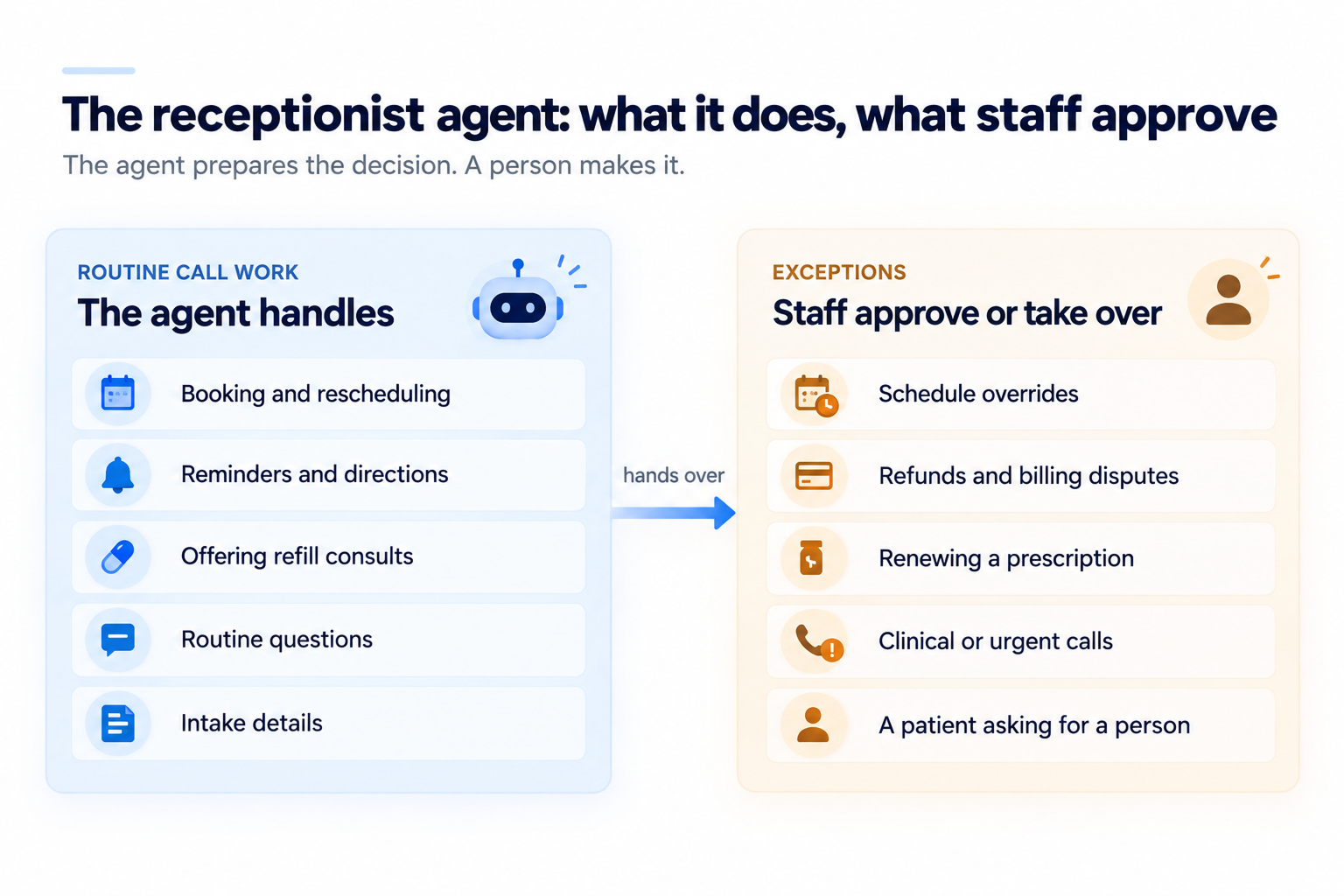
A receptionist agent runs front-desk call work itself and asks staff to approve the exceptions. Much of the call workload is handled automatically, so the practice can grow without adding front-desk staff at the same rate. The agent prepares the decision. A person makes it.
3.2 Four Guardrails to Set Before the First Call
The agent says it is an AI at the start of every call. It honours opt-outs and contact preferences, and you confirm consent rules for automated calls in each market. It never gives clinical advice, and urgent symptoms go straight to a clinician. Every call is logged to the patient record. Calls carry patient health data, so vendors need the right agreements, such as a HIPAA business associate agreement in the US, and Indian deployments must meet DPDP Act notice and consent duties.
3.3 Where to Start and What It Means for Your Team
Start with the call that leaks the most money, usually the no-show call or the waitlist offer. Track reach rate, booked rate, opt-outs and how often staff stepped in.
- Cost: call volume, languages and depth of EMR integration
- Risk: bookings that never reach the EMR, missed urgent symptoms, calls to opted-out patients
- Timeline: pilot one call type for a month against your baseline, then add the next
- Partner: worth it when you need EMR write-back, several call types or audit-ready logs
For scale, take a clinic with 2,000 visits a month and a 10% no-show rate. Rebooking one in four of those 200 patients recovers 50 visits a month. Use your own numbers.
As a healthcare AI development company, Tweeny designs voice agents around intake, scheduling and escalation to a human, and is currently building a voice AI agent for patient intake and appointment scheduling.
The calls that matter most are the ones nobody has time to make.
Voice AI agents in healthcare earn their place on the calls a busy front desk skips. Each starts from an event your system already records, so none depends on someone remembering.
Pick the call that loses you the most visits and run it for a month against your current numbers. When you are ready to scope it, talk to the engineers building voice AI agents for patient intake and scheduling.
Frequently Asked Questions
Quick answers to what leaders ask before they launch.
Will patients accept a call from an AI?

Can a voice agent renew a prescription?
Which call should we automate first?
Does a receptionist agent replace front-desk staff?
What do we need in place before launching?
Explore more blogs

Building intelligent products, modern web platforms, and custom digital experiences.