.png)
Real-Time Voice AI Agent Architecture: Enterprise Scale & Low Latency
A comprehensive deep dive into low-latency speech pipelines, state management, full-duplex transport, and production deployment safeguards.
Building a production-ready voice agent requires moving far beyond basic text-based LLM chains or simple API calls. In modern real-time applications, the challenge shifts from prompt quality to system architecture, latency optimisation, full-duplex orchestration, and robust state management.
When scaling voice systems to handle production traffic, teams encounter distinct distributed computing bottlenecks: context bloat, race conditions during tool execution, audio stream interruptions, and latency compounding.
In this post, we cover:
- Foundations of Voice Agent Architecture
- Core Architectural Pillars for Scale
- Pipeline comparison & deployment
- The Future of Autonomous Voice AI

Foundations of Voice Agent Architecture
Overview of Real-Time Voice Pipelines
A modern production voice agent relies on an integrated, low-latency streaming pipeline that bridges speech processing with a stateful intelligence harness.
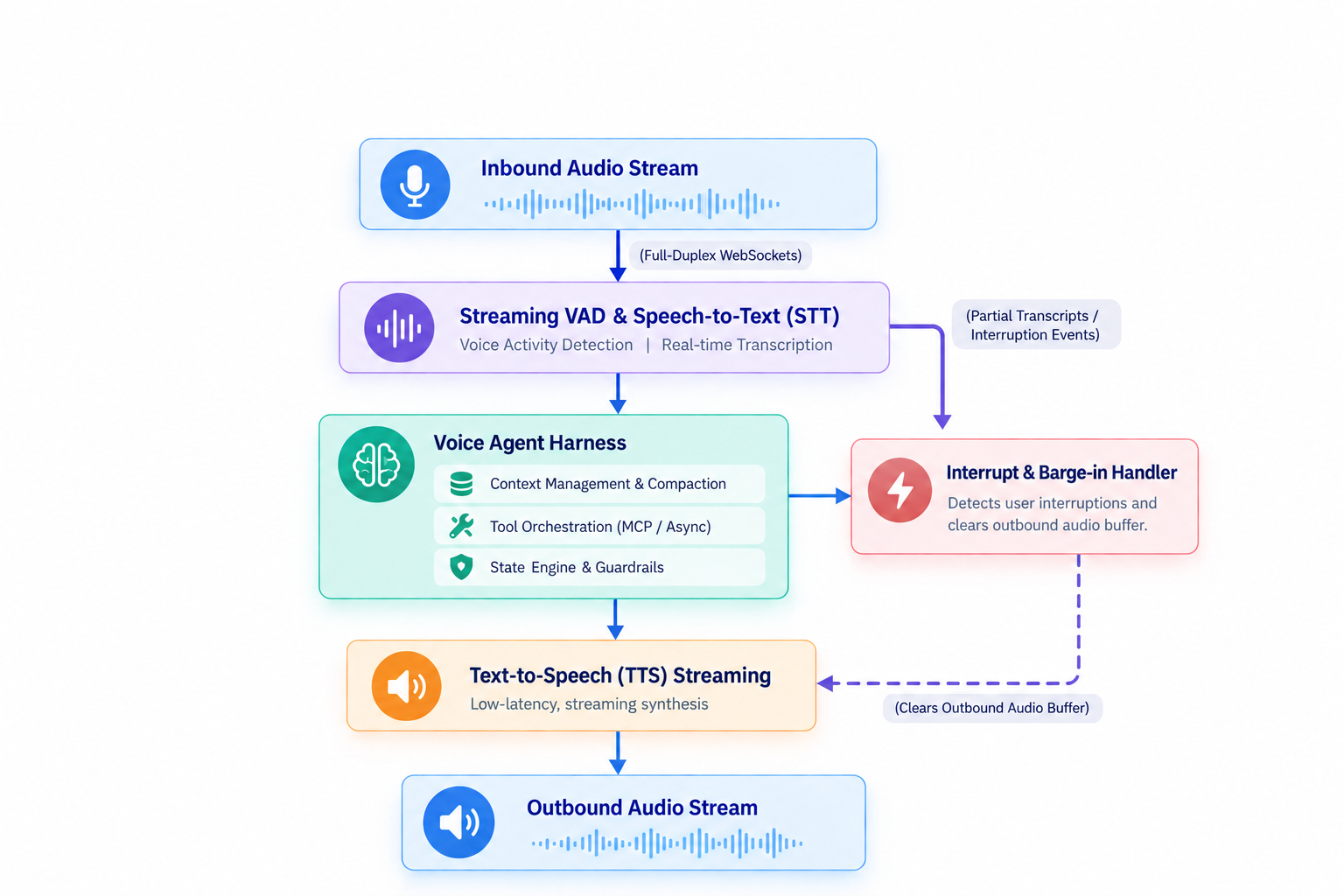
- Inbound Transport & VAD: Audio chunks stream continuously over bidirectional WebSockets. Voice Activity Detection (VAD) monitors silences and user speech starts, triggering immediate "barge-in" events when the user speaks over the agent.
- Speech-to-Text (STT): Streaming audio is converted into text tokens in real time, yielding speculative and finalised transcripts.
- Voice Agent Harness: The core software infrastructure wrapping the model. It manages prompt assembly, tool execution, context compaction, and persistent memory updates.
- Streaming Text-to-Speech (TTS): Response tokens generated by the model are immediately piped into a streaming TTS synthesiser, transmitting synthesised audio packets back to the client with sub-second latency.
Core Architectural Pillars for Scale
Ultra-Low Latency & Duplex Transport Frameworks for Real-Time Human Communication
To maintain natural conversation flow, human-to-human latency targets (~300ms–600ms) must be preserved.
- Transport Protocol: WebSockets or WebRTC are used over standard HTTP to maintain full-duplex communication, allowing simultaneous audio streaming and control signalling.
- Speculative Token Streaming: The agent harness streams generated text directly to the TTS model before the complete sentence is finalised, shaving hundreds of milliseconds off response times.
Voice Harness Engineering & Context Management Strategies to Prevent Context Rot
In long voice sessions, context windows quickly fill with conversation history, audio metadata, and tool output schemas. This causes "context rot", degrading model instruction-following and introducing latency spikes.
- Observation Masking: Hides verbose raw tool outputs while maintaining execution visibility in context.
- Compaction & Note-Taking: Periodically condenses historical conversation turns into key facts, maintaining strict token budgets to keep prefill latency minimal.
Event-Driven & Asynchronous Execution Models for Unblocking High-Throughput Voice Loops
Voice loops cannot freeze while waiting for slow database writes or third-party APIs.
- Decoupled Architecture: The voice conversation agent publishes events (e.g., ReservationRequested) and immediately acknowledges the user.
- Worker Execution: Background agents process heavy integrations asynchronously without stalling the primary conversational audio loop.
Deterministic Guardrails & Idempotency Controls for Safe Enterprise Voice Operations
Because audio interactions are fluid and prone to misunderstandings, execution safety is critical.
- Idempotency Keys: Network retries or repeated user confirmations do not execute duplicate backend operations (e.g., double payments or repeated bookings).
- Tripwires & Permission Hooks: Hardware-level rules and strict schema validation enforce business logic before tools can mutate external databases.

Pipeline Comparison & Deployment
Comparative Analysis of Real-Time Voice Pipelines Across Latency and Guardrail Trade-offs
Choosing the right pipeline structure depends on your target latency, budget, and task complexity.
Voice AI Agent Engineering and Production Deployment Safeguards in Messy Environments
At Tweeny, we build and scale voice AI agents that hold a real conversation and survive contact with production. That means designing for the messy parts first: callers who interrupt mid-sentence, accents and background noise the demo never covered, and silences that need to be read rather than filled. Every conversion step in a cascaded pipeline costs you milliseconds and a little meaning, so we budget latency end to end and pick the architecture that fits the use case rather than the one that benchmarks well. The result is an agent that responds fast enough to feel like a conversation and recovers gracefully when a call goes sideways. Learn more about our services.
"In real-time voice AI, elegance is measured in milliseconds, and system resilience is built on how gracefully you handle chaos."

Building a high-performing voice agent requires a delicate balance of architectural rigour, low-latency optimisation, and state management. While selecting between Cascaded and S2S pipelines establishes the core performance and control profile, overall success depends on an integrated, event-driven infrastructure. Ultimately, creating seamless, natural human-agent interactions relies as much on robust system foundations as it does on the underlying generative models.
Explore more blogs

Building intelligent products, modern web platforms, and custom digital experiences.