Learn why event-driven architecture and webhooks help AI agents respond to business events without constant polling.
Defining event-driven architecture
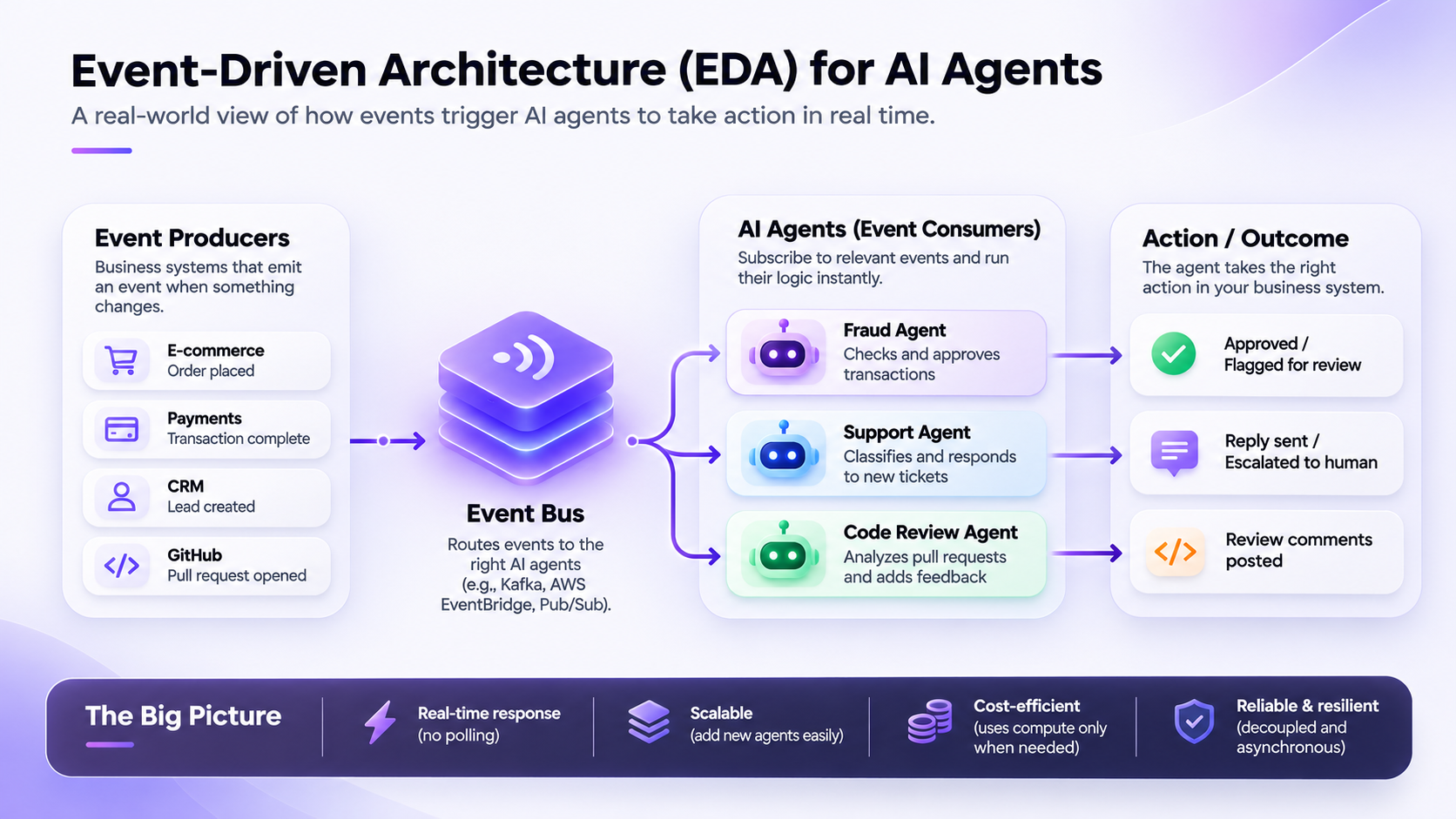
Event-driven architecture (EDA) is a software design approach in which components communicate through events that represent changes in state. An event might indicate that a payment was completed, a support ticket was created or a pull request was opened.
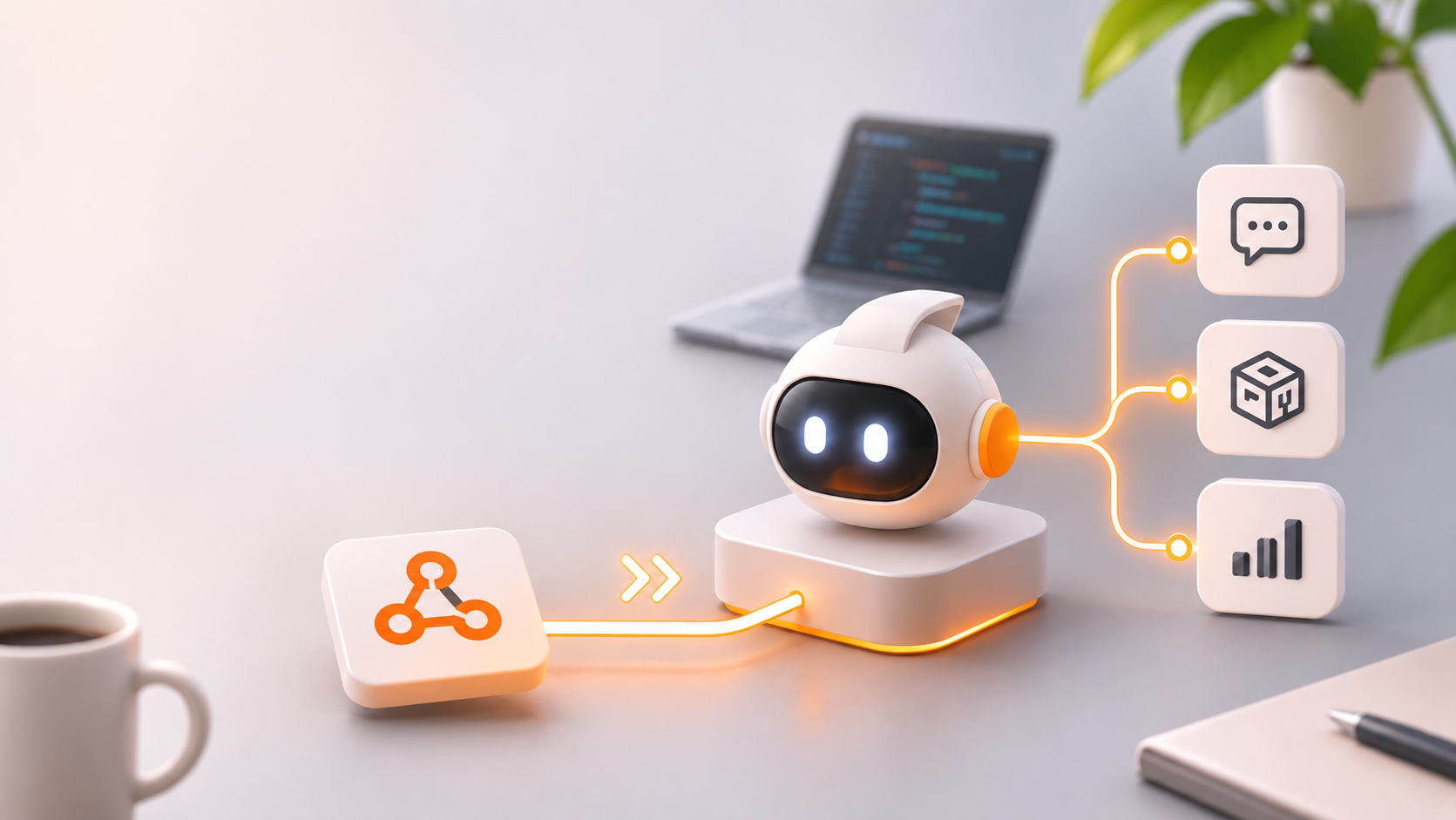
For AI agents, the pattern changes when and why work begins. An agent subscribes to the event types it understands and starts processing when a relevant event arrives, rather than waking up on a schedule to poll another system.
The five building blocks
- Event producer: The source application or service that emits an event when something changes, such as a CRM, payment gateway or monitoring system.
- Event bus: A broker or routing service, such as Kafka, AWS EventBridge or Google Pub/Sub, that delivers events to interested consumers.
- Event consumer: The agent or service that receives an event and performs the required work.
- Loose coupling: Producers do not need to know which agents consume their events. New consumers can be added without rewriting the source application.
- Asynchronous processing: Consumers process work independently, allowing the producer to continue and enabling workloads to scale across workers.
Where webhooks fit
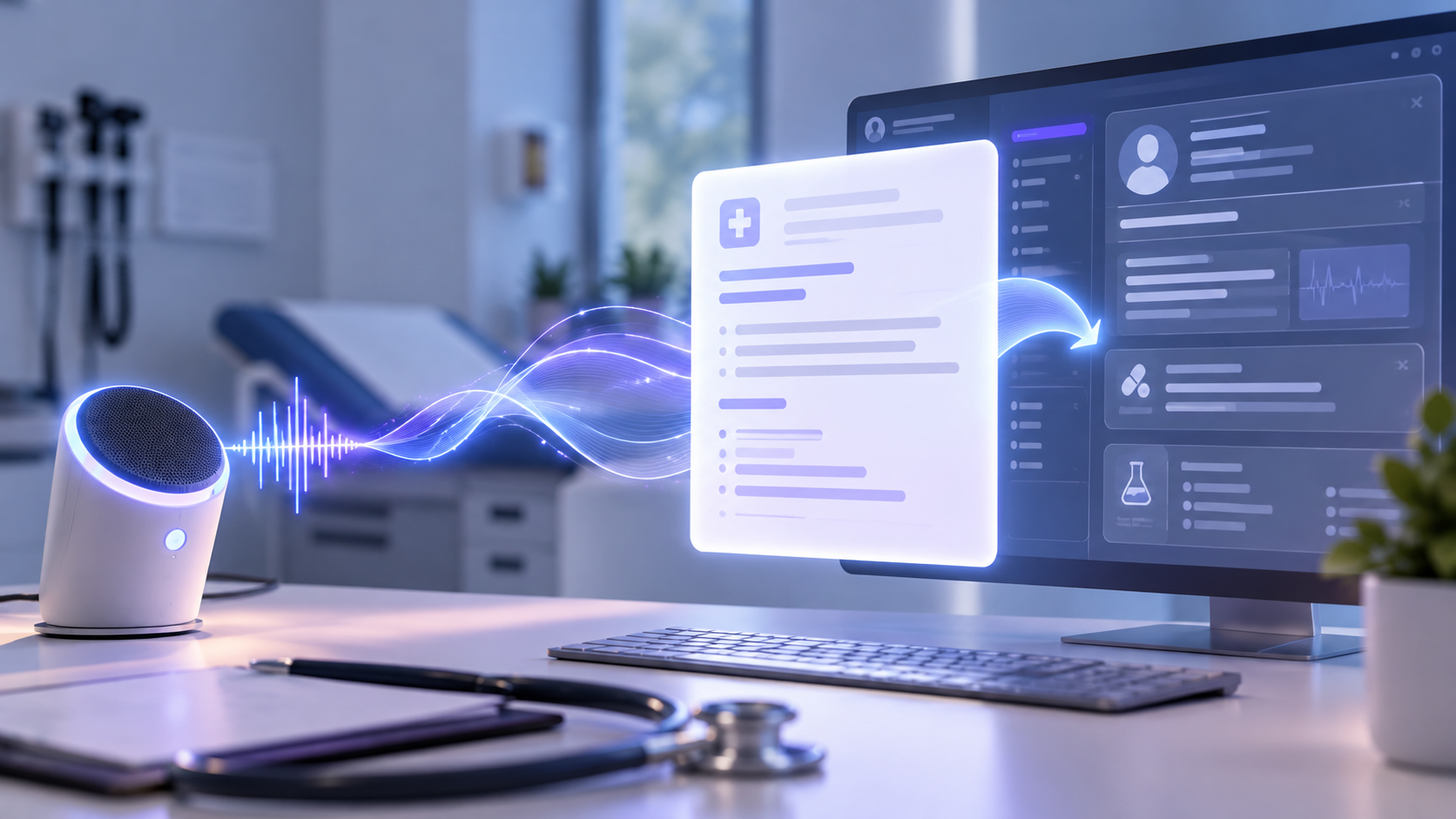
A webhook is a common way for one system to notify another that an event has occurred. The sending system makes an HTTP request to a configured endpoint. A robust implementation verifies the request, acknowledges receipt quickly and places the event on a queue for processing. The agent runtime can then retrieve the relevant context and decide what action to take.
Webhooks are event notifications, not a complete event-driven architecture by themselves. Queues, retries, idempotency, observability and failure handling are still needed for production reliability.
Real-world event-driven flows
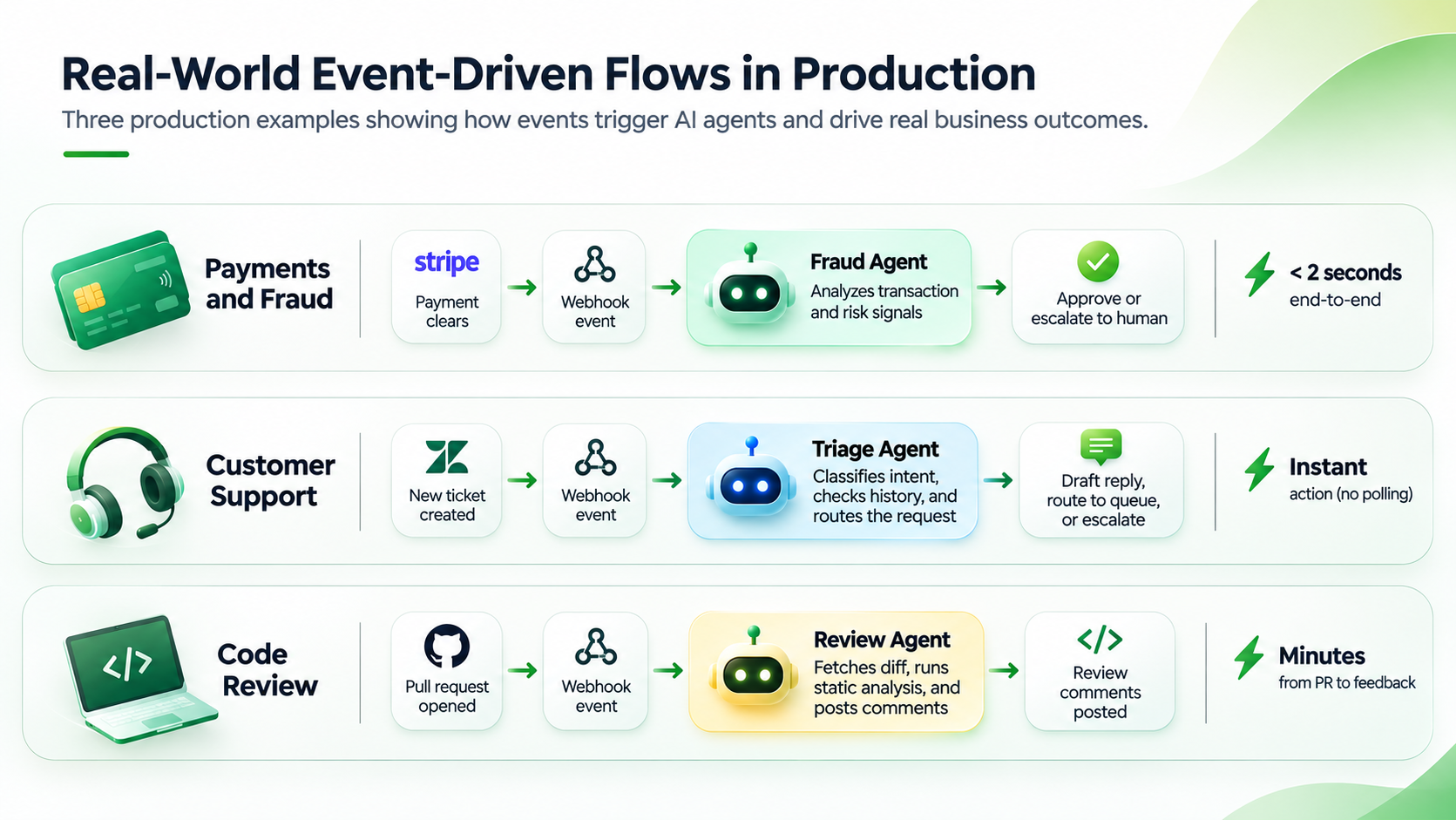
Payment events can start fraud checks, new support tickets can trigger triage, and pull-request events can initiate code review. In each case, the event starts a workflow that retrieves context, applies policies and takes an appropriate action or escalates to a human.
Multi-agent orchestration
Event-driven systems can trigger a single agent or coordinate several specialized agents. The orchestration pattern should match the work, the dependencies between steps and the level of autonomy that is appropriate.
Five multi-agent orchestration patterns
- Sequential: Agents run in a defined order, with each stage using the previous stage's output. Useful for drafting, review and other step-by-step workflows. A weak early result can propagate through the chain.
- Concurrent: Independent agents work on the same input in parallel, and their results are combined. Useful for multi-perspective analysis, but conflicting outputs need a clear resolution strategy.
- Group chat: Agents collaborate through a shared conversation coordinated by a manager. Useful for structured critique or maker-checker workflows, but needs limits to prevent repetition and loops.
- Handoff: One agent transfers control to a specialist when the task requires different expertise. Useful for dynamic triage, but routing rules should prevent tasks from bouncing between agents.
- Magnetic or manager-led planning: A manager agent maintains and adapts a task plan while delegating work to specialists. Useful for open-ended tasks, but requires clear goals, state tracking and stopping conditions.
Three production examples
Payments and fraud: A payment event can trigger a fraud-review workflow. The agent retrieves transaction context from the payment provider, evaluates the relevant signals and either recommends an outcome or routes the case to a human reviewer. High-impact decisions should have explicit policy checks and escalation paths.
Customer support: A new ticket in a platform such as Zendesk or Intercom can trigger a triage agent. It can classify intent, retrieve customer history, draft a response or route the issue to a specialist queue.
Code review: A pull-request event from GitHub can start a review workflow. An agent retrieves the diff, runs configured checks and posts findings for a human reviewer to assess.
Security and operational discipline
Autonomous agents should not inherit broad, unrestricted access. Give each agent a distinct non-human identity with least-privilege permissions, traceable credentials and an auditable record of actions.
- Verify webhook signatures, such as HMAC-SHA256, and validate timestamps to reduce replay risk.
- Use queues to absorb bursts and separate event receipt from longer-running agent execution.
- Make consumers idempotent so duplicate delivery does not repeat sensitive actions.
- Configure retries with backoff, dead-letter handling and clear failure alerts.
- Apply rate limits, timeouts and circuit breakers to downstream API calls.
- Use IP allowlisting where supported, while treating it as an additional control rather than a replacement for signature verification.
- Keep human approval for consequential actions and maintain agent tracing and audit logs.