.png)
AI Patient Scheduling Agents: How They Work, Use Cases and What to Build First
Three real-world stories of agents that fill empty slots, speak the patient's language and book after hours, plus a simple way to pick your first build
AI patient scheduling agents are software assistants that book, reschedule, remind and recall patients by phone, text or chat, using your live calendar. Working alongside modern solutions like prior authorisation automation AI and patient intake automation software, they handle the logistics your front desk never has time for and pass anything clinical to a human. The best first build for most clinics is patient recall: it earns revenue from patients you already have.
Every empty slot is money you have already spent. The doctor, the nurse and the room cost the same whether the chair is filled or not. Meanwhile, your front desk is answering the phone, checking people in, and managing administrative tasks like clinical documentation AI and medical coding automation AI at the same time. The work that fills the schedule, like calling overdue patients, is the first thing to slip.
In this post, we cover:
- How Do AI Patient Scheduling Agents Work?
- Where Do Scheduling Agents Pay Off First?
- Which Scheduling Agent Should You Build First?
- What This Means for Your Team
How Do AI Patient Scheduling Agents Work?
Think of it as a front-desk colleague who never sleeps, never forgets a callback and never skips the list.
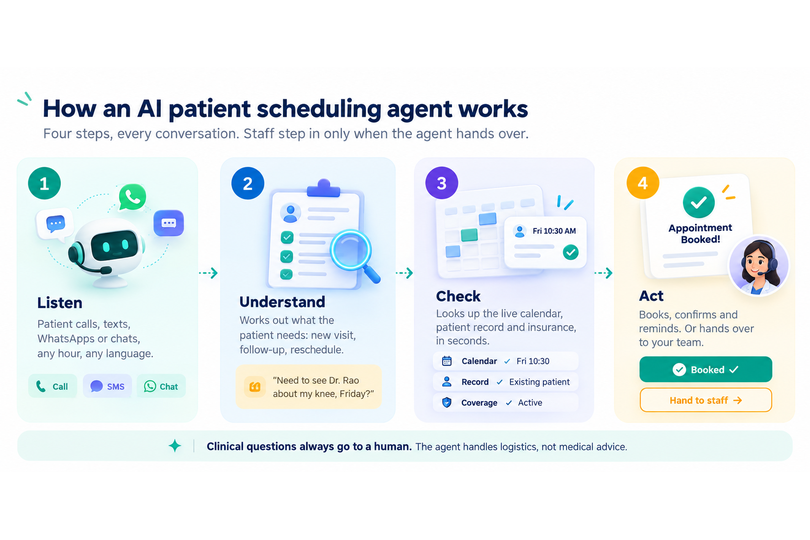
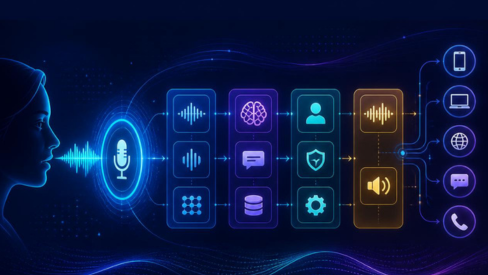
AI patient scheduling agents follow a simple loop. They listen to a patient on any channel and work out what the patient needs. They check your calendar, patient record and insurance data. Then they act: book, confirm, remind, or hand over to staff. Unlike an online booking form, the agent can also start the conversation itself.
That last point is what makes an agent different from the scheduling tools you already own. A booking widget waits for patients to show up. An agent goes looking for them: the patient who missed a follow-up, the one on the waitlist, the one who hasn't visited in a year.
Under the hood, the agent connects to your EHR, PACS, or practice management system—much like radiology AI integration services—usually through HL7 or FHIR interfaces. It books into the same calendar your staff use. Nothing lives in a separate spreadsheet.
The guardrail matters as much as the capability. A well-built agent never gives medical advice. When a patient describes a worrying symptom, it escalates to a clinician. Patients expect exactly this: in a Salesforce survey of 3,200+ patients reported by Fierce Healthcare in June 2026, 89% called an "escalate to a human" option essential, even for admin tasks.
Where Do Scheduling Agents Pay Off First?
The fastest wins come from patients who already want to see you but can't get through.
Three stories: the forgotten recall list, the Tamil-speaking patient and the 11 pm booking.
Scheduling agents pay off first in three places. They bring back patients who are overdue (recall and reactivation). They talk to patients in their own language (multilingual support). And they book appointments at night and on weekends (after-hours booking). Each one turns the demand you already have into visits on the calendar.
Story 1: Patient recall and reactivation
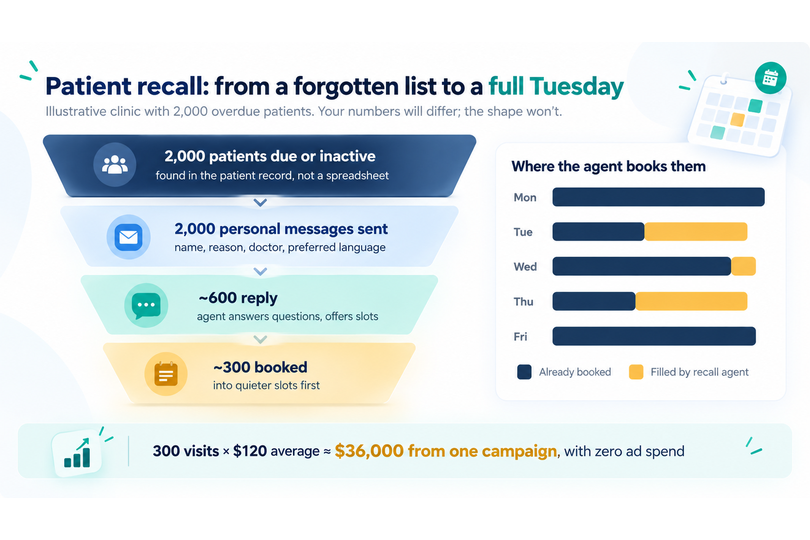
The moment: Picture a six-doctor clinic. Its records show 2,000 patients who are overdue: diabetes reviews, annual check-ups, refills that ran out months ago. Everyone agrees someone should call them. Nobody has the time, so the list sits there.
What the agent does: It works the list in a weekend. It finds every patient who is due or has gone quiet. Each one gets a personal message with their name, their doctor and the reason for the visit, in their preferred language. When a patient replies, the agent answers questions and offers slots, starting with the quieter days of the week.
Here is the math, using illustrative numbers. If 30% of those 2,000 patients reply and half of them book, that is 300 visits. At a $120 average visit value, one campaign brings in about $36,000, with zero ad spend. Run it every quarter, and it becomes a steady revenue line.
This is already happening at scale. Fierce Healthcare reported in May 2026 that Annapolis Internal Medicine booked 61% of its flu-shot appointments through AI-led outreach.
Story 2: Multilingual patient support
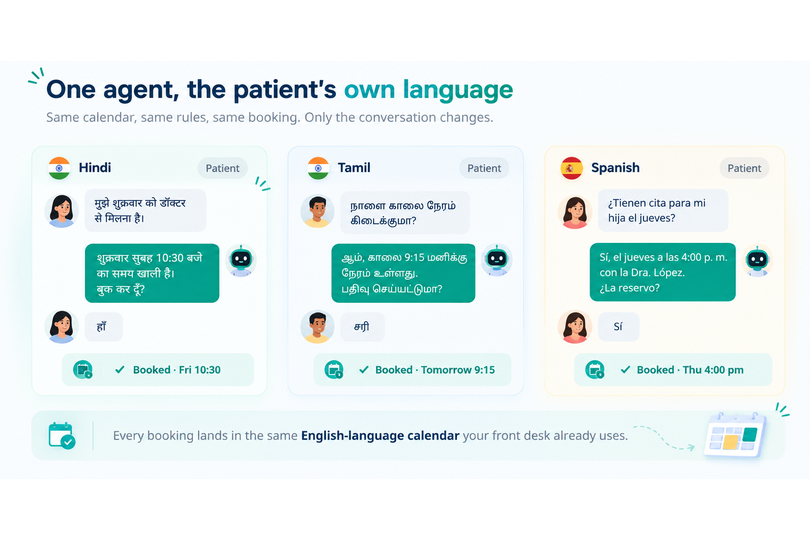
The moment: A retired schoolteacher in Chennai needs a follow-up with her cardiologist. She is comfortable in Tamil, not English. Twice she called, got confused by the phone menu, and hung up. Her daughter eventually booked for her, a week late.
What the agent does: Now she types her question in Tamil. The agent replies in Tamil, offers a 9:15 slot tomorrow, and books it. The appointment lands in the same English-language calendar the front desk already uses. The same agent can speak Hindi, Spanish or other languages your patients prefer.
The gap is real and measurable. In a secret-shopper study published in JAMA and reported by TechTarget Patient Engagement, 61% of calls from English speakers led to a scheduled cancer appointment. Only 36% of Spanish-speaking callers and 19% of Mandarin-speaking callers got the same result. Online is not much better: a 2025 University of Michigan study found 29% of US hospitals offer no patient portal login in any language other than English. The MGMA also advises sending reminders in the patient's preferred language to cut no-shows.
Story 3: After-hours appointment booking
The moment: A father notices a rash on his son's arm at 11 pm. It is not an emergency, but he wants the child seen tomorrow. The clinic line goes to voicemail. By morning, he has booked with a competitor that had an online slot.
What the agent does: With an agent on the line, he gets an answer at 11 pm. The agent asks a few scripted questions and books the first morning slot. If he mentions warning signs such as trouble breathing, the agent follows the clinic's triage protocol: it directs him to emergency care and alerts the on-call team.
Patients want this. In the same Salesforce survey covered by Fierce Healthcare, 67% said they would rather use 24/7 AI help than wait for office hours. And 44% said round-the-clock AI help would make them more likely to stay with their provider.
What This Means for Your Team
Cost, risk, timeline and when to bring in a partner.
The AI is the easy part. The integration and the guardrails are where projects succeed or stall.
Cost and timeline. A focused recall agent that connects to one EHR is a pilot measured in weeks, not quarters. Most of the effort goes into the integration and the guardrails, not the AI itself. Each extra language adds testing time, not a new build.
Risk. Patient data is sensitive, making HIPAA-compliant AI development essential to ensure encryption, role-based access, and compliance with HIPAA in the US or the DPDP Act in India, alongside audit logs of every conversation.
At Tweeny, we designed and built an end-to-end telehealth platform that unites patients, clinicians and administrators in one connected system. Patients book appointments, join secure video consultations, receive digital prescriptions and manage their health records in a single place. Doctors work from a centralised schedule, with clinical documentation, insurance management and follow-up coordination built in. The outcome is leaner day-to-day operations, easier access for patients and stronger continuity of care. It also means the hardest parts of a scheduling agent, such as the live calendar, the patient record and the handover to a clinician, have already been solved in production. See how Tweeny approaches telehealth platform development.
AI patient scheduling agents are not about flashy AI. They do the patient outreach your team already knows matters but never has time for. Recall, language support and after-hours booking all end the same way: more of the right patients in the right slots.
Your next decision is simple. Pull your overdue patient list, count it, and multiply by your average visit value. If that number is worth a quarter's attention, start there. Talk to the engineers who build healthcare AI agents about getting your first recall agent live.
Frequently Asked Questions About AI Agent Development
What is an AI patient scheduling agent?

Will a scheduling agent replace my front-desk staff?
Is an AI scheduling agent safe with patient data?
How fast does patient recall show results?
Can one agent handle several languages?
Explore more blogs


Building intelligent products, modern web platforms, and custom digital experiences.