.png)
The Autonomous Finance Function: Streamlining Compliance, Audit, and Real-Time Reporting with AI
Introduction: Finance Is Being Asked to Move at Business Speed
Finance is being asked to operate at the speed of modern business, but most finance systems were never built for it. While transactions settle instantly and decisions are made continuously, finance functions still rely on periodic closes, retrospective audits, and manual compliance checks. This growing disconnect is no longer just inefficient; it is risky.
As regulatory pressure and operational complexity increase, delayed reporting and reactive controls leave organizations exposed. Risks surface too late, audits disrupt operations, and finance ends up responding to the business rather than guiding it. A new operating model is emerging in response, one where intelligence is embedded directly into financial workflows, reshaping how compliance, audit, and reporting function at scale.
From Process Automation to Intelligent Finance Operations
Over the past several years, finance transformation has largely focused on automation, speeding up reconciliations, digitizing invoices, and improving reporting efficiency. While these initiatives reduced manual effort, they largely optimized individual tasks without changing how the finance function fundamentally operates.
What is changing now is not the level of automation but the placement of intelligence.
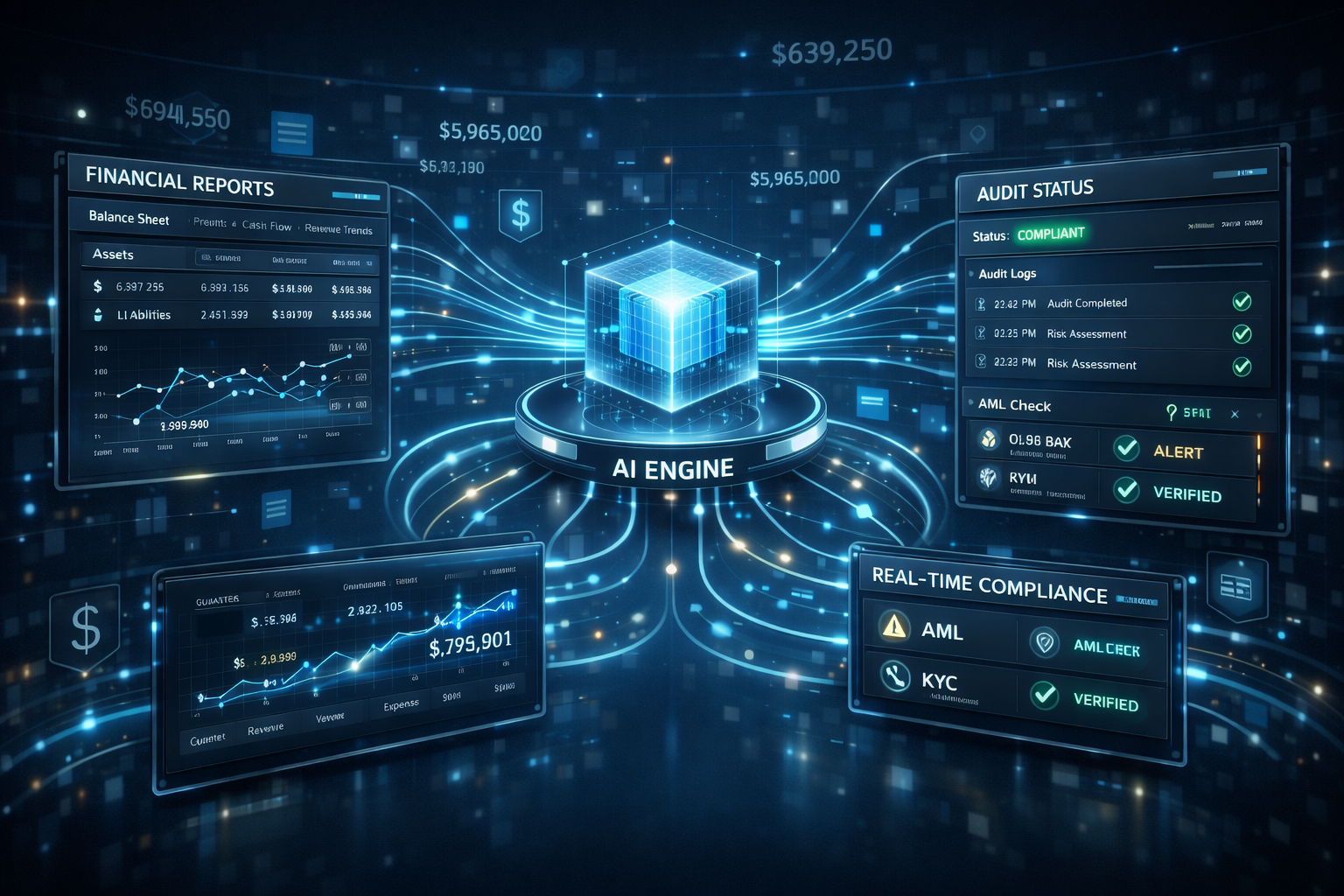
AI is moving beyond dashboards and forecasts into the core of financial operations. It is being embedded directly into transaction flows, control mechanisms, and governance logic. Rather than waiting for human review, modern finance systems can interpret activity as it occurs, apply policy rules automatically, and surface risks in real time.
This evolution shifts finance from a task-driven function to a self-regulating operational system, one designed to run continuously, adapt dynamically, and scale with the business rather than operate in periodic cycles.
Compliance, Audit, and Reporting Become a Continuous Intelligence Layer
Traditionally, compliance, audit, and reporting have operated as separate, sequential activities, with compliance enforced after transactions, audits conducted periodically, and reports generated long after decisions were made. This fragmented model struggles to keep pace with the speed and complexity of modern business.
AI-enabled finance systems rewire this model by embedding intelligence directly into financial workflows. Compliance logic is applied in real time at the point of execution, ensuring regulatory and policy rules are enforced as transactions occur. At the same time, systems continuously capture structured, traceable evidence, enabling audits to shift from disruptive, point-in-time exercises to always-on assurance. In parallel, financial data is synthesized continuously across ledgers, payments, and operational platforms, transforming reporting from retrospective summaries into real-time financial intelligence.
Together, these capabilities replace episodic controls with continuous financial governance, reducing remediation, strengthening consistency, and enabling finance to guide decisions as the business operates, rather than reacting after the fact.
Reporting Evolves into Real-Time Financial Intelligence
AI continuously connects ledgers, payments, and operational systems to surface what’s happening now, not weeks later.
Key capabilities include:
- Live exposure & liquidity visibility: Understand cash positions and financial exposure in real time.
- Early compliance risk detection: Identify regulatory or policy risks as they emerge, by region or product.
- In-flight cost and revenue signals: Spot financial trends while they are forming, not after the close.
- Proactive performance indicators: Detect early signals before they appear in monthly or quarterly reports.
Looking Ahead: The Future of Finance Operations
The future of finance will not be defined by faster closes or better dashboards; it will be defined by continuous financial governance. Finance operations are moving toward a model where controls, insights, and risk assessments update in real time as the business runs.
AI will increasingly function as a first-class control layer, interpreting events, enforcing policies, and escalating exceptions at machine speed. As these systems mature, the role of finance professionals will evolve. Routine validation and monitoring will be handled by intelligent systems, allowing teams to focus on judgment, scenario planning, and strategic leadership.
The Autonomous Advantage: Powering Finance at the Speed of Modern Enterprise
Tweeny Technologies builds software to help organizations move toward autonomous finance by bringing AI directly into everyday financial workflows. Instead of relying on manual checks and delayed reports, we’ve helped organisations connect compliance, audit, and reporting into one intelligent system where controls run continuously, evidence is captured automatically, and financial data stays live and easy to access. This helps teams cut down on handoffs, speed up reviews, and give leaders a clear, real-time view of the business.
For customers, this changes how finance teams spend their time. Routine reconciliation and remediation are automated, freeing teams to focus on analysis, forecasting, and decision support. Governance improves through built-in transparency and traceability, operations scale without added headcount, and finance evolves into a proactive, data-driven partner that helps the business move faster and manage risk earlier.
Conclusion
The rise of autonomous finance marks a structural shift in how organizations govern, scale, and understand their financial operations. It is no longer a trend but the essential operating model for the modern enterprise. We have embraced this shift by embedding intelligence directly into our compliance, audit, and reporting frameworks. By moving from reactive events to continuous oversight, we have reduced manual effort and accelerated review cycles.
For us, the impact extends beyond mere efficiency; our products are helping finance teams to now devote their energy to high-value decision support, while the governance improves through total traceability. We are proving that when finance operates continuously, the entire organization can move faster and make more confident, data-driven decisions.



Explore more blogs

Building intelligent products, modern web platforms, and custom digital experiences.