.png)
CAC vs Retention: Why Mid-Sized Firms are Pivoting to AI-Driven Customer Success
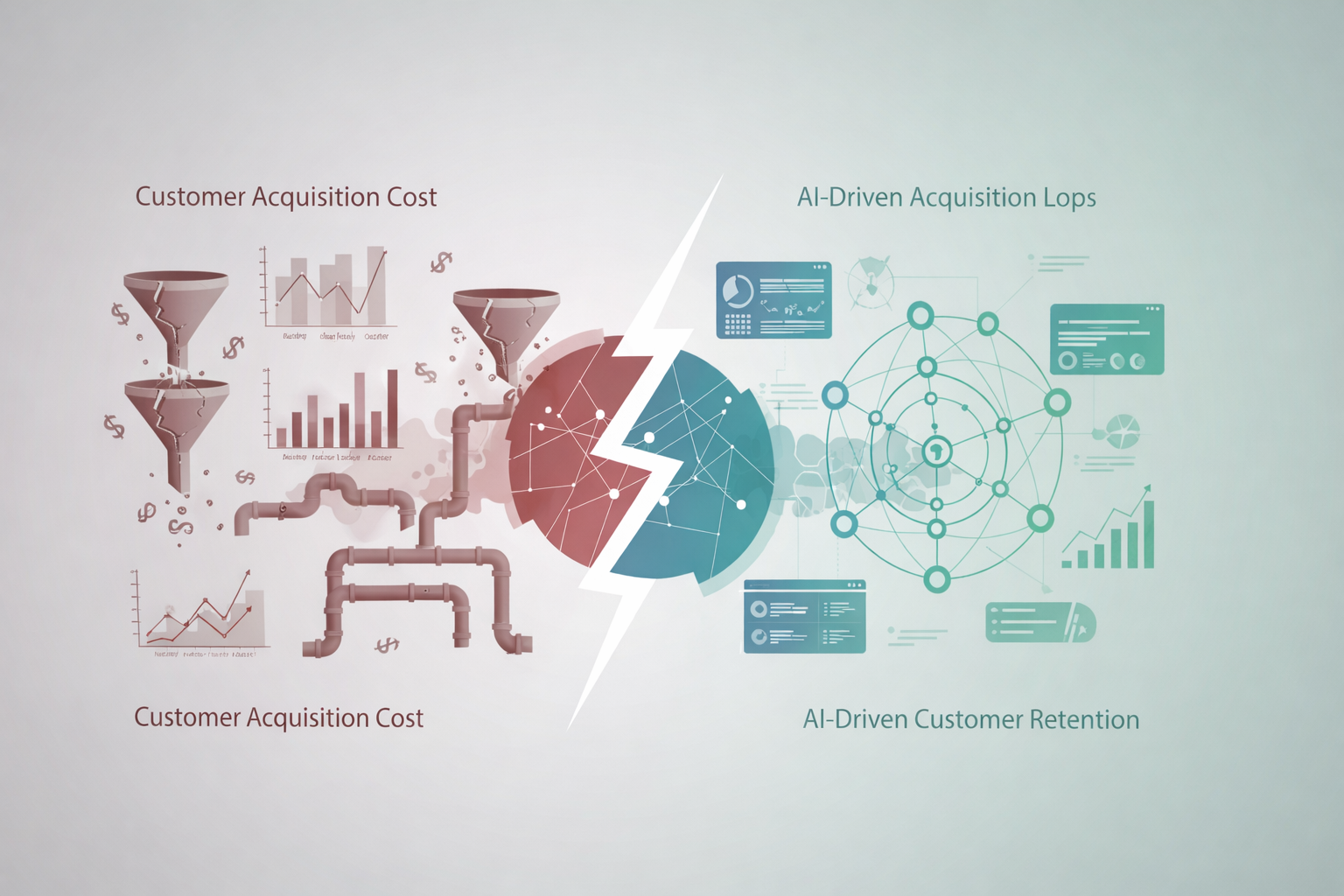
The economics of growth are quietly breaking
Growth is becoming more expensive at the same time it is becoming less reliable. Customer Acquisition Costs (CAC) continue to rise, while the lifetime value of many customers is increasingly difficult to defend. For years, companies masked this imbalance by spending more on acquisition and worrying about efficiency later, an approach that worked when channels were cheap and competition was forgiving. That model no longer holds.
Mid-sized firms feel this strain most acutely: without the margin buffers of large enterprises or the agility of startups, growth is no longer constrained by ambition but by economics. As a result, many organizations are being forced to reconsider what sustainable growth actually means and why AI-driven customer success is emerging as a strategic shift rather than a tactical upgrade.
CAC vs. retention: two very different operating models
CAC and retention are often discussed as opposing levers: spend here, optimize there. In reality, they represent two fundamentally different ways of designing and operating a business.
CAC-focused growth is built to pull revenue forward. Retention-focused growth is designed to make that revenue last.
Customer Acquisition Cost (CAC): Growth Through New Customers
Customer Acquisition Cost focuses on bringing new customers into the business. It operates mostly in the short to medium term and requires upfront investment before results are realized.
Key characteristics:
Retention & Customer Success: Growth Through Customer Value
Retention and Customer Success is about maximizing the lifetime value of existing customers. It plays out over the medium to long term and delivers compounding returns over time.
Key characteristics:
- Primary goal: Maximize value from existing customers
- Time horizon: Medium to long term
- Cost profile: Compounding impact over time
- Data reliance: Product usage, behavior, support, and outcome data
What is often overlooked is how closely these systems are linked. Weak retention quietly inflates CAC. When customers churn early or fail to realize value, acquisition spend becomes a sunk cost. On the surface, the business may appear to be growing. Underneath, unit economics are deteriorating.
This is why retention is no longer a downstream metric or a post-sales concern. It is a primary driver of sustainable growth.
What AI-driven customer success actually means
AI-driven customer success is often mistaken for chatbots, automation, or dashboards with predictions. In reality, it is a system-level capability, not a single feature. At a practical level, it consists of four connected layers:
1. Unified customer data: Data from how customers use the product, interact with support, move through onboarding, and engage over time is continuously brought together into one consistent customer view.
2. Predictive and behavioral intelligence: Models detect early signals of churn risk, stalled adoption, or expansion opportunities, often well before they are obvious to human teams.
3. Decision-making and orchestration: The system determines the right response: in-product guidance, proactive outreach, workflow escalation, or direct human involvement.
4. Continuous learning: Customer outcomes and real-world results are continuously fed back into the system, allowing models to refine predictions, improve accuracy, and increase relevance over time as customer behavior and conditions evolve.
This is not about replacing customer success teams. It is about giving them leverage so they can move from reacting to problems to actively managing customer value.
Common misconceptions and where teams go wrong
Many AI-driven customer success initiatives struggle not because the idea is flawed, but because expectations are misaligned.
1. AI-driven customer success is just automation: Automation without intelligence only scales inefficiency. The real value comes from predicting risk, prioritizing effort, and acting early.
2. Retention belongs to one team: Retention is shaped by product design, onboarding, pricing, support, and communication. Treating it as a siloed responsibility limits impact.
3. More data means better decisions: Without clear decision frameworks, more data creates confusion. What matters is fewer, higher-confidence signals, not more dashboards.
How we help teams make growth durable
At Tweeny Technologies, we work with mid-sized organizations that are feeling the pressure of rising acquisition costs and fragile retention economics. Our focus is not on adding more tools or surface-level automation, but on helping teams build customer success systems that actively protect and expand customer value.
We help clients unify customer data across product, revenue, and engagement touchpoints, apply intelligence that surfaces early risk and opportunity signals, and operationalize those insights into clear, timely actions. The result is a customer success motion that is proactive rather than reactive, one that reduces churn, improves lifetime value, and makes growth more predictable.
By treating customer success as a core growth system rather than a downstream function, we help organizations shift from expensive momentum to durable, compounding growth.
Conclusion: Growth is no longer about volume, but durability
As acquisition costs rise and competition intensifies, sustainable growth increasingly depends on retaining and expanding existing customers. Retention is no longer a downstream metric; it is central to the economics of growth.
AI-driven customer success enables this shift by making value delivery proactive, scalable, and continuous. It helps teams identify risk earlier, focus on the moments that matter most, and turn customer relationships into long-term assets.
For mid-sized firms, the next phase of growth will favor those that compound value over time. In that reality, retention is not an alternative to acquisition; it is what makes acquisition work.



Explore more blogs

Building intelligent products, modern web platforms, and custom digital experiences.