.png)
Marketing Automation That Actually Drives Revenue: Fewer Flows, Better Outcomes
The Shift From Automation Volume to Revenue Impact
Marketing automation has reached a point of maturity but not necessarily effectiveness.
Most teams now manage more workflows, triggers, and customer journeys than ever before. However, when leaders ask a simple question: which of these automations generates revenue? The answer is frequently unclear.
This matters now because the economics of growth have shifted. Customer acquisition is more expensive. Attention is fragmented. And customers expect relevance, not volume. In this environment, automation that only scales activity is no longer enough.
What organizations need instead are focused, outcome-driven automation systems designed to improve conversion, retention, and lifetime value, not just operational efficiency.
The future of marketing automation is not about doing more. It is about doing less better while maintaining a clear focus on business results.
Why traditional automation approaches fail
Most automation programs don’t start out complex. They grow that way.
A welcome flow is added. Then a re-engagement campaign. Then a product update journey. Over time, these individual efforts pile up into a dense and fragile ecosystem.
Common symptoms include:
- Multiple overlapping flows targeting the same users
- Automation designed around tools and channels rather than customer outcomes
- Teams optimizing individual campaigns without shared success metrics
- Measurement focused on opens, clicks, and volume instead of revenue impact
The result is complexity without leverage. Automation becomes harder to manage, harder to improve, and increasingly disconnected from real business performance.
At this point, automation is busy but ineffective.
The Core Idea: Revenue-Driven Automation Systems
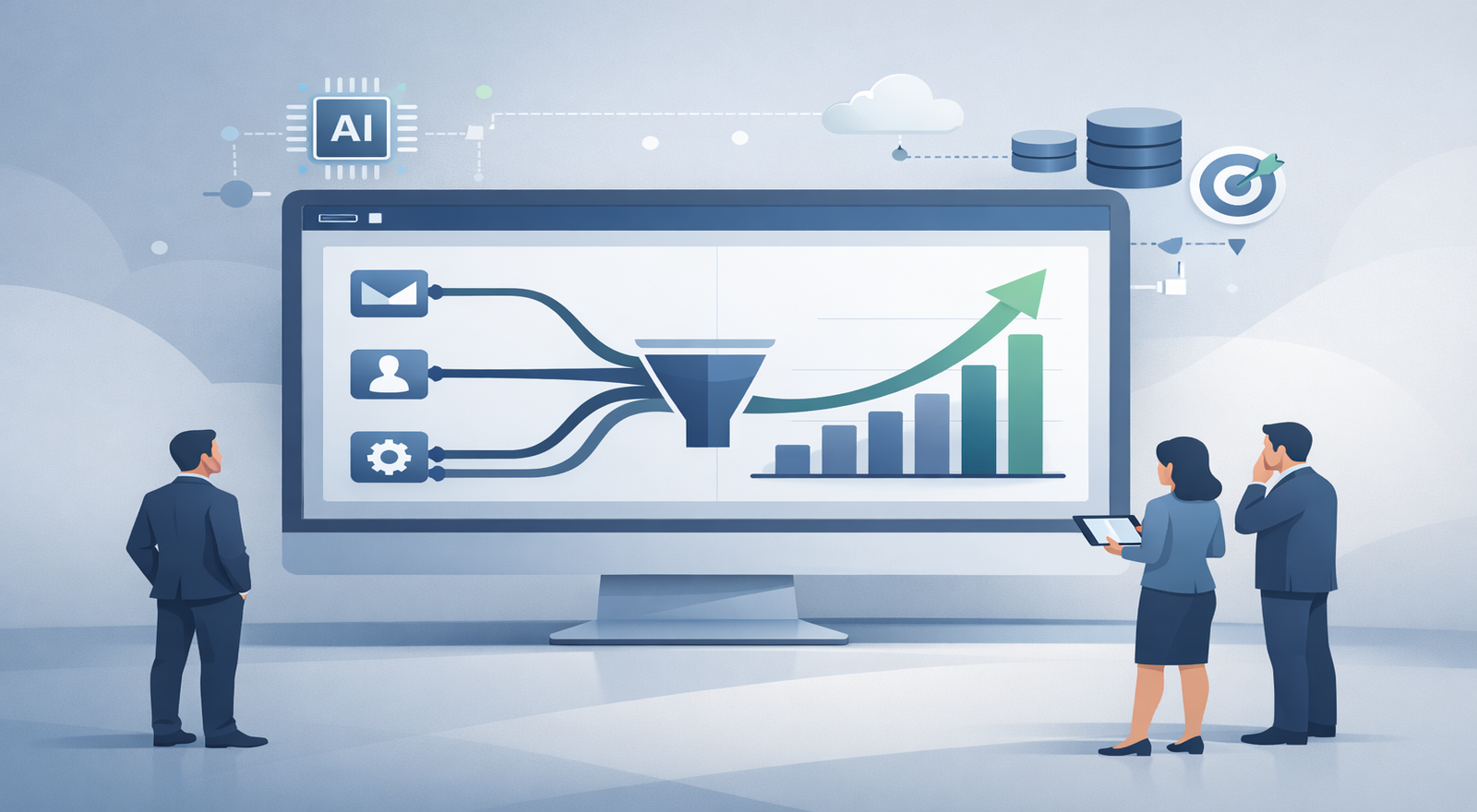
Marketing automation that drives revenue is built as a system, not a collection of campaigns.
At an architectural level, this means shifting focus from “what we send to what customers are trying to achieve."
A revenue-driven automation system is designed around:
- A small set of high-impact customer outcomes, such as activation, expansion, and retention
- Behavioral signals that indicate progress, readiness, or risk
- Automation and AI-driven workflows that respond intelligently in those moments
- Coordinated actions across marketing, product, sales, and customer success
Instead of dozens of disconnected flows, organizations design fewer, stronger journeys that guide customers toward value at the right time, with the right intervention.
Automation stops being about message delivery and starts becoming about progress enablement.
The Principles Behind Fewer, Better Flows
1. Anchor Automation to Revenue Moments
Not every interaction matters equally. High-performing teams focus automation on moments where revenue meaningfully changes, such as first value realization, upgrade readiness, or early churn signals.
Automating every possible touchpoint creates noise. Automating the moments that matter creates impact.
2. Prioritize Behavior Over Schedules
Time-based sequences assume customers move at the same pace. They don’t.
Revenue-driven automation relies on behavioral data usage patterns, engagement depth, and intent signals to trigger actions when customers are actually ready. Timing becomes contextual, not arbitrary.
3. Design Cross-Functional Workflows
The most effective automation systems connect marketing messages, in-product guidance, and human outreach into a single coordinated response.
When teams work from the same signals and outcomes, customers experience consistency instead of fragmentation and relevance instead of repetition.
4. Measure Outcomes, Not Activity
Opens and clicks are operational metrics, which show movement rather than value.
Revenue, retention, expansion, and time-to-value are all system metrics. When automation is measured against these outcomes, unnecessary complexity naturally disappears.
Designing Automation Systems Around Real Outcomes
At Tweeny Technologies, we help teams simplify growth by designing automation and workflow systems based on real customer behavior and business outcomes. Instead of creating new campaigns or disconnected automations, we collaborate with marketing, product, and customer success teams to identify the key moments that drive activation, retention, and revenue.
From there, we design AI-driven workflows that respond intelligently to customer signals, coordinate actions across teams, and reduce unnecessary complexity. The result is automation that feels intentional, scales without noise, and stays tightly connected to how customers create value so growth compounds without relying on volume or manual effort.
Conclusion: Design, Not Volume, Is the Future of Marketing Automation
Marketing automation is no longer a question of capability; it is a question of design.
Organizations do not struggle because they lack tools, data, or AI. They struggle because their automation has grown without a clear connection to outcomes.
The teams that succeed next will not be those running the most workflows, but those running the right ones built around customer behavior, coordinated across functions, and measured by revenue impact rather than activity. Fewer flows are not a constraint; rather, they are an indicator of maturity. In an environment where attention is scarce and efficiency matters, clarity becomes the real advantage. Automation that is intentionally designed will not just scale operations; it will compound growth.


Explore more blogs



Building intelligent products, modern web platforms, and custom digital experiences.