.png)
Moving from Monthly Closings to Real-Time AI Financial Reporting
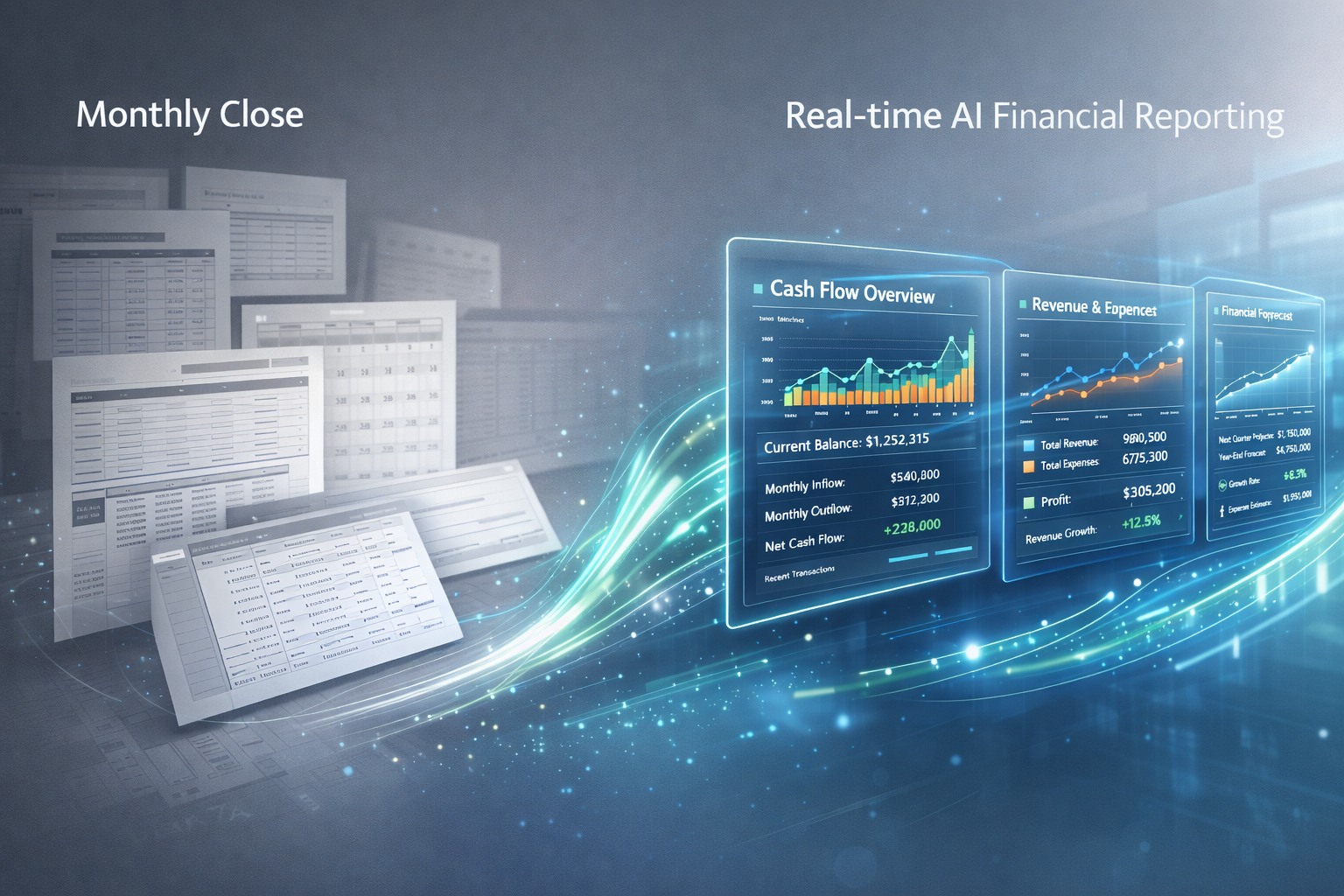
When Business Moves Faster Than Finance
For decades, the monthly close has been the foundation of corporate finance, a rhythm designed for an era when data was limited, systems were fragmented, and business moved at a measured pace. Revenue, expenses, margins, and cash positions were reconciled after the fact, providing a retrospective, backward-looking view that was sufficient for slower, less dynamic decision cycles. That operating model no longer aligns with reality.
Modern businesses run continuously: products ship in real time, customers transact globally around the clock, and supply chains shift with little warning. Yet finance teams are still asked to explain today’s business using weeks-old numbers.
This widening gap between operational velocity and financial visibility has turned the monthly close from a control mechanism into a strategic constraint. In response, real-time AI financial reporting is emerging, not as a new dashboard or automation layer, but as a fundamental rethinking of how financial truth is generated, trusted, and used to guide decisions.
The Foundational Shifts Behind Real-Time Financial Reporting
1. From Period-Based to Event-Driven Finance
Financial insight is no longer anchored to monthly reporting cycles. Instead, it is continuously updated as business events occur—sales are made, payments are received, contracts change, and costs move. Finance shifts from summarizing the past to reflecting the business as it operates in real time.
2. From Manual Reconciliation to Intelligent Oversight
AI systems increasingly handle classification, validation, and anomaly detection as data enters the system. This reduces the burden of manual reconciliation and allows finance teams to focus on judgment, governance, and interpretation rather than correction. Human expertise remains central, but it is applied where it adds the most value.
3. From Retrospective Reporting to Active Decision Support
Rather than explaining what happened last month, finance becomes a forward-looking partner to the business. Financial insight is embedded directly into operational and strategic workflows, helping leaders understand trade-offs, assess risk, and act while outcomes are still in motion.
The Limits of Monthly Closings
Monthly closings were designed to maximize accuracy in a world constrained by manual processes. Today, they introduce structural limitations:
1. Latency: By the time numbers are finalized, underlying business conditions have already changed.
2. Manual Dependency: Finance teams spend disproportionate time validating and correcting numbers, slowing decisions and crowding out strategic work.
3. Fragmentation: Financial data remains spread across ERPs, billing systems, CRMs, and operational tools, limiting real-time coherence.
4. Reactive Decision-Making: Margin erosion, cash pressure, and revenue leakage are often identified only after they have already compounded.
As organizations scale across markets, products, and pricing models, these constraints intensify. Financial risk becomes a reporting outcome rather than an active decision-support system.
From Reporting to Continuous Intelligence: The Role of Agentic AI
Agentic AI changes this operating model by shifting finance from periodic reconciliation to continuous intelligence. Instead of waiting for a monthly close, autonomous agents monitor, validate, and interpret financial data as it is generated.
Transactions are continuously reconciled against policies and accounting logic, while exceptions are identified and resolved in near real time. In parallel, analytical agents synthesize live signals across revenue, margin, and cash, surfacing emerging risks and anomalies as they occur, not weeks later in a report.
In this model, accuracy is no longer achieved through delay. It is achieved through continuous validation, coordination, and intelligence, allowing finance to move at the same speed as the business it supports.
Real-World Scenarios
A SaaS Company Managing Usage-Based Pricing
For SaaS businesses with usage-based or hybrid pricing models, revenue changes continuously with customer behavior, yet financial insight often arrives only at month-end.
- Traditional limitation: Usage data and contract terms are reconciled after the reporting period closes, leaving revenue leakage, billing errors, and churn risk undiscovered until it is too late.
- Real-time visibility: Usage events are captured as they occur and mapped directly to contract terms, allowing revenue accruals to update continuously.
- Early intervention: Deviations from expected usage, pricing thresholds, or discount structures surface immediately, enabling teams to address customer friction and pricing issues in real time.
- Better forecasting: Finance can refine forecasts based on live customer behavior rather than static, historical snapshots.
A Fast-Scaling Startup
For fast-growing startups, cash, not revenue, is often the most critical constraint, yet financial visibility frequently lags behind the pace of change.
- The challenge: Cash flow models are typically updated monthly and remain disconnected from real-world shifts in hiring velocity, customer collections, and vendor commitments, creating blind spots.
- What changes with real-time reporting: Burn rate and runway are continuously recalculated using live inputs from billing, payroll, accounts payable, and collections systems.
- Why it matters: As conditions change, forecasts update immediately, reducing uncertainty and surprise.
- The outcome: Leadership teams gain a clear, current view of financial resilience, enabling more deliberate decisions around growth, spending, and fundraising.
How We Help Customers Build Real-Time Financial Visibility
At Tweeny Technologies, we help customers move from retrospective financial reporting to real-time financial insight by building software designed for how modern businesses operate. Our platforms continuously ingest financial and operational data, apply intelligent validation and reconciliation, and surface meaningful insight as business events unfold.
By combining strong data architecture with AI-driven analysis, we reduce manual effort without compromising accuracy or control. This allows finance teams to step away from month-end firefighting and focus on governance, forecasting, and decision support using financial information that reflects the business in motion, not after it has passed.
Conclusion: From Retrospective Reporting to Strategic Control
The question is no longer whether real-time AI financial reporting is achievable, but whether organizations can remain competitive while relying on delayed financial insight. In an environment defined by constant change, visibility that lags behind reality does more than slow decisions; it erodes strategic control.
Moving beyond monthly closings is not about reporting faster. It is about reshaping finance to match how modern organizations actually operate: continuously, across functions, and at scale. Real-time financial reporting allows leaders to see performance as it unfolds, understand what is driving results, and intervene with precision rather than hindsight.
Organizations that make this shift will do more than close faster. They will transform finance into a living decision system, one that reflects the business in motion and supports confident, informed leadership.



Explore more blogs



Building intelligent products, modern web platforms, and custom digital experiences.