.png)
The Agentic Workflow Stack: Foundations, Infrastructure, and Why You Should Think in Layers
The Failure Rate: Why Demos Stall in Pilot
You can stand up an impressive agent demo in an afternoon. Standing up an agent that runs your accounts payable, your incident response, or your customer onboarding without supervision is an eighteen-month engineering program. The gap between those two things is not the model. It is the agentic workflow stack sitting underneath it, and most teams cannot draw it on a whiteboard.
That is the problem this series is here to fix. In this part , we cover the foundations: what an agentic workflow actually is, why your existing workflow tooling buckles the moment a non-deterministic step is introduced, and the layer model that makes the rest of the stack legible. Parts 2 and 3 will go deep on orchestration patterns and on the production concerns evaluation, governance, cost, and reliability that decide whether your agents make it past the pilot.
The Production Gap: From "We Use AI Agents" to "We Run Agents"
The headline numbers are bullish. Gartner predicts that 40% of enterprise applications will ship with task-specific AI agents by the end of 2026, up from less than 5% in 2025. McKinsey's State of AI 2025 survey finds that 23% of organizations are already scaling at least one agentic system, with another 39% running experiments.
The fine print is more sobering. McKinsey notes that of the firms' scaling agents, most are doing so in only one or two functions, and within any given function, fewer than 10% report meaningful agent deployment. Gartner has separately warned that more than 40% of agentic AI projects are at risk of cancellation by 2027, citing cost overruns, unclear value, and the absence of foundational infrastructure.
That last phrase is the one to underline. The pilots dying in 2027 are not dying because the model was wrong. They are dying because nobody decided who owned memory, who owned tool authentication, who paid the inference bill when an agent looped, and what "correct" meant for a workflow with three hundred valid paths.
The teams that ship are the ones that stop treating "the agent" as a single artifact and start treating it as a stack
The Definition and Fundamental Characteristics of the Agentic Workflow
An agentic workflow is a process where the plan is generated and revised at runtime by a language model that has access to tools, memory, and state instead of being authored in advance by a developer or an automation engineer.
Three properties separate it from anything you have automated before:
- Intent-driven execution. You hand the system a goal ("reconcile this batch of invoices against the PO file") rather than a sequence of steps.
- Tool use as I/O. The agent decides which APIs, databases, browsers, or subordinate agents to call, in what order, and with what arguments.
- Feedback and replanning. Observations from the world flow back into the agent's state and can change the plan mid-flight.
At Tweeny Technologies, the agentic workflow stack is not just a theoretical model; it is the required blueprint for engineering autonomous systems. We approach every solution by treating the agent not as a single model but as a deliberate set of layered decisions across models, tools, memory, and orchestration, ensuring our products move successfully from pilot to production-grade reliability.
The Six-Layer Agentic Stack: A Working Reference Model
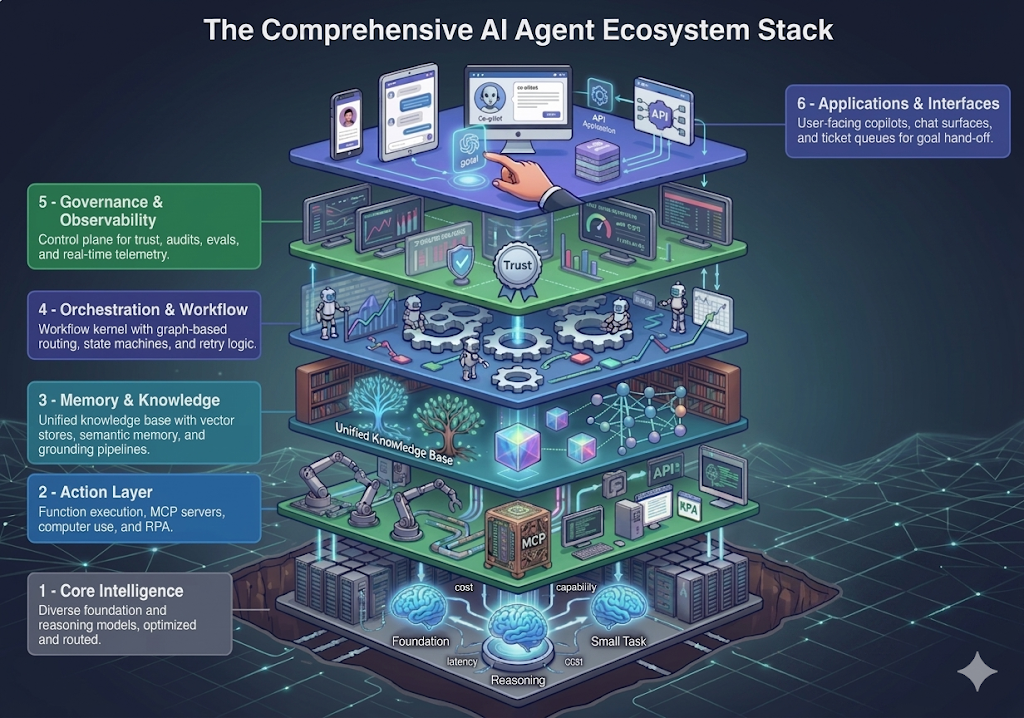
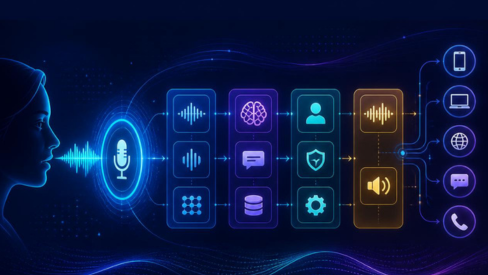
The complexity of building robust agents demands a structured approach. We define the agentic workflow stack across six fundamental layers.
Layer 1 - Core Intelligence: Foundation models, reasoning models, small task-specific models, and the routing logic that decides which one to call. Usually a buy decision, increasingly a multi-vendor one.
Layer 2- Action Layer: Function calls, MCP servers, browser and computer-use surfaces, RPA connectors, and internal APIs. Anything that lets the agent change state in the outside world.
Layer 3 - Memory & Knowledge. Short-term scratchpads for the current run, long-term stores (vector, graph, relational) for facts and decisions across runs, and the retrieval and grounding pipelines that connect them to the model.
Layer 4 - Orchestration & Workflow. The graph, state machine, or multi-agent topology that decides what runs next. Checkpointing, retries, parallelism, branching. This is the "kernel" of an agentic system, and it is where LangGraph, CrewAI, AutoGen, and the framework wars currently play out.
Layer 5 - Governance, Evaluation & Observability. Traces, evaluations, guardrails, audit logs, cost and latency telemetry, and human-in-the-loop approval. This is the layer that decides whether you can trust the layers below it.
Layer 6 - Applications & Interfaces. Where humans (or upstream systems) hand off goals. A copilot pane, a chat surface, a ticket queue, a webhook, and a scheduled trigger. This is the only layer your end users see.
The Model Substrate: Portability, Topology, and Cost Control
Three decisions at this layer constrain everything above.
Model portability. Treat the model as a swappable component behind a gateway (LiteLLM, Bedrock, or Vertex). Run capability-based routing: small models for classification, large ones for planning, and specialists for code or vision. Teams that hard-code a single provider into agent logic pay for it twice, once at procurement and again on the next price cut they cannot absorb.
Inference topology. Self-host what you need to control; rent the rest. Self-hosting frontier models you do not fine-tune is the most expensive form of comfort engineering in 2026. Reserve self-hosting for fine-tuned specialists, regulated workloads, and latency-critical paths.
Cost governance from day one. Token budgets at the agent level, not the org level. A misconfigured planner can burn a quarter's budget in a weekend, and the only thing that catches it before the invoice does is a per-agent ceiling wired into the gateway.
The Interoperability Surface: MCP, A2A, and the Adapter Trap
Two protocols matter in 2026:
- MCP (Model Context Protocol) - The now-standard way to expose tools and data to agents. No MCP servers means custom adapters everywhere, and adapters are where agent programs go to die.
- A2A (Agent-to-Agent) - The emerging protocol for multi-agent collaboration, under the Linux Foundation. Still early, but worth designing for.
A pragmatic stance: standardize on MCP internally, plan for A2A in the multi-agent roadmap, and keep a thin adapter layer for vendors who have not caught up. These protocols define how your agent executes its will, building directly on the model decisions made in Layer 1. Together, Layers 1 and 2 form the substrate; everything else in the stack is a leverage point on top of them.
Conclusion: Stacks, Not Frameworks, Determine Success
The agentic workflow stack must be viewed not as a single framework choice but as a deliberate set of layered design decisions. The rigor applied to the foundational layers, models & inference, and Tools & Protocols is what dictates the scalability and trustworthiness of the entire system. Build on a deliberate stack and you get a durable system; skip the foundations and you get an expensive demo. The next installments in this series will examine the higher layers, beginning with orchestration and continuing through governance, evaluation, and observability.
If you want to pressure-test your own foundations, specifically your model, tools, memory, and orchestration logic against this stack model before Part 2 lands, we run a 30-minute agentic readiness review with engineering leadership. Bring your top use case, and we will walk the layers with you and flag the gaps most likely to bite.


Explore more blogs

Building intelligent products, modern web platforms, and custom digital experiences.