.png)
Model Context Protocol as a Stateless Memory Layer: Reference Architecture and Enterprise Migration Paths
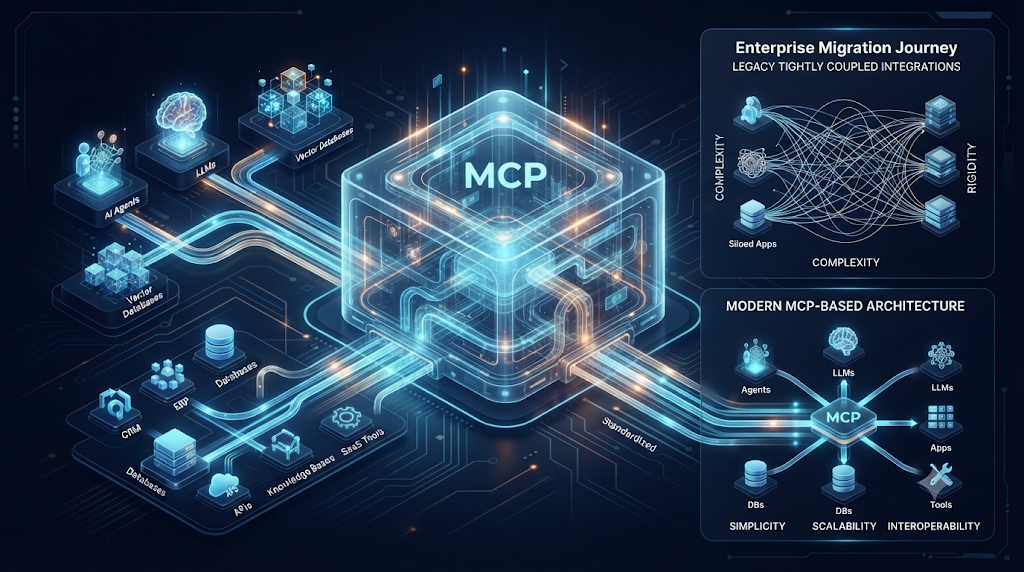
Your agents work in the demo and fall apart in production. A pilot assistant answers ten questions flawlessly. The same system, load-balanced across a dozen pods for real users, starts dropping context, stalling on reconnects, and pinning every conversation to whichever server happens to hold its session. The usual suspect isn't the model. It's a state. Most teams stand up their first Model Context Protocol (MCP) servers as stateful services that keep session memory in process, and that one decision quietly caps how far the system can scale.
The Reference Architecture
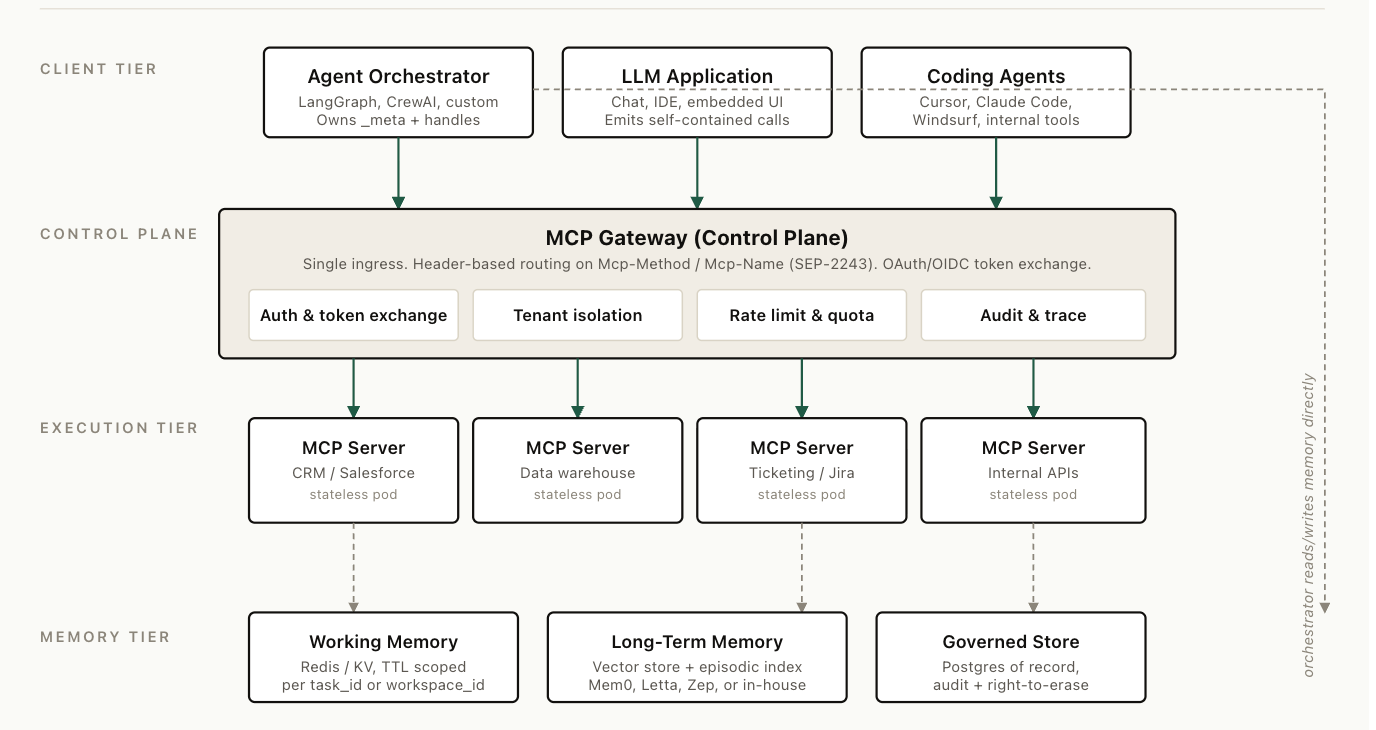
Client Tier- The agent orchestrator (LangGraph, CrewAI, or an in-house framework), the LLM application, and any coding agent that speaks MCP. This tier now carries three responsibilities that used to belong to the server: assembling meta on every request, tracking any handles the server issued during a multi-step flow, and reading and writing application memory through explicit calls.
Control Plane- A single MCP gateway sits in front of the fleet. It intercepts every stateless HTTP POST, inspects the Mcp-Method and Mcp-Name headers for routing, enforces OAuth or OIDC authentication, and issues short-lived, tightly scoped workload tokens to downstream servers.
Execution Tier- Lightweight, stateless MCP servers, one per backend system: CRM, data warehouse, ticketing, and internal APIs. Each pod is disposable, holds no session, and can be scaled by a standard HPA on CPU or request rate. In hybrid or multi-cloud deployments, these servers run inside their respective network segments and hold outbound-only connections to the control plane, which sidesteps most inbound firewall work.
Memory Tier- Working memory (Redis, TTL-scoped to a task_id or workspace_id); long-term memory (a vector store plus an episodic index, backed by Mem0, Letta, Zep, or an in-house layer); and a governed store of records (typically Postgres) for anything that needs an audit trail and a right-to-erase workflow.
Architecting for Scale: Transforming MCP from Stateful Service to Stateless Memory Layer
Most AI agents falter in production because they rely on stateful, in-process session memory that fails under load. This document outlines a reference architecture to transition your Model Context Protocol (MCP) servers into a stateless, scalable memory layer, providing a phased roadmap to modernize your architecture without a full system rewrite
Phase 1: Discovery
Focus Strategy: Audit Integration Sprawl
Actions & Technical Changes:
Inventory the entire fleet and map server ownership. Use an egress gateway to detect "Shadow MCP" servers connecting from developer laptops. Expect 2 weeks for mid-market and 1 month for large enterprises.
Phase 2: Decentralization
Focus Strategy: Stateless Refactoring
Actions & Technical Changes:
Strip in-process session stores/local JSON caches. Move working memory to a Redis store keyed by task_id or workspace_id. Run new SDKs in parallel; utilize the 12-month window. Expect 4 weeks per team.
Phase 3: Centralization
Focus Strategy: Gateway & Governance
Actions & Technical Changes:
Interpose an API gateway; route traffic on Mcp-Method and Mcp-Name. Enforce OAuth/OIDC and mint workload tokens with tool-scoped claims. Centralize all audit tracing. Expect 4 weeks for the first cut.
Phase 4: Modernization
Focus Strategy: High-Impact Rollout
Actions & Technical Changes:
Roll out to high-value/revenue-adjacent surfaces. Enable the Tasks extension for async jobs. Retire sticky routing; success is validated when pods can be redeployed during business hours without user impact.
Roll out to high-value/revenue-adjacent surfaces. Enable the Tasks extension for async jobs. Retire sticky routing; success is validated when pods can be redeployed during business hours without user impact.
Where the state actually lives now
The gateway-and-tier picture only holds if the team keeps three kinds of state straight. This is the most common place migrations go sideways.
Connection-level state (protocol version, client info, and capabilities) lives with the client and rides in params._meta on every request. Request-level state (multi-turn correlation, resource references) lives in the payload as server-issued handles that the client is expected to echo back. Application-level state (memory, in every meaningful sense of the word) lives in the memory tier and is never held inside the MCP server process itself.
Architecting for Production-Grade Agents
At Tweeny, we are dedicated to building scalable, robust agentic systems that transcend the limitations of traditional, stateful architectures. By pioneering the adoption of stateless Model Context Protocol (MCP) implementations, we empower enterprises to bridge the gap between experimental prototypes and reliable, production-ready infrastructure.
Conclusion
Transitioning to a stateless Model Context Protocol (MCP) architecture is the critical pivot from experimental prototypes to production-ready agentic systems. By decoupling state from MCP servers and centralizing governance through an intelligent gateway, you evolve from brittle, session-bound services toward a resilient, horizontally scalable memory layer. While this migration demands structural discipline, particularly in strictly managing the boundaries between connection, request, and application-level state, the outcome is a robust, observable, and secure ecosystem. Ultimately, the true metric of architectural success is not merely the completion of this roadmap but the ability to evolve your infrastructure, redeploying and scaling services during business hours without ever disrupting the user experience.


Explore more blogs

Building intelligent products, modern web platforms, and custom digital experiences.