.png)
Multi-Agent vs. Sub-Agent: How Task Delegation Actually Works Between AI Agents in 2026
Every engineering team eventually hits the same wall: a single agent isn't enough, but a disorganized swarm is unmanageable. By 2026, industry standards have diverged into two distinct patterns: the collaborative multi-agent peer group and the structured hierarchical sub-agent model. Choosing between them isn't merely an architectural preference - it dictates your latency, token budget, and system stability. This guide breaks down these two topologies, explains the delegation protocols that power them, and provides a framework to help you choose the right path for your specific production needs.
The agent already works. It answers questions, calls a few tools, and does the job. But there's a new demo out, a new framework blog, a new tweet with a diagram of six little robots passing notes, and suddenly your one honest agent looks lonely.
Peer vs. Hierarchical Topologies
Each topology represents a fundamentally different approach to agent coordination and system control.
A multi-agent system is an AI architecture that distributes a complex task across multiple autonomous, specialized AI agents rather than relying on a single monolithic model to do everything. Just like a human team, each agent has a specific role (such as a researcher, coder, or writer), its own system prompt, and access to specific tools. These agents collaborate within a shared environment to solve problems, coordinating their efforts through mechanisms like message passing, shared memory (blackboards), or formal task handoffs.
A sub-agent is a specific type of worker agent utilized within a hierarchical multi-agent topology. In this setup, a central "parent" orchestrator or manager agent interprets the main goal, breaks it down into smaller tasks, and explicitly delegates those tasks to "child" sub-agents.
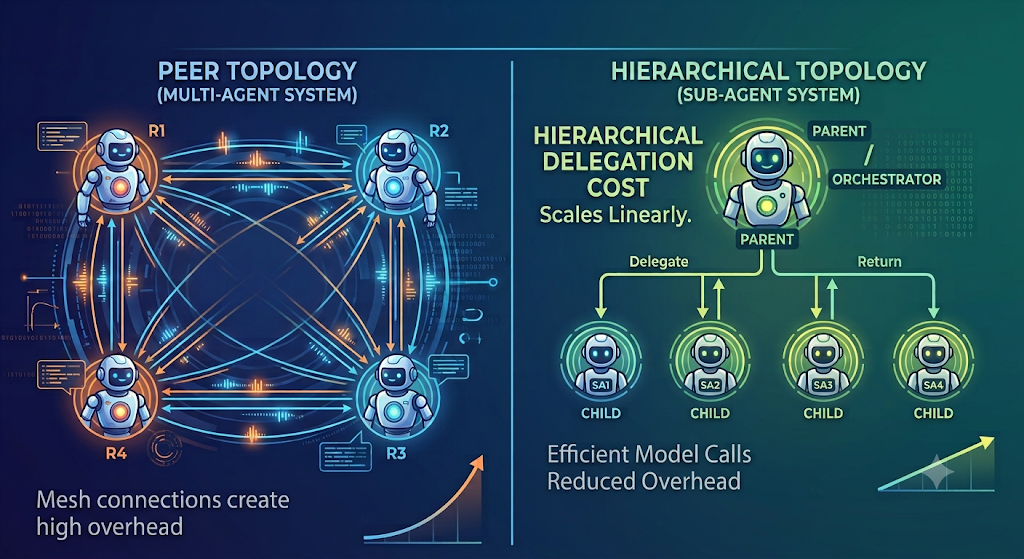
Here is what dictates most production choices: in a multi-agent peer topology, coordination cost scales with the number of edges between agents. Four peers means twelve possible directions a message can travel; five peers means twenty. Because every message is a full model call, costs mount quickly. In contrast, a hierarchical sub-agent topology scales coordination linearly: one manager, four workers, four delegations, four returns. This efficiency explains why most production systems in 2026 ship as sub-agent hierarchies and rely on peer coordination only when necessary.
A real-world example: how an AI coding agent hands out a ticket
The clearest place to watch task delegation in the wild is inside the AI coding agents your team probably already uses - Claude Code, Cursor Agent, Devin, and OpenHands. When an engineer asks one of them to "add rate limiting to the API," the lead agent doesn't do the whole job itself. It reads the ticket, figures out what kinds of work it contains, and hands each piece to a specialized sub-agent. Here's roughly what happens inside:
- Lead agent (the manager). Reads the ticket, decomposes it into subtasks, decides which sub-agent gets what, and holds the final diff at the end. It never touches the code itself.
- Codebase Researcher. Gets a scoped brief — "find every existing middleware, rate-limiting library, and per-route config in this repo" — and returns a short summary of the relevant files and patterns. It sees the codebase, not the ticket.
- Planner. Gets the ticket and the researcher's summary, and drafts a step-by-step implementation plan (files to change, order of changes, tests to add). It sees findings, not raw code.
- Coder. Gets the plan and the specific files it's allowed to touch, and writes the actual patch. It doesn't see the ticket or the research — only the plan and the code it needs.
- Test Writer. Gets the plan and the coder's diff, then creates unit and integration tests for the new rate-limit behavior. It sees the change, not the reasoning behind it.
- Reviewer. Gets the final diff plus the tests, and flags security, style, or regression risks before anything reaches a human. It sees the artifact, not the process.
Delegation as a map: graph-based routing and state management
The teams shipping reliable systems in 2026 have quietly stopped thinking about agents as autonomous employees. They think about them as nodes on a map.
That's the move behind LangGraph, OpenAI's Agents SDK, and CrewAI Flows—all three converged on the same primitive: a graph where nodes are agents (or tools), edges are conditional transitions, and a shared state object is the only thing that travels between them. Nothing else moves. No side channels, no whispered messages, no "Wait, let me ask Agent C real quick."
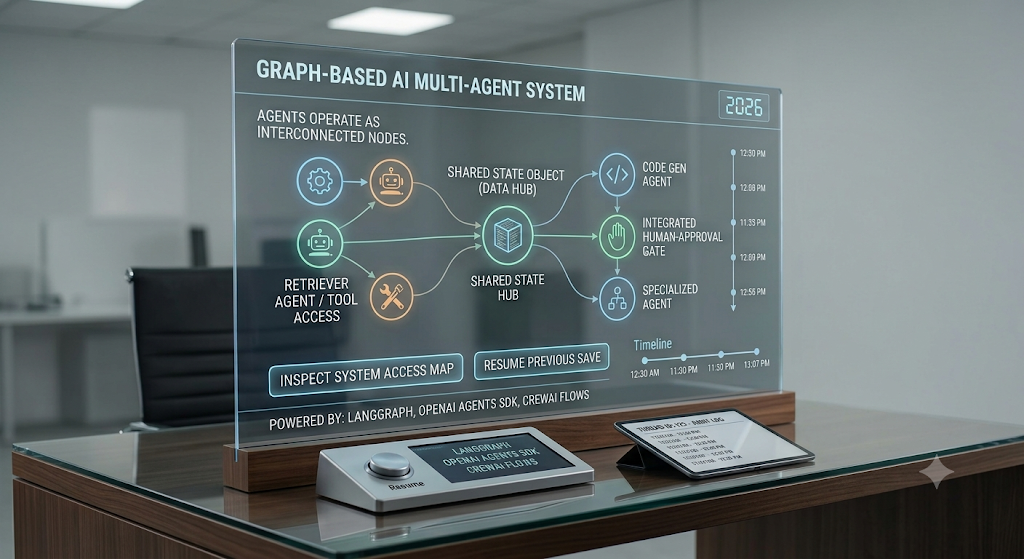
The reason this matters is boring and profound: a graph is inspectable. You can see, before you run anything, which agents can call which other agents. You can drop a human-approval gate into the graph as a first-class node instead of bolting it on with middleware. You can checkpoint the state at every transition. So, when the retriever dies 40 minutes into a run, you don't start over; you resume from the last good save. LangGraph's checkpoint model is explicit about this: state is persisted, transitions are logged, and every run carries a thread ID you can audit.
Engineering Partner for Enterprise AI Agent Systems
At Tweeny, we help engineering leaders design, build, and ship production-grade AI agent systems, not proofs of concept, not demos, but the kind of systems that hold up on-call rotations, security reviews, and cost audits. Our team works across the full 2026 agent stack: LangGraph, CrewAI, OpenAI Agents SDK, Claude Agent SDK, MCP servers, custom orchestration layers, and every human-in-the-loop pattern you've read about in this piece. We come in when your agent has stopped being a novelty and started being infrastructure when the token bill needs a plan, the delegation protocol needs to be auditable, and the on-call engineer needs a diagram they can actually follow. If any of that sounds like your situation, we'd like to help.
Conclusion: The Strategic Trade-offs of Agent Architecture
Ultimately, architectural choices between peer-to-peer and hierarchical models aren't just design preferences—they are bets on your system's longevity. While flexible peer models feel like rapid innovation, they often collapse under the weight of unmanageable state and opaque messaging. The most robust production systems don't just "let agents talk"; they treat agents as nodes in an inspectable, deterministic graph. By prioritizing clear delegation protocols, state checkpointing, and rigid hierarchies over chaotic swarm dynamics, you transform your agents from unpredictable black boxes into scalable, auditable infrastructure. Choosing the right path today means moving past the novelty of autonomous swarms to the reliability of engineered systems.



Explore more blogs

Building intelligent products, modern web platforms, and custom digital experiences.