.png)
Speaking the Language Isn't Enough: What Makes Patients Trust a Multilingual AI Assistant
Patients trust a multilingual AI assistant when it does five things well. It understands how they really speak, addresses them with respect, says plainly that it is an AI, hands them to a person when it matters, and remembers them next time. Translation gets the call answered. These five signals decide whether the patient stays on the line.
The stakes are commercial as well as clinical. India's 2011 Census, the most recent language count, recorded 121 languages, and Hindi is the mother tongue of 43.6% of the population. A front desk that works in one or two languages turns people away without knowing it. An assistant that speaks the language but sounds cold, evasive, or confused does the same at scale.
In this post, we cover:
- What Makes Patients Trust a Multilingual AI Assistant?
- How Should the Assistant Talk to Patients?
- What Does This Mean for Your Team?
What Makes Patients Trust a Multilingual AI Assistant?
What the evidence shows, and the five signals patients look for.
1.1 Does Speaking a Patient's Language Build Trust?
It earns you a hearing. At one US health system, an AI caller working in each patient's preferred language got a yes from 18.2% of Spanish-speaking patients, against 7.1% of English-speaking patients. That shows people will engage with an AI in their language. Whether they come to trust it depends on what happens next.
The study, published in the Journal of Medical Internet Research in 2025, covered 1,878 patients at WellSpan Health in September 2024. The AI agent phoned people due for colorectal cancer screening and offered a home test kit. Spanish-language calls also ran longer, 6.05 minutes against 4.03. When the program launched, Becker's Hospital Review reported that the agent could pass a call to a person. WellSpan also planned to add Haitian Creole and Nepali.
1.2 What Patients Expect From AI
Surveys show the conditions patients attach. In a March 2026 Ipsos survey of 254 US patients for Wolters Kluwer, 89% said it matters that a human expert validates AI health answers. Fierce Healthcare's coverage of the same survey noted that 42% of patients often bring AI-generated information to their appointments. The European Patients' Forum's 2026 survey report, based on 874 responses, found that 98% believe AI can help healthcare. It also found that 93% want to be told about AI at the very start of their care. Patients are open, with conditions.
1.3 The Five Signals Patients Look For
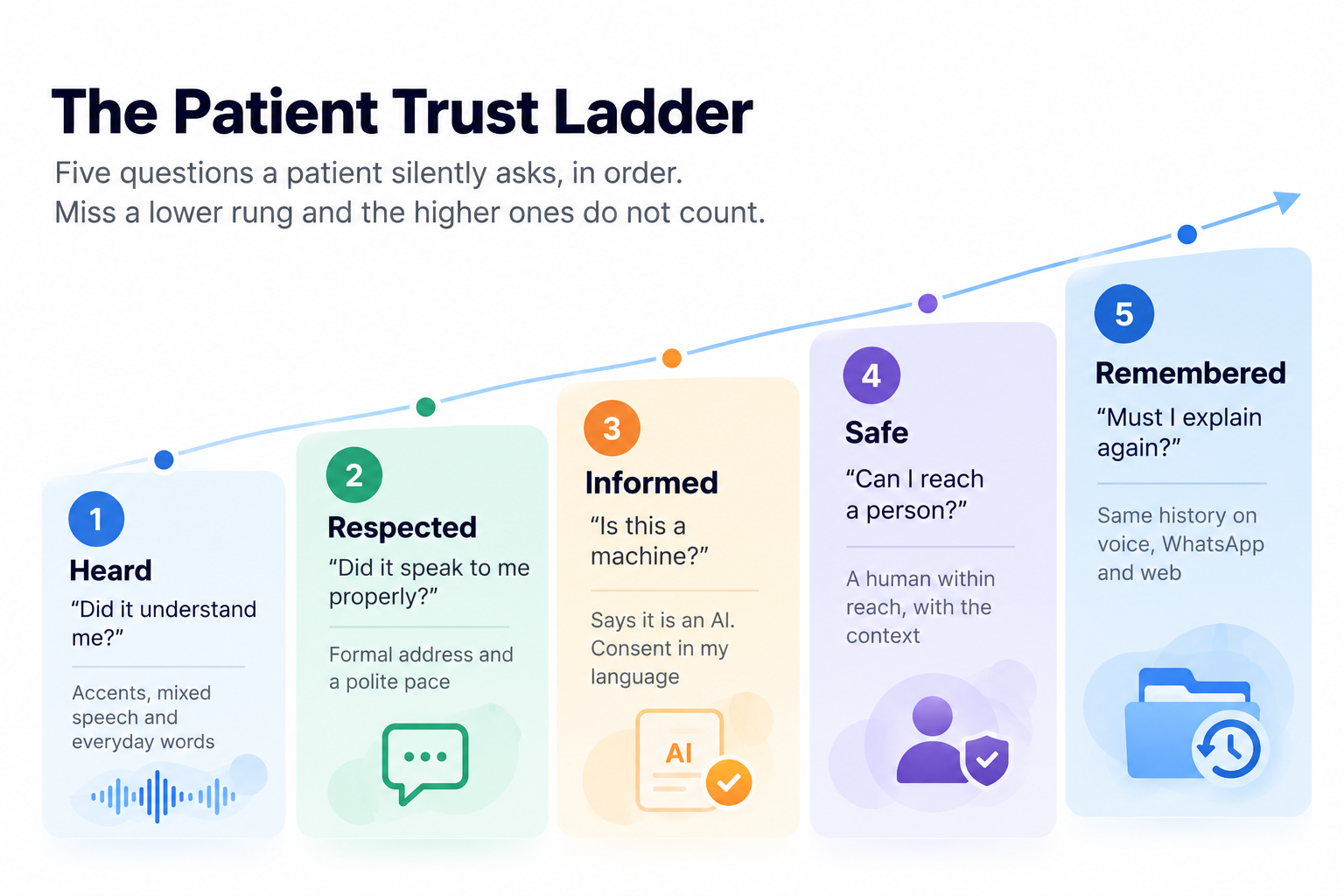
Five signals, which we call the Tweeny Patient Trust Ladder: Heard, Respected, Informed, Safe, and Remembered. Each rung answers a question the patient is silently asking. Miss a lower rung, and the higher ones do not count, because the patient has already hung up or stopped replying.
The order matters. Most teams stop at rung one because understanding speech is the part vendors demonstrate. Speech-to-text and intent detection are necessary. They are also the easiest part to buy.
Rungs two to five are operating decisions. Someone has to choose the form of address, write the disclosure line, staff the handoff, and decide what the assistant remembers. That puts this on the leadership agenda.
How Should the Assistant Talk to Patients?
Tone, formality, and when to hand over to a person.
2.1 How Should the Assistant Sound in Each Language?
It should sound like your best front-desk person in that language, not like a translated script. That means the respectful form of address, the everyday word in place of the textbook one, and comfort with mixed speech. Write each language natively, then have a native speaker from your patient community review it.
2.2 Formality and Everyday Words
Formality comes first. Hindi separates aap from tum, Spanish separates usted from tú, and Tamil separates neenga from nee. A 60-year-old patient addressed with the casual form hears disrespect, however accurate the rest is. Default to the formal form.
Vocabulary comes next. In much of India, patients say "sugar" for diabetes and "BP" for high blood pressure. Mixed speech is normal too. "Kal ka appointment reschedule karna hai" is one request in two languages, and the assistant should treat it as ordinary.
2.3 Matching the Tone to the Channel
The channel changes the tone as well. A voice bot needs short sentences and should read back names, dates, and times. A WhatsApp message can carry buttons, and many patients type Hindi or Tamil in Roman letters. If voice is your first channel, our guide to real-time voice AI agent architecture covers the timing side.
2.4 When Should the Assistant Hand Over to a Human?
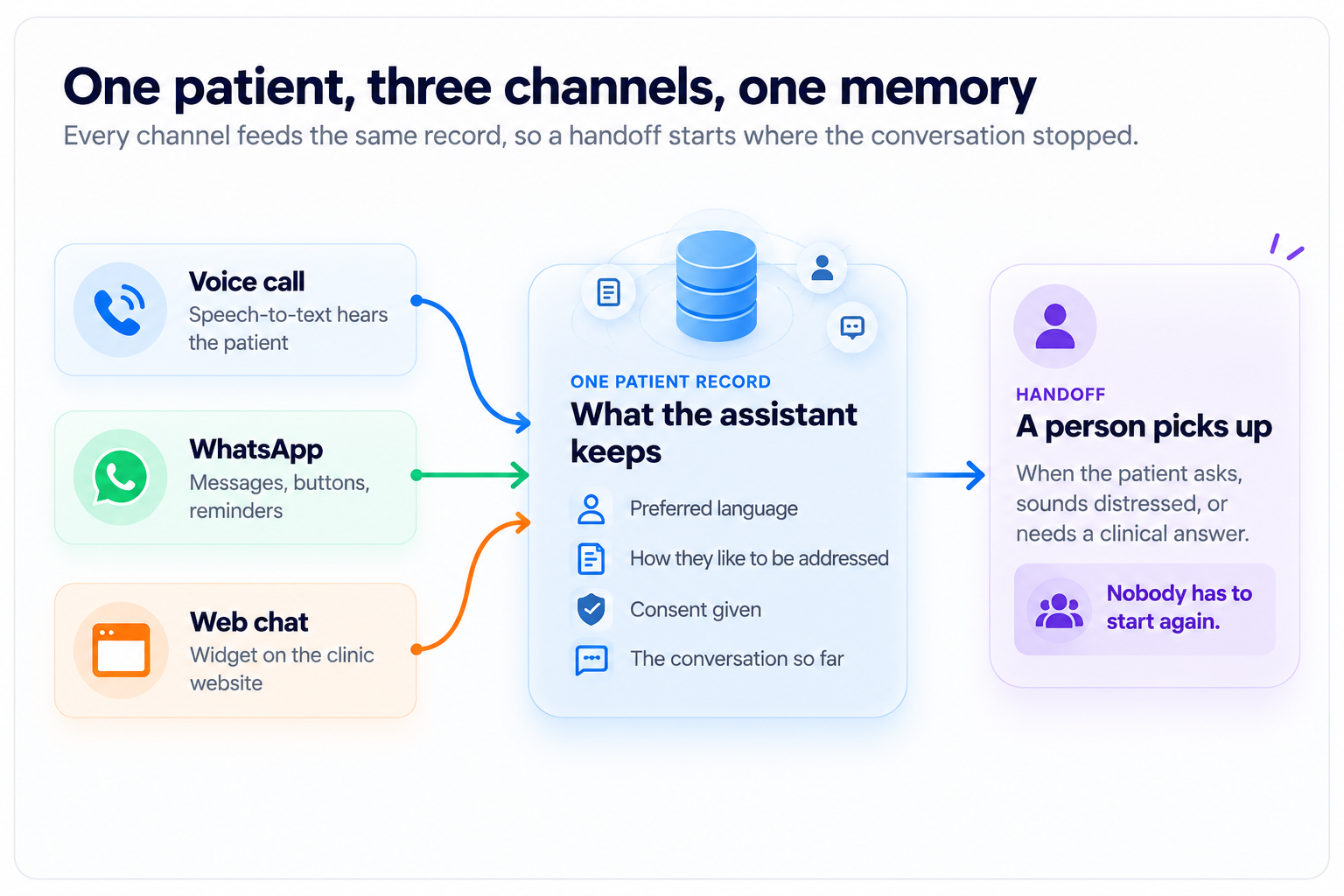
Hand over whenever the patient asks, sounds distressed, describes an urgent symptom, or needs a clinical answer. The assistant handles patient intake, booking, and routine questions. A person handles judgment. The handoff must carry the conversation so far, in the patient's language, so nobody has to start again.
Keep the scope narrow. Clinical guardrails should stop the assistant from diagnosing or advising on doses. In a clinical moment, its job is to escalate to a clinician with context.
2.5 One Memory Across Every Channel
Memory makes the handoff work. A patient may start on your web chat widget, continue on WhatsApp through the WhatsApp Business API, and finish on a phone call. One record should hold their language, consent and history across all three. That is what omnichannel means in practice.
What Does This Mean for Your Team?
Cost, risk, timeline, and when to bring in a partner.
3.1 Where to Start
Launch with the two or three languages that cover most of your patients on the one channel they already use. Budget for native-speaker review and a staffed handoff, not only for software. Report every metric by language. If one language lags, fix it before you add the next.
3.2 What to Plan For
- Cost: Each added language brings script writing, native-speaker review, and test conversations on top of usage fees
- Risk: A mistranslated instruction, a missed urgent call, or consent—the patient did not understand
- Timeline: Pilot one use case in two languages, then widen by language before you widen by channel
- Partner: Worth bringing in when you need EHR or EMR integration, more than one channel, or evidence for HIPAA or DPDP
3.3 Who Is Already Doing This
Health systems are already moving. In November 2025, MobiHealthNews reported that Tampa General Hospital put voice AI agents on its patient access lines in under three months. The agents connect to its Epic records and phone system.
3.4 Choosing Your First Use Case
Appointment booking is usually the safest first use case, because the request is clear and the result is easy to check. Our post on AI patient scheduling agents covers what to build first.
As a healthcare AI development company, Tweeny designs patient-facing assistants around intake, triage support, and escalation to a human. We are currently building a voice AI agent for patient intake and appointment scheduling.

Translation is the entry ticket. Respect is what keeps the patient in the room.
A multilingual AI assistant earns trust the way a good receptionist does. It listens well, speaks properly, tells the truth about what it is, and knows when to fetch a colleague. Language coverage can be bought. The other four rungs come from choices your team makes.
Your next decision is a small one. Pick two languages and one use case, and name an owner for each rung. If you want a second opinion on scope, talk to the engineers who build patient-facing AI assistants.
Frequently Asked Questions
Do patients need to be told they are talking to an AI?

Can a multilingual AI assistant handle Hinglish and other mixed speech?
Is machine translation good enough for patient messages?
How do we measure patient trust by language?
Explore more blogs

Building intelligent products, modern web platforms, and custom digital experiences.