.png)
Agent-First Design: Building Tweeny’s Digital Experience for Enterprise AI
A comprehensive guide to shaping an enterprise AI brand, simplifying intelligent agent workflows, and creating a scalable digital platform.
Creating Intuitive Navigation for Multi-Layered Technical Capabilities
In the rapidly evolving landscape of artificial intelligence, standing out requires more than powerful technology; it demands clarity. As AI-native products, intelligent agents, and enterprise software engineering transform how business gets done, communicating these complex Enterprise AI capabilities clearly and effectively becomes a primary product strategy.
In this post, we share our design philosophy behind Tweeny’s digital experience and how we approached structured information architecture, messaging, and visual systems to make sophisticated AI product development concepts tangible for modern enterprise teams.
In this post, we cover:
- Communicating the core value proposition of Enterprise AI
- Structuring Information Architecture for AI Product Development
- Designing Visual Systems for Intelligent Agents and AI-Native Products
- Closing Thought: Building a Scalable Digital Foundation for AI Innovation
Communicating the Core Value Proposition of Enterprise AI
Creating Intuitive Navigation for Multi-Layered Technical Capabilities
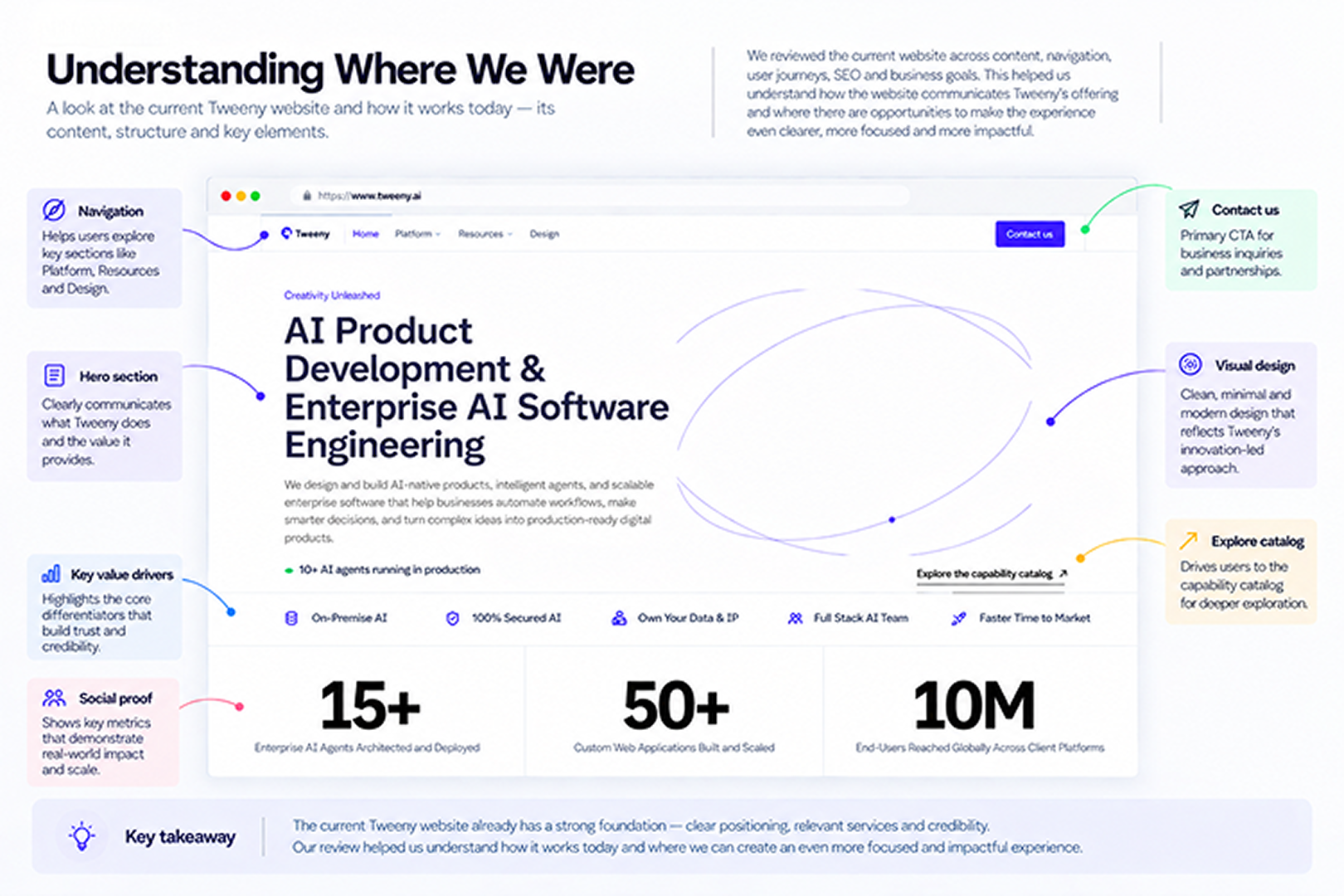
For an AI product and software engineering company, the first challenge is communicating complexity without making the experience feel complex. Tweeny works across AI product development, enterprise software engineering, intelligent agents, and emerging AI technologies – areas that can easily become abstract when presented only through technical terminology. Our approach was to make the value proposition immediately understandable while retaining the depth expected from an enterprise technology company.
The hero became an important part of this communication. The headline establishes Tweeny’s core offering, AI Product Development & Enterprise AI Software Engineering, while the supporting copy explains what that means in practical terms: building AI-native products, intelligent agents, and scalable software that help businesses automate workflows, make smarter decisions, and turn complex ideas into production-ready products. We complemented the messaging with visual elements that suggest intelligence, systems, and connectivity rather than relying on generic AI imagery. This combination of clear language, visual storytelling, and supporting proof points creates an entry point where visitors can understand both what Tweeny does and the kind of problems it helps solve. For more details, visit Tweeny.ai.
Structuring Information Architecture for AI Product Development
Creating Intuitive Navigation for Multi-Layered Technical Capabilities
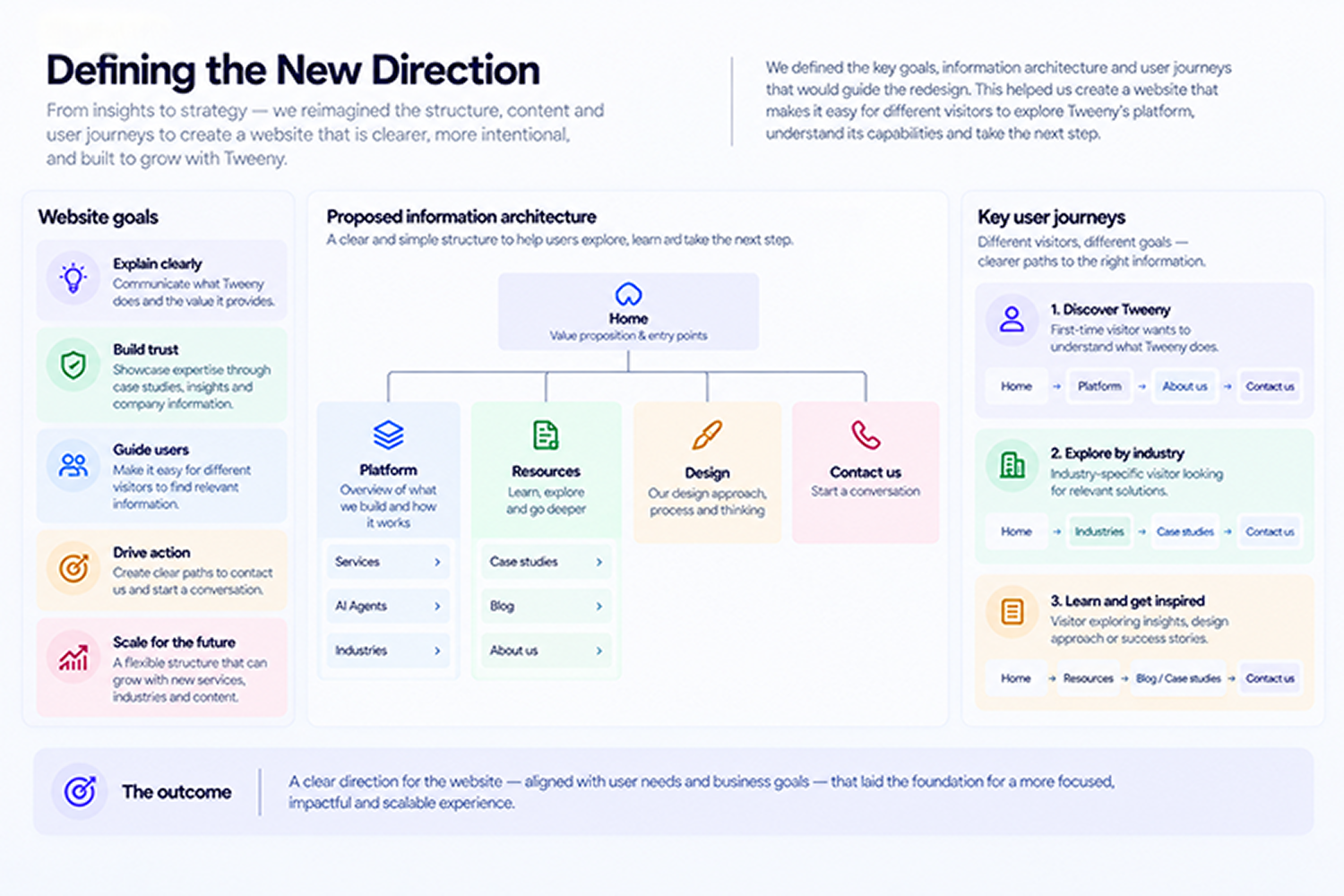
Once the value proposition is established, the next design challenge is helping visitors understand the breadth of Tweeny’s capabilities. AI companies often have multiple layers to communicate services, products, agents, industries, case studies, technology, and expertise. Instead of presenting these as disconnected offerings, we structured the experience around a simple mental model: what Tweeny offers, where it can be applied, and how visitors can learn more.
This thinking shaped the website architecture around five primary destinations: "Home, Platform, Resources, Design, and Contact Us." The platform brings together services, AI agents, and industries, allowing visitors to explore Tweeny through capabilities and applications. Resources brings together case studies, about us, and the blog, creating a space for proof, knowledge, and context. Design has its own space to communicate our design philosophy and thinking. The structure is intentionally simple but flexible enough to accommodate new capabilities and content as Tweeny evolves. The objective wasn't to expose every layer of the business immediately; it was to create a hierarchy that lets visitors progressively discover what is relevant to them.
Designing Visual Systems for Intelligent Agents and AI-Native Products
Translating Dynamic AI Strategy into a Connected Visual Framework
An agent-first positioning requires more than simply mentioning AI agents across the website. The visual language needs to communicate a world where AI systems interact, collaborate, automate, and create outcomes. This became an important consideration in translating the strategy into the design system. We explored a visual language built around movement, connections, systems, and interaction, allowing the interface to feel dynamic without becoming visually noisy.
The design process therefore became a continuous connection between design, development, and launch. We wanted the experience to feel modern and technically credible while remaining approachable to people who may not have a deep technical understanding of AI. Motion, typography, interaction, diagrams, structured content, and visual hierarchy all contribute to this balance. The result is a design direction that gives Tweeny a stronger foundation for communicating its work today while leaving room for the products, agents, capabilities, and ideas that come next.
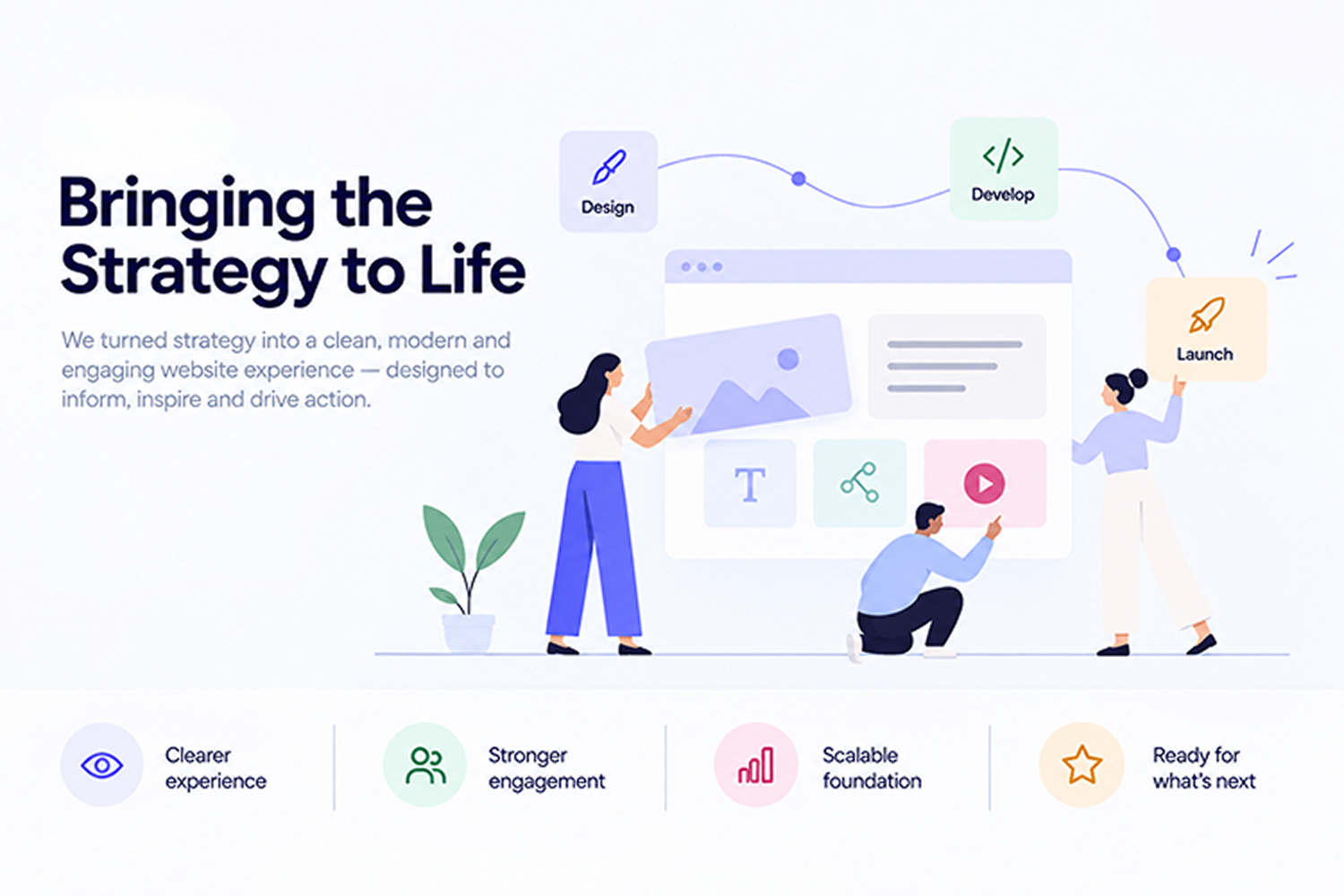
The redesign became an opportunity to think beyond individual pages and interfaces. We approached the website as a communication system, one that needed to explain complex AI capabilities, create a clear path through the product ecosystem, establish credibility, and remain flexible as Tweeny continues to evolve.
Our design philosophy ultimately comes down to a simple idea: AI experiences should feel intelligent without feeling complicated. The website should make sophisticated technology easier to understand, give visitors enough context to explore it, and create a clear connection between Tweeny’s capabilities and the problems businesses are trying to solve.
“The result is a foundation built around clarity, structure, interaction, and scalability — a digital experience designed not only to communicate what Tweeny does today but also to create space for where AI products and agents are heading next.”
Explore more blogs

Building intelligent products, modern web platforms, and custom digital experiences.