.png)
Inside the Agentic Workflow Engine: Model, Tools, Memory, and Orchestration
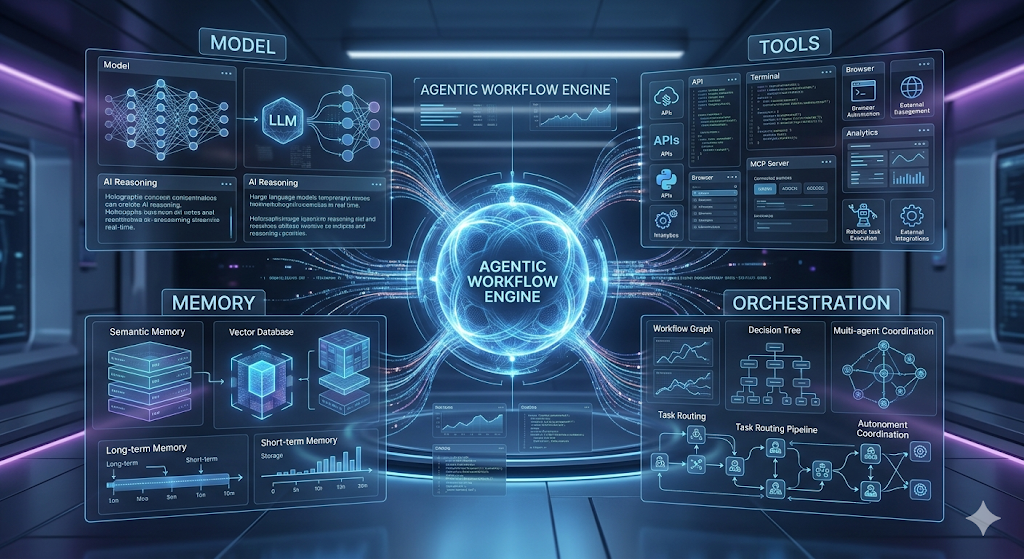
The Agentic Workflow Engine: An Overview
The true innovation of an agentic workflow engine lies not in the underlying model but in the robust runtime that surrounds it. As enterprise adoption of task-specific AI agents rapidly accelerates, projected to jump from under 5% in 2025 to 40% by the end of 2026, teams are learning a crucial lesson: the LLM endpoint is only about 15% of the total build. The remaining 85% is the workflow engine itself. This post will systematically break down this engine into its four critical components, detailing the function, composition, and common failure points of each:
- Model layer: Reasoning and tier routing.
- Tool layer: External system interactions.
- Memory layer: Persistence and state management.
- Orchestrator: The decision-making loop.
The model layer is a routing decision, not a vendor decision
The instinct on most early agent projects is to pick a single frontier model and put it everywhere. That works for a demo. In production, it makes the bill look indefensible and the latency look amateur. A serious agent runtime treats the model as a tier, not a constant.
Three tiers show up in almost every production system:
- Frontier tier (Claude including Opus 4.8, GPT including 5.5, Gemini including 3.5 Flash, Grok, and Meta's Llama 4): Handles planning, tool selection, and any step where the cost of being wrong is high.
- Mid-tier: Handles structured extraction, classification, and routine reasoning where the schema is tight.
- Small/distilled tier- often self-hosted, handles cheap high-volume jobs like reranking retrieved chunks, scoring tool outputs, or summarizing scratchpad state between steps.
Routing between the tiers is itself a system. Research-grade routers like R2-Router and EvoRoute learn cost-quality tradeoffs from past traces; production teams more commonly run a simpler classifier in front of the call that inspects task type, expected token count, and required tool surface, then picks the tier. The payoff is real: on a moderately complex agent we recently instrumented for a fintech client, replacing a "frontier-only" policy with a three-tier router cut costs per completed task by 58% with no measurable change in success rate.
Two other model-layer decisions matter and get ignored:
- Structured output enforcement: Use JSON mode or schemas to prevent downstream parsing failures, which otherwise become frequent daily incidents at scale.
- Fallback policies: Define explicit paths for timeouts or errors, such as retries or human reviews, to prevent silent system degradation.
The tool layer: function calling inside, MCP outside
Tools are how the agent acts on the world. Confusion in this layer usually traces back to conflating two distinct concerns: how the model expresses what it wants to do and how that intent gets executed.
Those two concerns map cleanly to two technologies:
- Function calling (the intent layer): The model receives JSON schemas describing each callable tool and emits a structured call like {"name": "search_orders", "args": {"customer_id": "C-9421"}}. A validator on your side enforces the schema; if the call fails validation, the model retries. This is bound to a single LLM at a time.
- Model Context Protocol (MCP) (the execution layer): MCP standardizes how tool calls leave the model and reach the system that does the work. A Slack MCP server, a Postgres MCP server, a filesystem MCP server — each runs as its own process, holds only the credentials it needs, and exposes its tools to any agent that speaks the protocol. Function calling is bound to one model. MCP is bound to none, which is why a16z calls it the "USB-C of AI tools."
Tools that mutate state need idempotency keys, and the engine has to thread them through. This is invisible until it isn't.
The memory layer: thread-scoped versus store-scoped
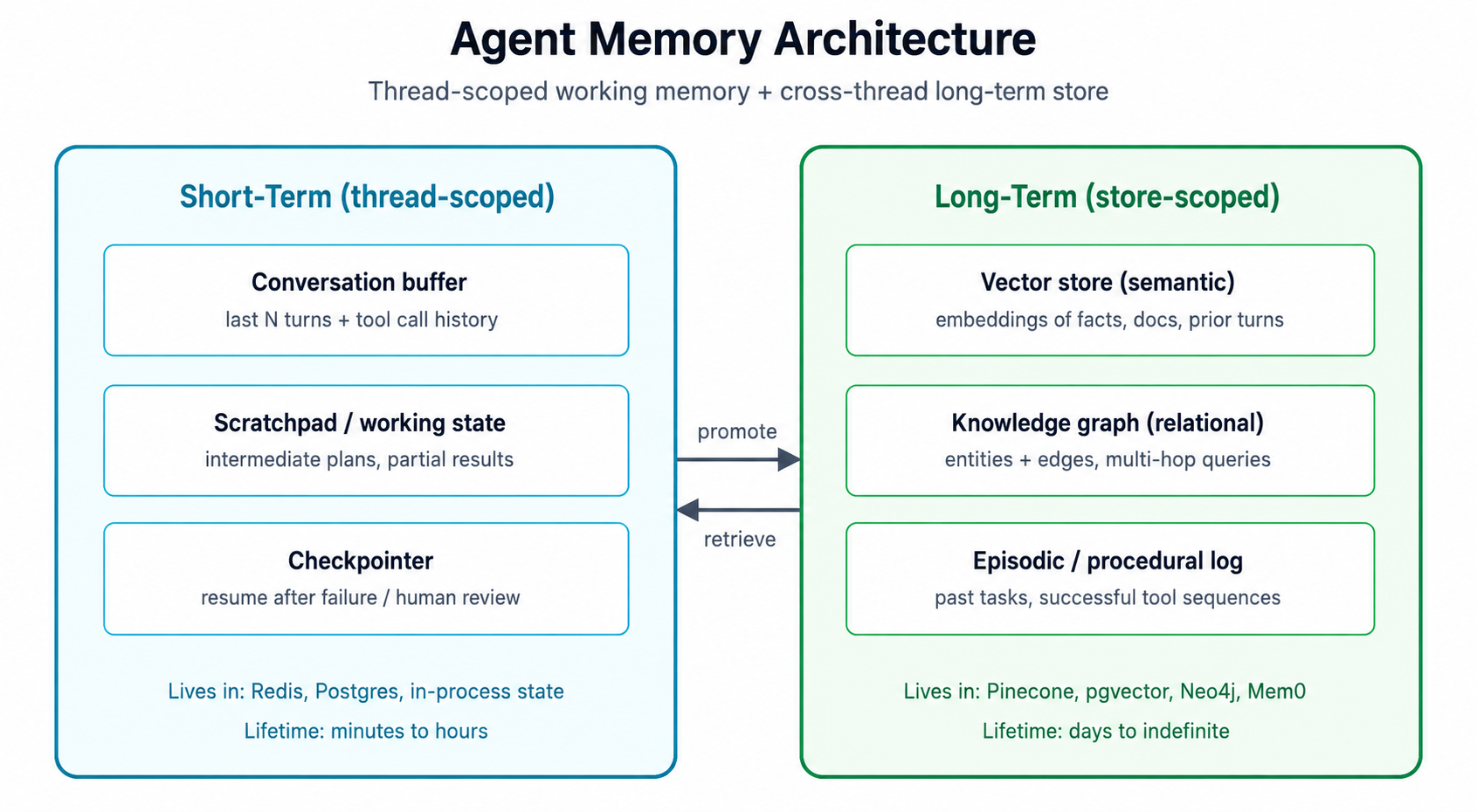
A stateless agent is a fancier chatbot. The moment you ask one to "remember what we decided last week," to "follow up on the deal you opened on Tuesday," or to "use my preferences from the onboarding call," you are in memory territory. The architecture splits cleanly into two regions.
Short-term memory is thread-scoped. It is what the agent holds while a task is in flight:
- Conversation buffer : the last N turns plus tool-call history.
- Scratchpad / working-state: intermediate plans, partial results, and in-progress reasoning.
- Checkpointer: a durable snapshot of execution state so the workflow can resume after a crash or a human-review pause.
Short-term memory typically lives in Redis, Postgres, or in-process state and has a lifetime measured in minutes to hours. LangGraph popularized the "checkpointer" term; the pattern matters because long-running agents that cannot resume are a support liability.
Long-term memory is store-scoped. It is what makes the agent useful across sessions. Three substrates dominate in 2026, and each is good at a different retrieval pattern:
- Vector store : semantic search over unstructured text. Right for "What was that document about pricing?"
- Knowledge graph : entities and edges for relational, multi-hop facts. Right for "Which contracts inherit terms from the parent MSA?"
- Procedural log : past task traces with their tool sequences. Right for "Have I solved a ticket like this before, and what worked?"
The state-of-the-art configuration is hybrid vector plus graph plus episodic because no single substrate handles every retrieval pattern well.
The orchestrator: the part that decides what happens next
The orchestrator manages the execution flow. Projects often fail due to overbuilt orchestration; start with simple pipelines before moving to complex graphs.
The three patterns, in order of complexity:
- Linear pipeline -A fixed sequence of steps with no branching (extract → transform → write). Right when the workflow is deterministic and the model's role is only to fill in the semantically tricky steps. Boring and reliable, which in production is a compliment.
- Supervisor with workers- A routing agent inspects the task, delegates each step to a specialist (research, code, review), and merges the results. Right when the task needs genuine specialization and the failure modes of each specialist are different.
- Stateful Graph (nodes + edges, loops + retries) - A network where any agent (or a single agent looping on itself) decides the next hop at runtime, including branching back on itself. Maximum flexibility and the largest failure and evaluation surface of the three. Right, only when the task genuinely cannot be expressed as a pipeline or a fixed supervisor tree, which is rarer than most teams assume.
Pattern selection correlates strongly with project survival. Gartner forecasts that more than 40% of agentic AI projects will be cancelled by the end of 2027, and the failure pattern is rarely the model. It is an overbuilt orchestration graph of agents launched against problems a linear pipeline would have solved in a tenth of the code, with a tenth of the eval surface.
pipelines. We have successfully deployed products to support our customers.
Company Specialization: Autonomous AI Agents
We specialize in lead generation automation pipelines and have successfully deployed products to support our customers. At Tweeny Technologies, we design and deploy autonomous AI agents that think, reason, and act by researching prospects, drafting proposals, updating CRMs, and executing multi-step workflows. Our systems are built on tool use, persistent memory, and goal-oriented execution, approaching solutions as layered decisions across models, tools, memory, and orchestration for production-grade reliability.
Conclusion: The Future of Agentic Runtimes
In conclusion, the agentic workflow engine is the result of the seamless composition of its four layers: the model layer for routing, the tool layer for action, the memory layer for persistence, and the orchestrator for flow. While the model provides the reasoning, it is this robust runtime infrastructure that ensures reliability and operational success. Ultimately, the future of agentic AI depends not on the choice of a single model, but on the engine that governs how that model interacts with the world.
The investment shape that follows from this is worth naming. Teams that ship reliable agents do not put 80% of their effort into prompts and 20% into infrastructure. The split is closer to inverted. The model gets the headlines; the runtime gets the renewals.



Explore more blogs

Building intelligent products, modern web platforms, and custom digital experiences.