.png)
Inside an AI Agent: What's Really Happening Between Your Prompt and the Response
Between the moment you type a request and the moment an agent answers, roughly three seconds pass. Inside those three seconds, the agent identifies you, pulls your history, decomposes your sentence into a plan, calls a database, hits an API, checks its own answer against a rulebook, and returns a reply that reads like a single thought. It's the most crowded three seconds in modern software. It's also, for almost everyone outside the teams that build these systems, a black box.
That opacity is the whole problem. When an agent works, the choreography is invisible. When it fails, you can't tell which step gave out. Vendors sell "AI." Engineers ship "an agent." Executives sign off on "an integration." Nobody points at the middle of the diagram and says, "This is what's actually inside."
This post opens the box. Not the pitch-deck version — the real one. By the end, you'll understand how an agent takes a task apart, why 88% of agent pilots never reach production, and the evaluation loop that separates systems that keep working from ones that quietly rot in place.
What are AI agents, and how do they actually work?
AI agents are software systems that use large language models (LLMs) to pursue goals and complete tasks on behalf of a user. They exhibit reasoning, planning, and memory, and they hold enough autonomy to make decisions, learn, and adapt across many steps. If a chatbot is a stateless function that returns a message, an agent is a program that keeps working until the job is done.
Their range comes from the multimodal foundation models beneath them. Modern agents process text, voice, video, audio, and code simultaneously and can converse, retrieve, reason, and act on external systems. They persist state across turns, hand off work to other agents in multi-agent workflows, and drive real transactions by filing a ticket, moving money, or updating a record.
But the model is not the whole agent. The model is one specialist inside a larger control system that keeps repackaging context, deciding what to do next, running tools, checking results, and looping. That control system is what buyers actually purchase when they buy "an AI agent. " Six components sit around the model in every production-grade design.
ReAct Framework
ReAct is a powerful conceptual framework and prompting strategy that turns a large language model (LLM) from a passive text generator into an autonomous problem solver. It does this by combining step-by-step thinking with the ability to interact with external tools and environments. It was introduced by researchers in 2022. This approach, adopted by major agent frameworks like LangChain and AutoGen, OpenAI's function calling, Anthropic's tool use, and Vercel's AI SDK, improves performance by reducing hallucinations through real-world fact verification and enabling dynamic problem-solving. It also enhances transparency, providing a clear, step-by-step 'Thought' audit trail that can be captured by observability platforms like Langfuse, allowing engineers to trace the agent's logic, debug tool failures, and monitor performance in real-time.
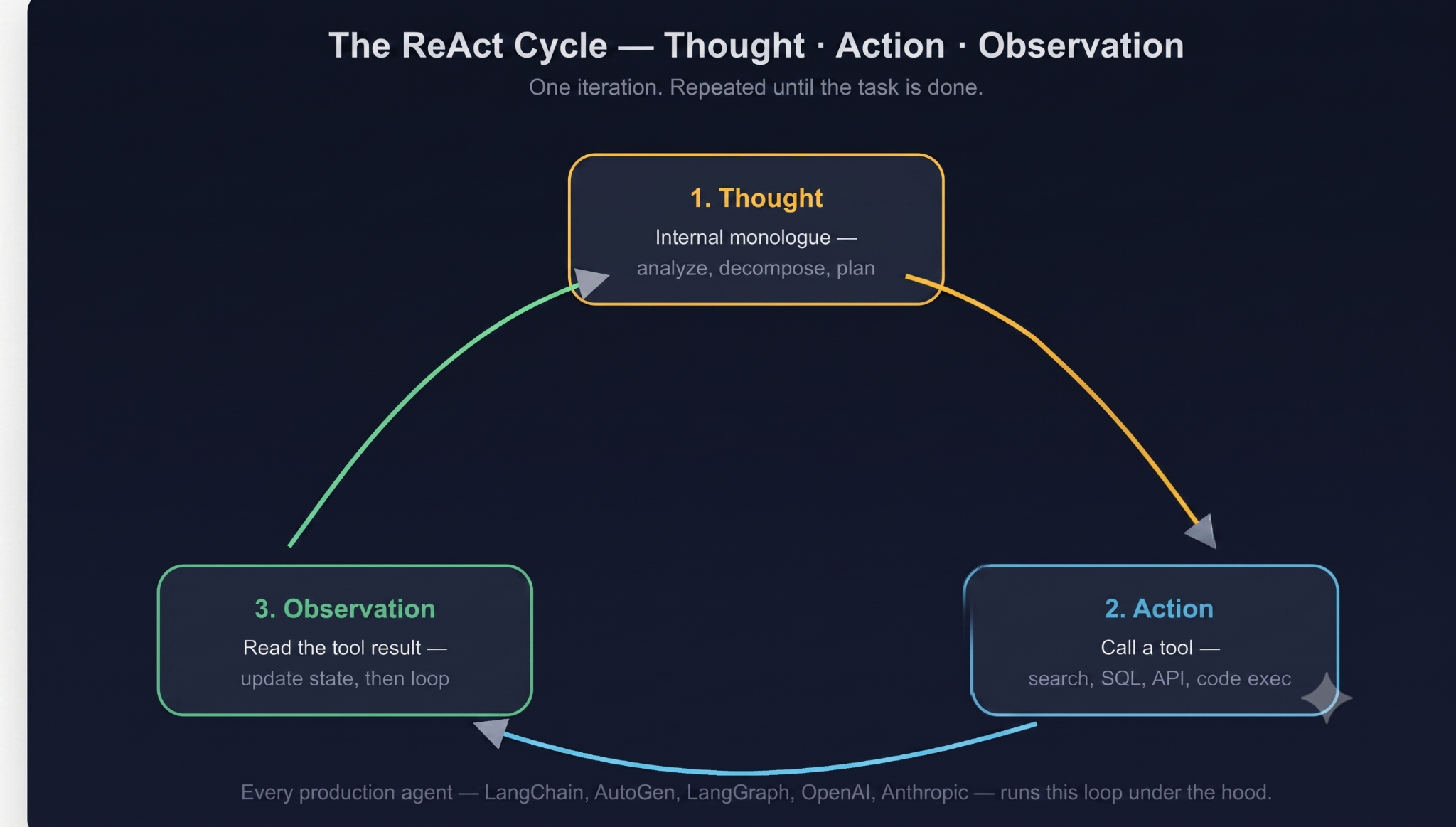
The Core Mechanism: The ReAct Framework
A ReAct agent operates in a continuous, iterative cycle that mimics how humans intuitively approach complex tasks. It relies on three alternating steps:
- Thought (Reasoning): The AI generates an internal monologue to analyze your request. It breaks the larger problem down into manageable sub-tasks, identifies what information is missing, and formulates a plan.
- Action (Acting): Based on its thought process, the agent executes a specific command using an external tool. This could be searching the web, querying a SQL database (e.g., SELECT * FROM food_orders WHERE order_status = 'cancelled'), or running a block of code.
- Observation: The agent takes in the result of its action (e.g., reading the search results or the output of the code) and updates its knowledge base.
Task analysis inside an AI agent
It's easy to mistake an AI agent for just "the AI," but that’s like calling a conductor "the orchestra." Think of an agent as a skilled orchestrator. The LLM is just one specialist on the team, a brilliant one, sure, but it’s not running the whole show. When you ask it to do something like "reconcile this invoice," the agent doesn't just dump that request onto the model. Instead, it acts as a project manager, breaking that request down, guiding the work through seven specific steps, and looping back again and again until it’s finished.
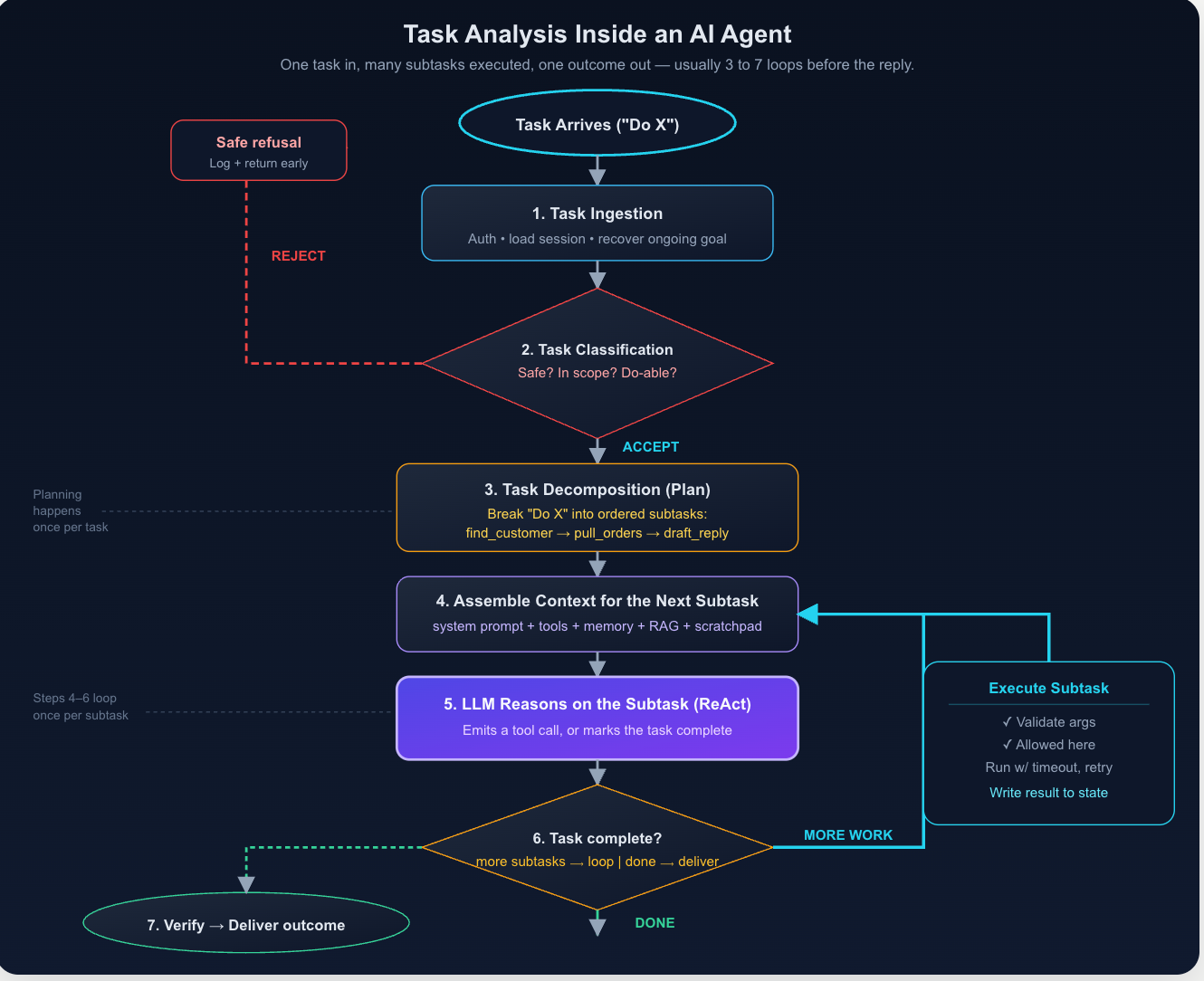
Here's what each step actually does, in one line:
- Task Ingestion (Authentication & Memory): The agent identifies who you are and retrieves your past history. It ensures it has the "memory" needed to understand the context of your current request.
- Task Classification (Filtering & Routing): The agent checks if the request is safe and within its capabilities. If it’s malicious or outside its scope, it stops immediately.
- Task Decomposition (Planning): The agent breaks your main goal into a logical list of small, sequential "to-do" items (subtasks: find_customer → pull_orders → draft_reply). This acts as the roadmap for the entire operation.
- Assemble Context (Preparation): For each specific subtask, the agent gathers only the necessary information (tools, history, documents, and system instructions). This ensures the model has exactly what it needs to succeed without unnecessary noise.
- LLM Reasoning (Execution Trigger): The model "thinks" about the current subtask. It decides: "Do I have enough info to finish this, or do I need to use a tool?"
- Execute + Check (Tool Interaction): If the model decides to use a tool (like a database or calculator), the agent runs it, manages errors, handles timeouts, and checks the output. If the result isn't enough, it loops back to step 4 to keep working.
- Verify + Deliver (Quality Control): Once the subtasks are done, the agent reviews the final answer against your requirements, removes any sensitive info (PII), and sends you the finished result.
From Prototype to Production: Building AI Agents That Actually Get Work Done
At Tweeny Technologies, we specialize in the hardest problem in enterprise AI today: closing the gap between a promising pilot and a production-grade agent that earns its place in your operating stack. Most AI projects stall in that gap because teams treat agents as clever prompts wrapped in a chat interface. We treat them as distributed software systems—with planning, memory, tool orchestration, and self-verification so the output isn't just text but a completed task: a filed report, a reconciled record, a published document, or a routed decision. The difference sits in the engineering discipline underneath — structured task decomposition, deterministic tool routing, evaluation harnesses that flag regressions before your users do, and observability that traces every decision the agent makes.
That's the foundation that turns "impressive demo" into "trusted teammate," and it's why our agents keep working three months in instead of quietly falling out of use. We drop them straight into the tools your team already lives in, Notion, Slack, Google Workspace, and the rest of your day-to-day stack, so the agent shows up where the work is, with the context it needs and the permissions it should have. Reports write themselves from the source. Research keeps running in the background. Documentation stays current on its own, as a byproduct of the work getting done. We're not here to sell you "AI"; we're here to give you a teammate that actually pulls its weight inside the tools you already trust.
Conclusion
Ultimately, the gap between a promising prototype and a production-grade AI agent is not bridged by smarter models alone but by rigorous engineering. By peeling back the black box, it becomes clear that reliable agents are built on transparent orchestration, disciplined frameworks like ReAct, and continuous evaluation loops. When teams shift their focus from treating agents as mysterious text generators to managing them as complex, iterative software systems, they move beyond the experimental phase and into true, scalable utility.




Explore more blogs


Building intelligent products, modern web platforms, and custom digital experiences.