.png)
From Manual Prompting to Agentic Loops: The Architecture Shift Redefining Enterprise AI in 2026
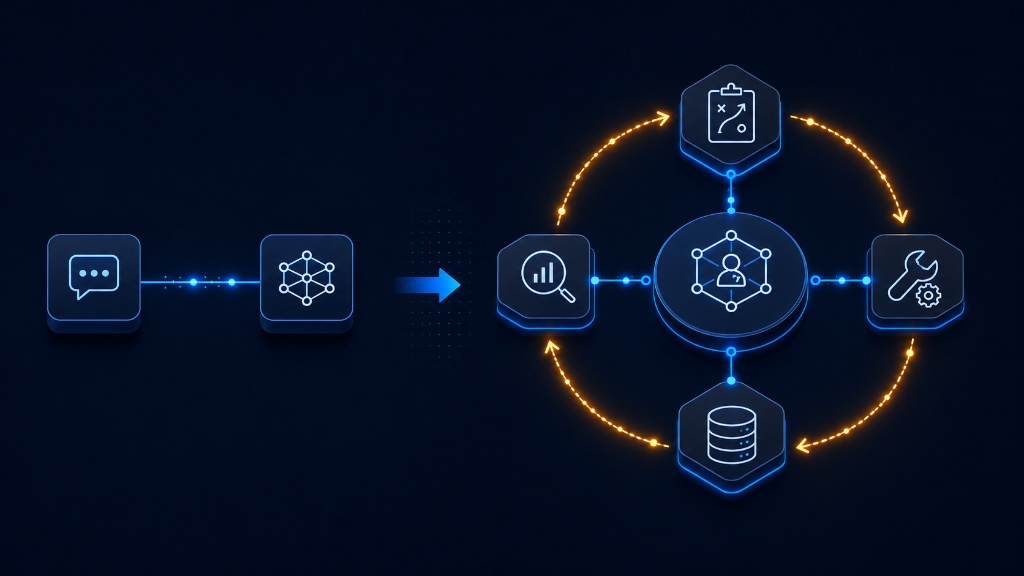
The Death of the Perfect Prompt
For most of the past four years, working with AI meant one thing: you type, it responds. Craft a prompt, read the output, refine, and repeat. For simple tasks it worked, but enterprise workflows are not simple tasks. They span dozens of steps, live systems, and mid-execution failures. The prompt-response model had a hard ceiling, and by mid-2026, the best engineers had already moved past it.
The signal came in the first week of June. Peter Steinberger of OpenAI posted two sentences that hit 6.5 million views: "You shouldn't be prompting coding agents anymore. You should be designing loops that prompt your agents." Boris Cherny, head of Claude Code at Anthropic, confirmed it was already his reality: "My job is to write loops." Then Google's Addy Osmani named the practice in a Substack essay: "Loop engineering is replacing you as the person who prompts the agent."
The Shift: Two Concepts You Must Separate
Agentic Loop: A repeating, goal-directed cycle in which an AI agent takes an action, receives feedback from its environment, reasons about that feedback, and decides its next move, continuing autonomously until a verifiable completion condition is satisfied. Not a chain (A→B→C). Dynamic: the agent observes, adapts, and retries without human intervention at each step.
Loop Engineering: The software engineering discipline of designing the structural controls around an agentic loop: state machines, iteration limits, tool boundaries, verification gates, and human escalation paths. It makes loops that are not only capable but also safe, auditable, and deterministic enough for production.
- MANUAL PROMPTING→AGENTIC LOOP→LOOP ENGINEERING
Why single-turn prompting failed and changed the enterprise
To understand why loop engineering matters, you need to see the arc of how we got here. The AI development paradigm has shifted three times in just four years:
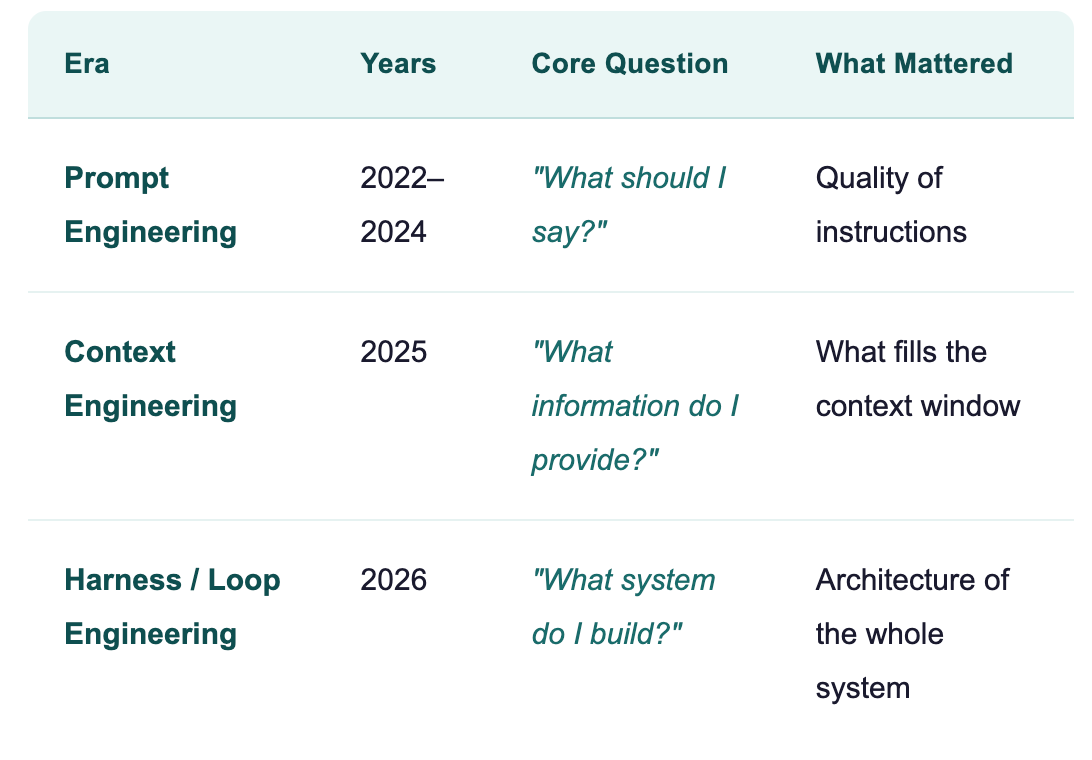
- From Prompts → Context → Harnesses → Loops
The Anatomy of An Agentic Loop
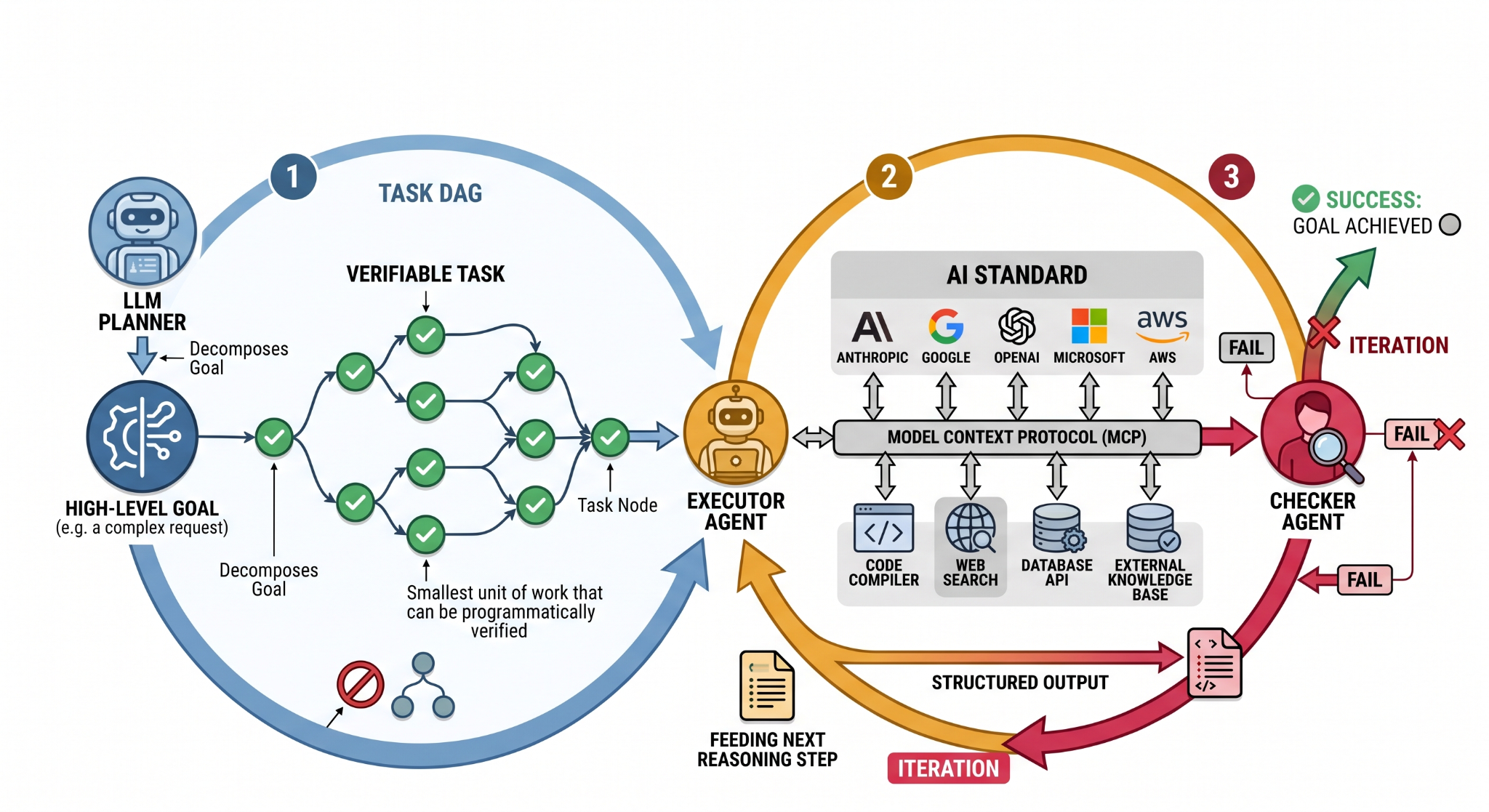
A well-engineered agentic loop has three functional stages. Understanding each is a prerequisite to hardening the controls around it.
Optimizing LLM agent architecture for reliable performance requires a deep understanding of these intertwined phases.
1. Planning & Routing
The planner decomposes a high-level goal into a directed acyclic graph (DAG) of smaller, independently verifiable tasks. The right granularity: the smallest unit of work that can be programmatically verified. "Fix failing tests" is not a node.
2. Tool Execution
At each node, the executor agent interfaces with the real world, not its internal weights. Tool access is mediated by the Model Context Protocol (MCP), now an open standard governed by the Linux Foundation's Agentic AI Foundation (organizations: Anthropic, Google, OpenAI, Microsoft, and AWS). Every tool call returns structured output feeding the next reasoning step.
3. The Reflection Gate
A separate checker agent distinct from the executor evaluates the output against the task's success criteria. The executor that wrote the code is statistically too lenient in grading its own output. Boris Cherny's /goal primitive in Claude Code implements exactly this: a separate lightweight model checks completion after every turn, so the agent that did the work never decides it's done.
Beyond the Single Loop: Orchestrating Multi-Agent Swarms
The naive approach: deploy one large LLM with a long system prompt covering every domain. The result: mediocre across all of them, with a context window perpetually bloated by instructions relevant to only 10% of any given task. The 2026 standard is specialized, narrow sub-agents, each with a focused system prompt, scoped tool access, and a clear handoff protocol.
A multi-agent swarm is a decentralized architecture where numerous specialized sub-agents operate in parallel to achieve a common goal. Unlike a monolithic model, swarms distribute tasks among focused agents, planners, executors, and checkers, allowing for dynamic scaling, improved reasoning through specialized prompts, and the ability to handle complex, long-horizon projects that exceed the capacity of a single agent.
We Don't Just Build AI Features: We Engineer the Loops That Run Them
While many organizations still approach enterprise AI development by focusing on prompt engineering, the art of phrasing queries for LLMs, we operate at a more sophisticated level. We design and deploy agentic AI workflows that power your products, implementing robust state machines, LLM orchestration layers, tool boundaries, and reflection gates.
These systems transform standard large language models into production-ready AI agents capable of reliable, autonomous execution. Whether you require a single-agent loop for end-to-end AI automation with built-in verification or a multi-agent swarm where specialized sub-agents manage planning, execution, and quality control in parallel, we architect solutions for the complex demands of your business.
Our expertise covers the full stack: from selecting the optimal orchestration framework such as AutoGen and LangGraph to establishing human-in-the-loop (HITL) governance protocols that keep your team in control.
Conclusion: The New Software Engineering Paradigm
The architecture shift of 2026 is a fundamental reorientation of where engineering judgment gets applied. In the prompt era, value was created by the quality of instruction. In the agentic loop era, value is created by the quality of the system, the state machine that constrains the agent's decision surface, the iteration limits that prevent token runaway, the HITL checkpoints that keep humans in the governance loop, and the sub-agent split that keeps makers separate from checkers. Ultimately, adhering to loop engineering best practices is essential for sustainable and scalable AI development.




Explore more blogs


Building intelligent products, modern web platforms, and custom digital experiences.