.png)
Designing for Autonomy: Architectural Patterns for Asynchronous Multi-Agent Systems
From Experimental Demos to Production-Grade Architecture
The era of the AI magic trick is over. To move beyond brittle demos and build production-grade autonomy, engineering teams must stop treating AI agents as black boxes and start managing them as unpredictable distributed systems. When isolated agents rely on local memory and synchronous chains, they inevitably deadlock under real-world traffic. Scaling complex reasoning safely requires a paradigm shift: treating architectural constraints not as limitations but as the essential scaffolding that keeps multi-agent systems from collapsing.
Foundational Pillars of Reliable Autonomy
The path to reliable autonomy rests on five foundational pillars that turn unpredictable chaos into a strategic advantage:
- State Externalization: Eliminate local memory dependencies to maintain a single source of truth.
- Idempotency: Prevent redundant operations and runaway computational costs.
- Event-Driven Architecture: Decouple operations to break the fragile reliance on synchronous chains.
- Deterministic Guardrails: Enforce hard business logic to govern autonomous decisions safely.
- Distributed Tracing: Ensure complete forensic observability to track data-driven performance at scale.
By implementing safeguards like optimistic locking and supervisor-level vetoes, you ensure your architecture is defined by consistent performance, rather than hand-picked successes.
Four Core Architectural Patterns for Multi-Agent Systems
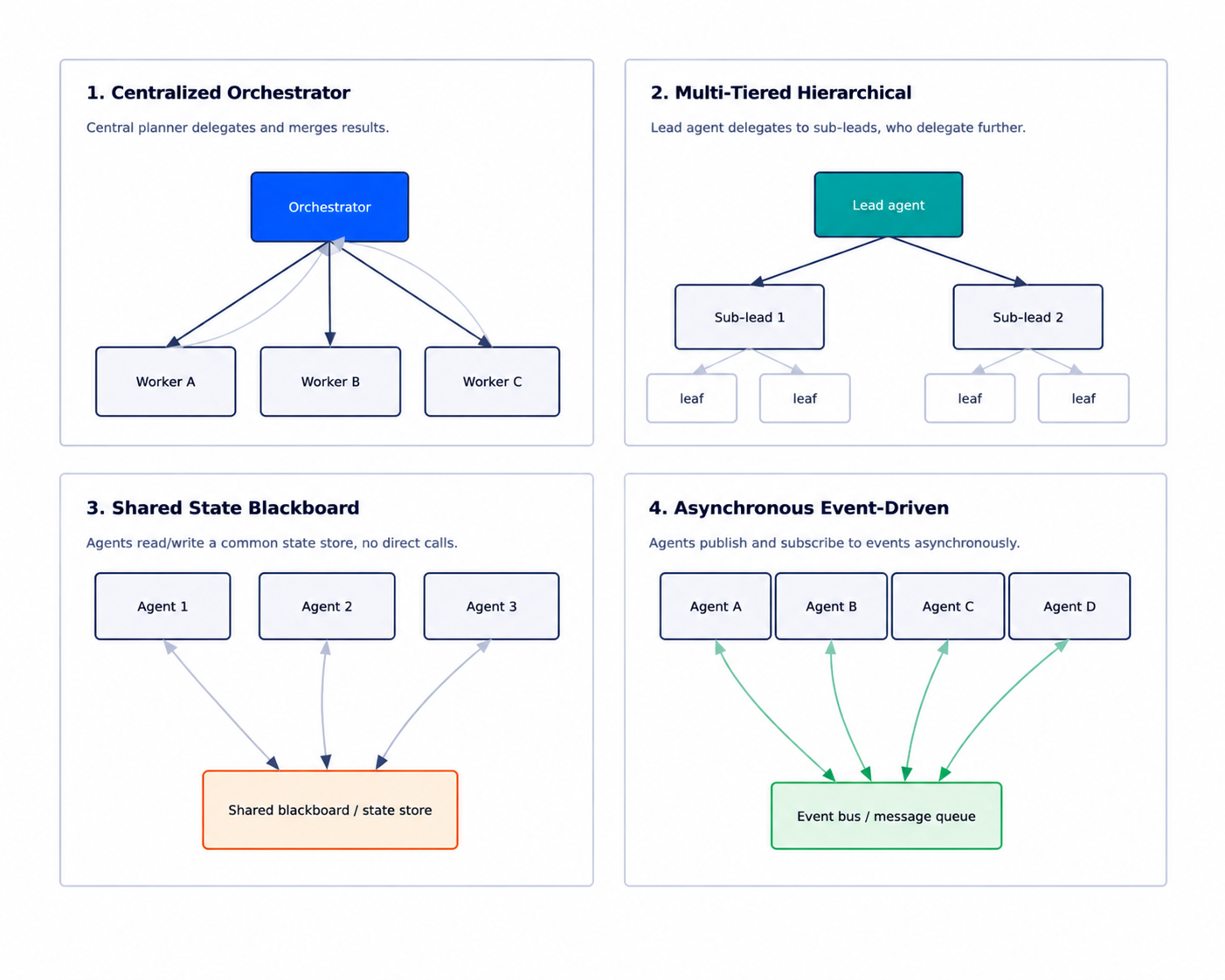
The four distinct architectural patterns for structuring multi-agent systems, each designed to manage how agents interact and collaborate:
- Centralized Orchestrator: A central "orchestrator" agent manages the workflow by delegating tasks to specific workers and merging their results, acting as the single point of control and coordination.
- Multi-Tiered Hierarchical: This pattern creates a tiered leadership structure where a lead agent delegates tasks to sub-leads, who may further delegate to leaf nodes, allowing for more complex, specialized task distribution.
- Shared Blackboard State: Agents operate independently without direct communication, instead reading from and writing to a common "blackboard," or shared state store, which acts as the centralized repository for information.
- Asynchronous Event-Driven: Agents function autonomously and asynchronously by publishing and subscribing to events via a central event bus or message queue, decoupling the agents from one another and allowing for a highly flexible, responsive system.
Pattern in Practice: Asynchronous Event-Driven Architecture
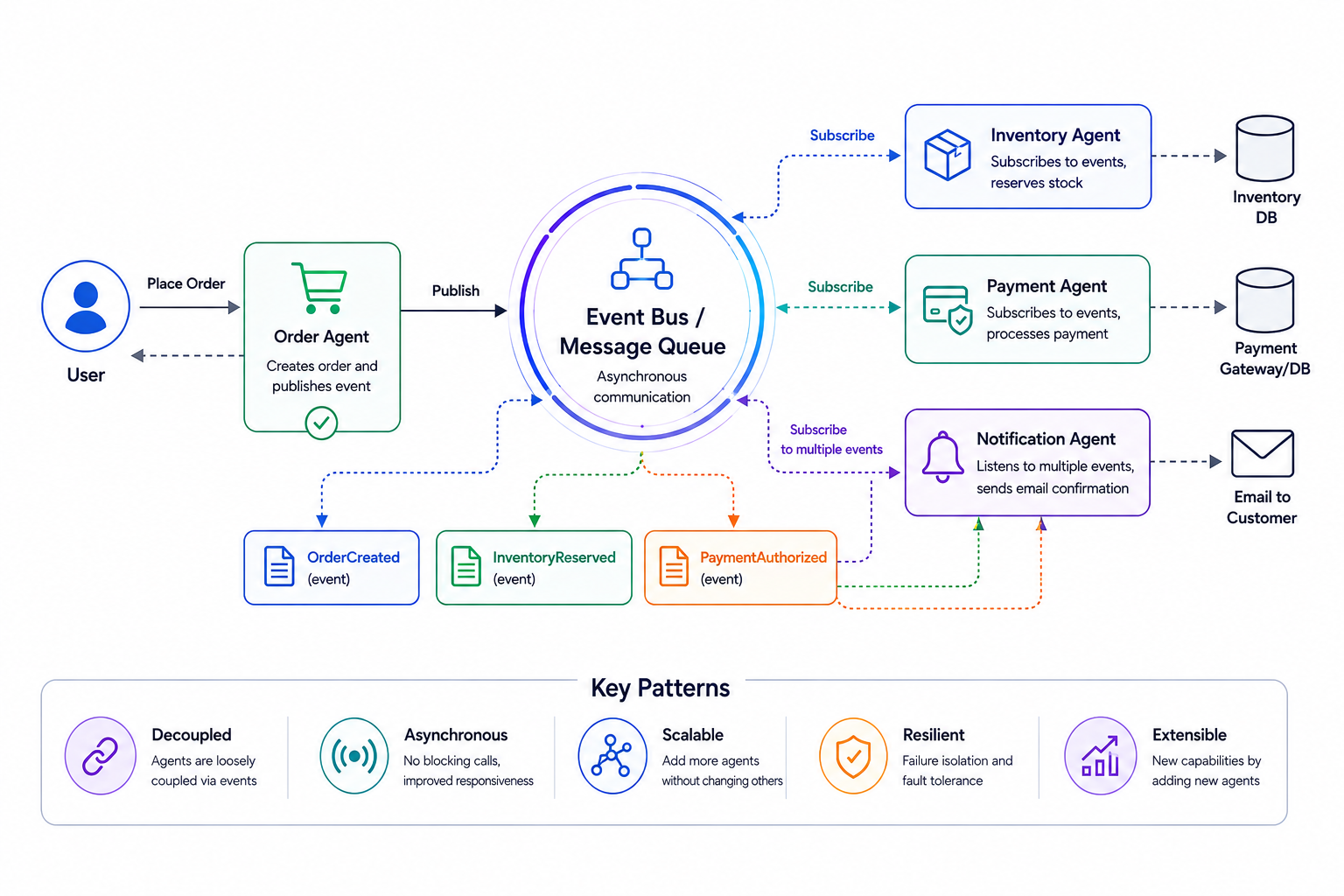
The Asynchronous Event-Driven architecture operates by decoupling agents entirely, allowing them to function autonomously without direct, synchronous communication. Instead of waiting for a request-response cycle, agents publish events to a centralized bus or message queue and subscribe to the specific types of events they are equipped to handle. This creates a highly responsive, non-blocking system where the failure or slow performance of one agent does not cascade to others, ensuring the system remains resilient under fluctuating traffic.
Real-World Example:
Consider an e-commerce order processing system during a high-traffic sale:
- When a customer clicks "Place Order," an Order Agent publishes an OrderCreated event to the message bus and immediately returns a success message to the user, keeping the checkout process fast.
- The Inventory Agent is subscribed to the OrderCreated event; it picks up the message, decrements the stock, and publishes an InventoryReserved event.
- Simultaneously, a payment agent consumes the same OrderCreated event, processes the transaction, and publishes a PaymentAuthorized event.
- Finally, a notification agent listens for both the InventoryReserved and PaymentAuthorized events to trigger an email to the customer.
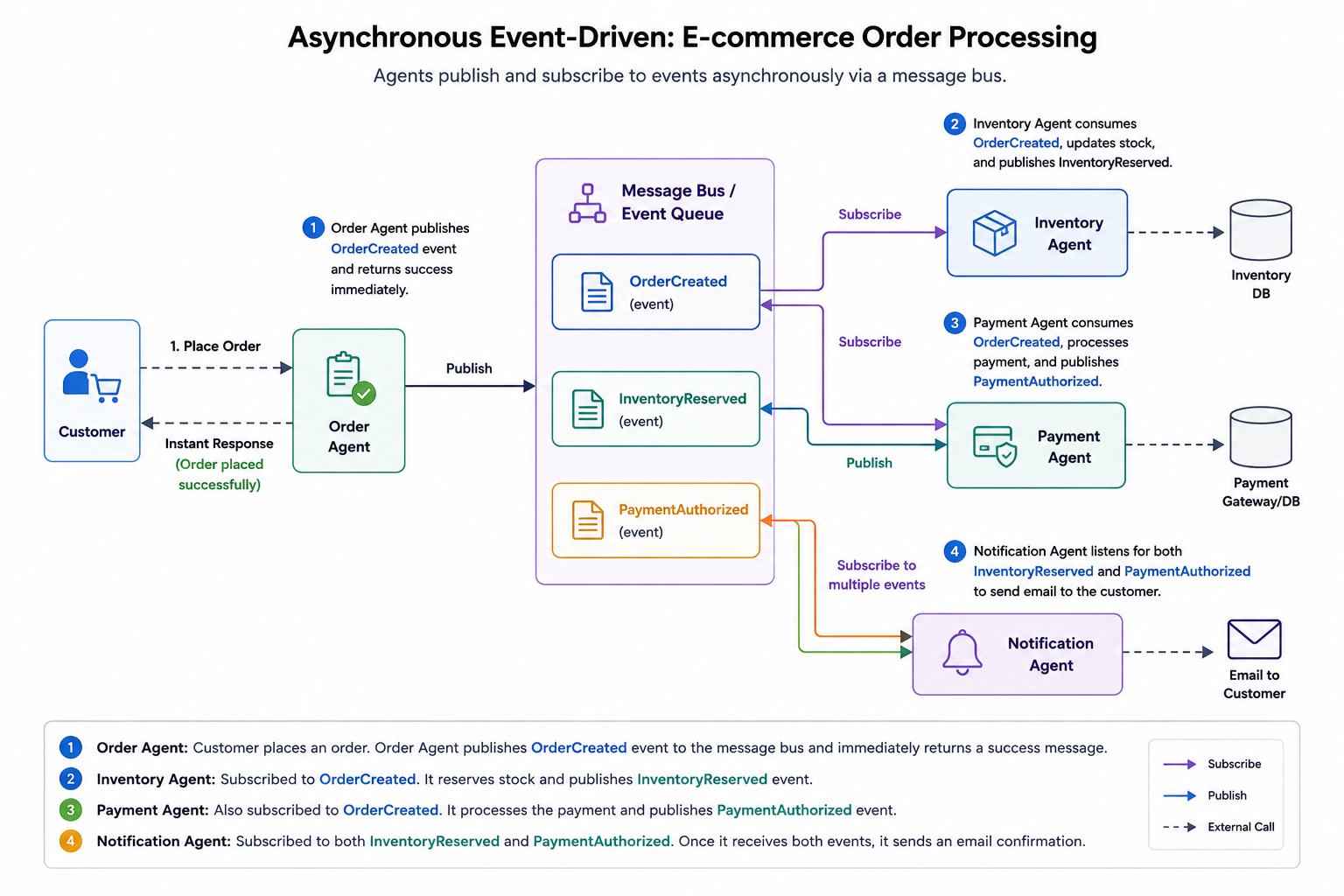
Customer → Order Agent → Message Bus → Inventory + Payment Agents → Notification Agent → Customer
Architecting for Production-Grade Autonomy
At Tweeny, we are committed to moving beyond the hype of experimental AI by focusing on the architectural rigor necessary for true autonomy. We believe that scalable, production-grade agent systems rely on robust, decoupled designs and standardized protocols. By implementing the architectural principles discussed in this document, we are building the resilient infrastructure that powers the future of intelligent, automated enterprise software.
Conclusion
Building robust multi-agent systems is less about the sophistication of the models themselves and more about the architectural rigor surrounding them. By shifting from treating agents as isolated black boxes to designing them as distributed systems supported by the five foundational pillars of resilience, the standardized connectivity of the Model Context Protocol (MCP), and proven architectural patterns like asynchronous event-driven design, you can effectively move beyond brittle prototypes. Ultimately, your success hinges on correctly matching your workflow's complexity to the right architectural pattern, as demonstrated by practical, real-world implementations. When you align these design principles with a commitment to observability and standard protocols, you create a foundation that doesn't just manage agent autonomy but scales it safely into a reliable, production-grade engine.




Explore more blogs


Building intelligent products, modern web platforms, and custom digital experiences.