.png)
Building Efficient AI Agents: Why You Should Switch to Event-Driven Webhooks Today
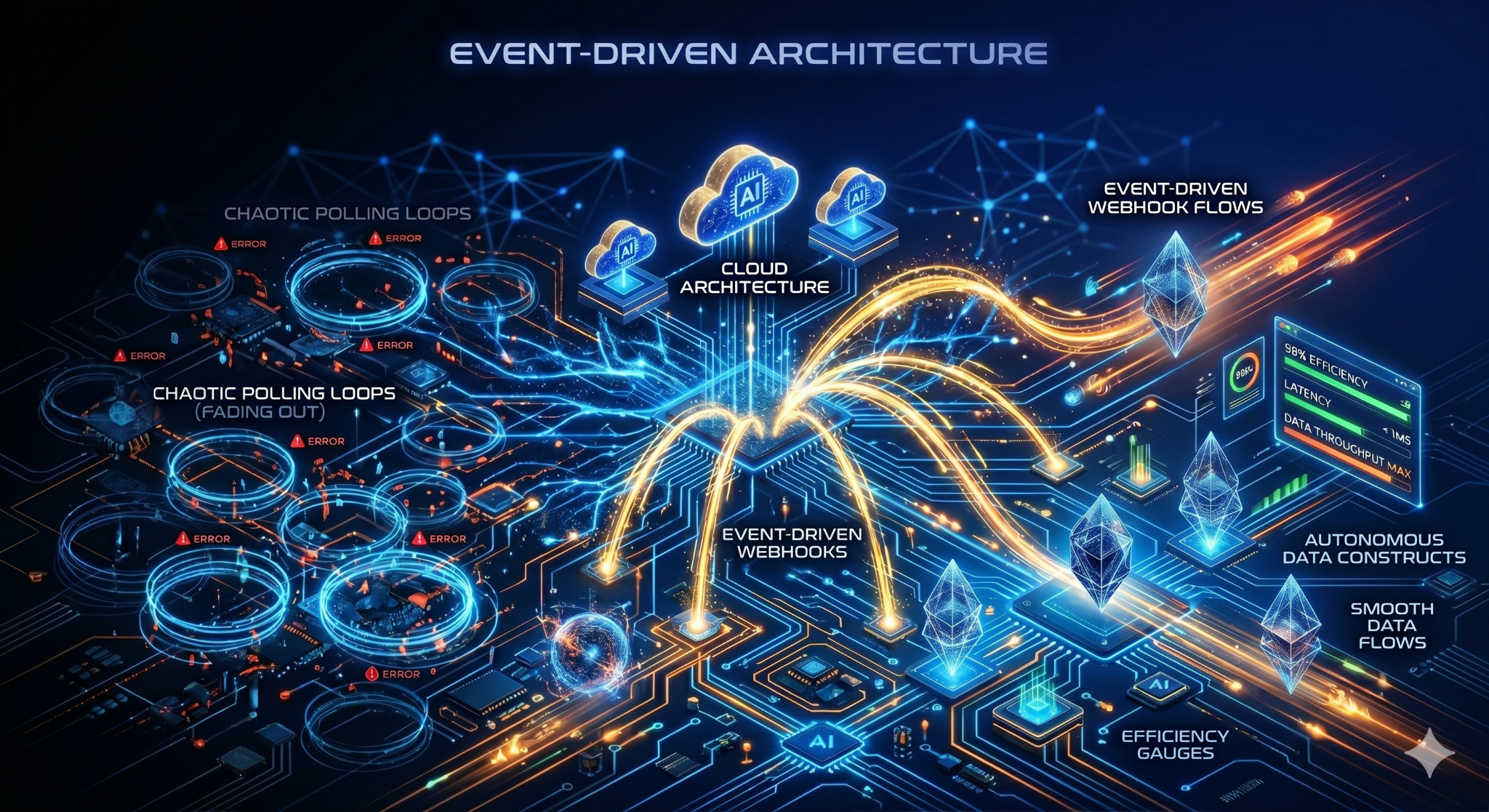
The conversation about AI agents has shifted in the last eighteen months. We are no longer debating whether autonomous systems can reason or take actions on behalf of a business; we are debating whether they can do so reliably, at cost, and at scale.
That second debate is where most enterprise programs are quietly losing ground, and the root cause is rarely the model itself; it is the architecture underneath. Most AI agents in production today still sit on a request-response foundation: they wake up on a schedule, ask whether anything has changed, reason briefly, and go back to sleep. This was acceptable when agents were experimental, but it is now indefensible, as systems like OpenAI’s GPT-Realtime-2 demand millisecond latency for real-time responsiveness in live conversation, turning agents into a workforce.
The teams that recognize this early and rebuild around event-driven webhooks will pull ahead on three dimensions: latency, unit economics, and scale. This post lays out why the shift is happening now, what event-driven architecture actually means, where teams typically misstep, and how to treat the transition as a competitive lever rather than a refactor.
Defining Event-Driven Architecture (EDA) for AI Agents
Event-driven architecture (EDA) is a design pattern where systems communicate by producing and consuming discrete events rather than polling each other or making direct API calls. For AI agents, this changes the operating model entirely: each agent subscribes to specific event types and acts the moment a relevant change occurs in its environment.
Five components do the work:
- Event producer. The source system that emits a signal when its state changes: a CRM marking a deal closed, a payment gateway confirming a transaction, a monitor crossing a threshold.
- Event bus. Message brokers like Kafka, AWS EventBridge, and Google Pub/Sub route events to interested subscribers, decoupling who fires the event from who handles it.
- Event consumer. The AI agent that subscribes to a topic and runs its logic when matching events arrive.
- Loose coupling. Producers and consumers never call each other directly. Adding a new agent means subscribing to events, not modifying any upstream system.
- Asynchronous processing. Agents handle events as they arrive, in parallel, without blocking the producer or each other. Throughput scales with consumer count.
Real-World Event-Driven Flows in Production
The pattern is concrete, not theoretical. Three flows that already run at scale:
Payments and fraud. When a payment clears, Stripe initiates a charge, which is followed by the webhook. After receiving the event, a fraud agent uses Stripe's API to retrieve transaction context, evaluates it based on past trends, and either automatically approves or forwards it to a human reviewer. Latency from start to finish: less than two seconds.
Customer support. A new ticket in Zendesk or Intercom triggers a webhook to a triage agent. The agent classifies intent, checks customer history, and either drafts a reply, hands off to a specialist queue, or escalates to a human. The agent never sat idle; it ran only because the ticket existed.
Code review. A pull request opened in GitHub fires a webhook. A review agent fetches the diff, runs static analysis, and posts comments through the API before the human reviewer has finished their coffee. WorkOS Project Horizon's "code factory" runs a more advanced version of this, with a manager agent orchestrating specialist agents per pull request.
The infrastructure underneath is unglamorous and stable: a webhook receiver with HMAC verification, a queue (SQS, Kafka, or similar) to absorb bursts, an agent runtime that picks up jobs and reasons through them, and an outbound API client that takes action. The interesting work is in the policies, taxonomies, and guardrails around it.
Five Core Patterns for Multi-Agent Orchestration
Five core multi-agent orchestration patterns manage how specialized AI agents coordinate and collaborate.
- Sequential orchestration: This pattern chains AI agents in a predefined, linear order, where each agent processes the output of the previous one to create a pipeline of transformations. It is ideal for tasks that require step-by-step processing and progressive refinement, such as document drafting and review, where stages have clear dependencies and the sequence is deterministic.
- Concurrent orchestration: In this approach, multiple AI agents run simultaneously on the same task. It is best used when a problem benefits from diverse, independent perspectives or specializations (like brainstorming, ensemble reasoning, or voting-based decisions) and for time-sensitive scenarios where parallel processing reduces latency. The results from the independent agents are often aggregated into a comprehensive final outcome.
- Group chat orchestration: This pattern enables multiple agents to collaborate through a shared conversation thread coordinated by a chat manager. It is highly effective for consensus-building, structured "maker-checker" validation loops (where one agent creates output and another evaluates it against criteria), and scenarios that benefit from real-time human-in-the-loop participation.
- Handoff orchestration: This method involves the dynamic delegation of tasks between specialized agents, where full control transfers from one agent to another, meaning only one agent is typically active at a time. An agent assesses the context and decides whether to resolve the issue directly or route it to a more capable specialist. It is extremely useful when the required expertise or sequence of agents only becomes clear during the processing of the request.
- Magnetic orchestration: Designed for open-ended and complex problems without a predetermined solution path, this pattern features a manager agent that dynamically builds, adapts, and refines a "task ledger." The manager communicates with specialized agents (who often have tools to interact with external systems), iterating, backtracking, and delegating as needed to build and execute a complete plan of approach
Common AI Orchestration Patterns: Use Cases and Operational Risks
Sequential Orchestration Pattern
Use Case: Best for staged workflows like drafting, reviewing, and polishing.
Risk: The main risk is that early errors can propagate to later stages.
Concurrent Orchestration Pattern
Use Case: Ideal for multi-perspective analysis on the same input using parallel agents.
Risk: The key challenge is resolving conflicting outputs during merging.
Group Chat Orchestration Pattern
Use Case: Useful for brainstorming and maker-checker collaboration loops.
Risk: Conversations may become repetitive or enter loops with too many agents.
Handoff Orchestration Pattern
Use Case: Designed for triage workflows where the right specialist is identified dynamically.
Risk: A common risk is tasks bouncing between agents without resolution.
Magnetic Orchestration Pattern
Use Case: Effective for open-ended problems and dynamic planning workflows.
Risk: Without sufficient semantic context, the workflow may stall or lose direction.
Security and Operational Discipline for AI Agents
The most common security mistake is under-scoping agent permissions. The viral OpenClaw recently highlighted that granting full system access to an unmanaged agent leads to serious, known security risks. Every autonomous agent must be issued a unique, trackable non-human identity (NHI) with scoped permissions and an explicit audit trail to minimize the blast radius if compromised. Authentication is the floor, not the ceiling. Webhook endpoints should validate HMAC-SHA256 signatures on every inbound payload. Additionally, they should reject any request whose timestamp falls outside a tight window (e.g., five minutes) to neutralize replay attacks. For defense in depth, enforce IP allow listing where possible and put circuit breakers on every outbound call to prevent herd failures when downstream services degrade.
Case Study: Event-Driven Marketing Automation at Tweeny
Companies are adopting these principles rapidly beyond core engineering. At Tweeny, for instance, the lead generation automation pipeline uses event-driven principles to manage customer journeys. Instead of polling a CRM, the system reacts to discrete events like a form completion or a trigger from one of our portfolio products. This instant reaction is used to trigger tailored content delivery, sales alerts, and lead routing, demonstrating how EDA provides the speed and customization needed for modern product marketing.
Conclusion: The Strategic Shift from Polling to Listening
The shift from polling to event-driven is, in the end, a shift from asking to listening. Asking is expensive, latent, and wasteful when extended across a fleet of autonomous agents. Listening is the operational posture that lets agents behave like a workforce rather than a batch job. The teams that take this seriously will not get there by adopting a new tool. They will get there by treating agents as first-class identities. By designing event taxonomies before integrations.
By enforcing security and guardrails as defaults rather than afterthoughts. By building the metadata layer that turns reactive systems into intelligent ones. The technology is ready. The architectural discipline is what separates the programs that compound from the programs that stall. If your agents are still polling, the question is no longer whether to make the change. It is how much of a head start you are willing to concede before you do.



Explore more blogs

Building intelligent products, modern web platforms, and custom digital experiences.