.png)
Beyond the Frontier Model: Why Distributed Agents are the New Enterprise Standard
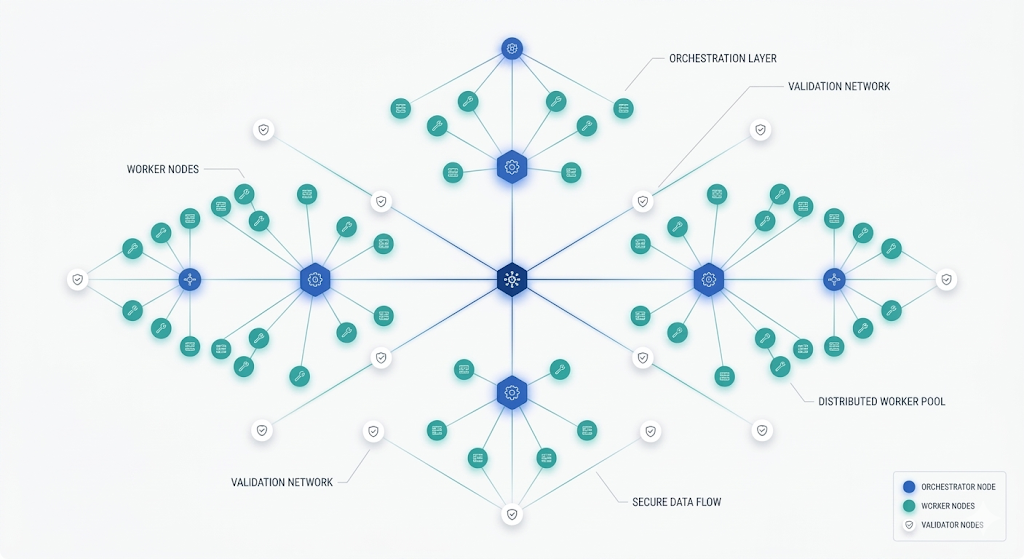
Fixing the AI Bottleneck: How Multi-Agent Systems Solve Complex Workflows
When enterprises first started deploying AI, the instinct made sense: pick the best model available, give it access to your data, and let it run. Simple, fast, and easy to demo. For narrow tasks like summarizing a document or drafting an email, it held up fine.
Then came the real workflows. Procurement approvals that touch five systems. Compliance reviews that require reading policy, checking history, and generating audit-ready output.
Customer journeys that span intake, verification, fulfilment, and follow-up. One model doing all of this at once doesn't just slow down; it breaks down. Context gets lost mid-task, earlier instructions get quietly forgotten, and errors compound silently before anyone notices something went wrong.
The architecture was always the problem, not the model. Treating AI like a single brilliant generalist, when the work demands a coordinated team, is why so many pilots have stalled at proof-of-concept and never made it to production. Multi-Agent Systems (MAS) are the correction: breaking complex workflows into specialized, autonomous agents that each own a defined slice of the problem and handing off cleanly to the next.
Why Frontier Models Alone Don't Scale and What Breaks First
Frontier models are extraordinarily capable. That's not the issue. The issue is what happens when you ask one model to be the entire system for a complex, multi-step enterprise workflow. Three things break, in order:
A single model's context window is shared across every step of the workflow. The more complex the task, the more state it has to track and the more it silently drops. By the time a frontier model is halfway through a 12-step procurement workflow, it has quietly forgotten constraints set in step two. It doesn't error out. It just produces subtly wrong output.
In a single-model architecture, the only thing preventing an AI from using permissions it shouldn't is the instruction in its prompt. That's not governance; it's wishful thinking. Distributed agents solve this structurally: each agent gets only the credentials its role requires, enforced at the infrastructure level, not the prompt level.
Routing every step of a workflow — including simple classification, extraction, and formatting through a frontier model is expensive and slow. Distributed architectures let you match model capability to task complexity. Reserve the frontier model for orchestration and judgment. Let smaller, faster, cheaper models handle everything else. Teams that make this shift consistently see 30-40% cost reductions on the same workloads.
Building the Stack: Layers and Frameworks
Every production multi-agent deployment is built on the same three infrastructure layers, regardless of industry or use case. Get these right and the system is debuggable, governable, and scalable. Skip any one of them and you'll spend the next six months firefighting.
The three essential layers are as follows:
- Orchestration: The process of decomposing high-level goals into smaller, manageable tasks and delegating those tasks across specialized agents.
- Observability: The practice of logging every agent action with full attribution, which ensures that system failures are traceable and that the architecture remains debuggable.
- Governed Data Access: The security approach of providing agents with scoped credentials tailored to their specific needs, rather than granting blanket system access.
Three orchestration frameworks have emerged as the practical choices for enterprise teams.
- LangGraph: Best for stateful, cyclic workflows needing fine-grained control. This is a low-level framework, ideal when you need precision over every agent step.
- CrewAI: Best for role-based collaborative workflows and faster onboarding. This is a high-level framework where pre-built delegation patterns help reduce setup time.
- Microsoft Agent Framework: Best for cloud-native enterprise deployments. It reached general availability in April 2026 and unifies earlier agent tooling under one roof.
Governance: The Variable That Determines Outcomes
Rapid deployment has created a new problem: "agentic sprawl," unregulated agents accumulating technical debt and security risks across the organization, often without any central visibility into what they can access or who owns them. The striking thing isn't that this is happening; it's that the vast majority of organizations are aware of the problem but haven't put a centralized approach in place to address it.
The fix isn't complicated; it's just unglamorous. Before any agent goes to production, three things need to be in place:
1. Centralized Audit Logging with Agent Attribution
Every tool call, inter-agent message, and decision must log agent ID, timestamp, input, and output. Without this, you can't debug failures, satisfy regulators, or run post-mortems. Non-negotiable in regulated industries.
2. Human-in-the-Loop Escalation Thresholds
Define explicit confidence thresholds below which an agent escalates to human review. The escalation path must be deterministic; a compliance agent that is 94% confident on a contract clause should flag, not auto-approve.
3. Scoped Credentials Per Agent, Not Per System
Zero-trust applied to AI: each agent receives only the minimum permissions its role requires. A research agent gets read-only access; a generation agent gets write access to a draft folder, not production. Also watch for "trust bubbles" where interacting agents fall into agreement loops that quietly undermine the original objective.
Operationalizing Agentic Architecture: An Expert Perspective
At Tweeny Technologies, we translate these architectural principles into production-grade reality. We specialize in designing and deploying autonomous multi-agent systems that move beyond experimental chat interfaces to operational execution. By layering robust orchestration, strict security governance, and deep observability, we help enterprises bridge the gap between AI potential and reliable business outcomes. Our expertise lies in architecting systems that decompose complex workflows from compliance and procurement to data reconciliation into coordinated agentic teams, ensuring that your AI infrastructure is not just intelligent but also resilient, scalable, and audit-ready.
Architecting for the Future: From Frontier Models to Distributed Systems
Frontier models got enterprises through the door. Distributed agents are what keep them in the room. The leap in raw model capability over the last two years is real, but capability alone doesn't translate to production-grade AI. The teams pulling ahead aren't the ones with access to the best model. They're the ones who stopped treating that model as the entire system and started treating it as one layer in a coordinated architecture.
Over 70% of organizations already run agents in production. Whether your company ships or is quietly cancelled before it reaches production depends on the architectural choices you make today regarding topology, protocol stack, model routing, and governance.


Explore more blogs

Building intelligent products, modern web platforms, and custom digital experiences.