.png)
AI-Assisted Coding vs Traditional Development: A Strategic Comparison
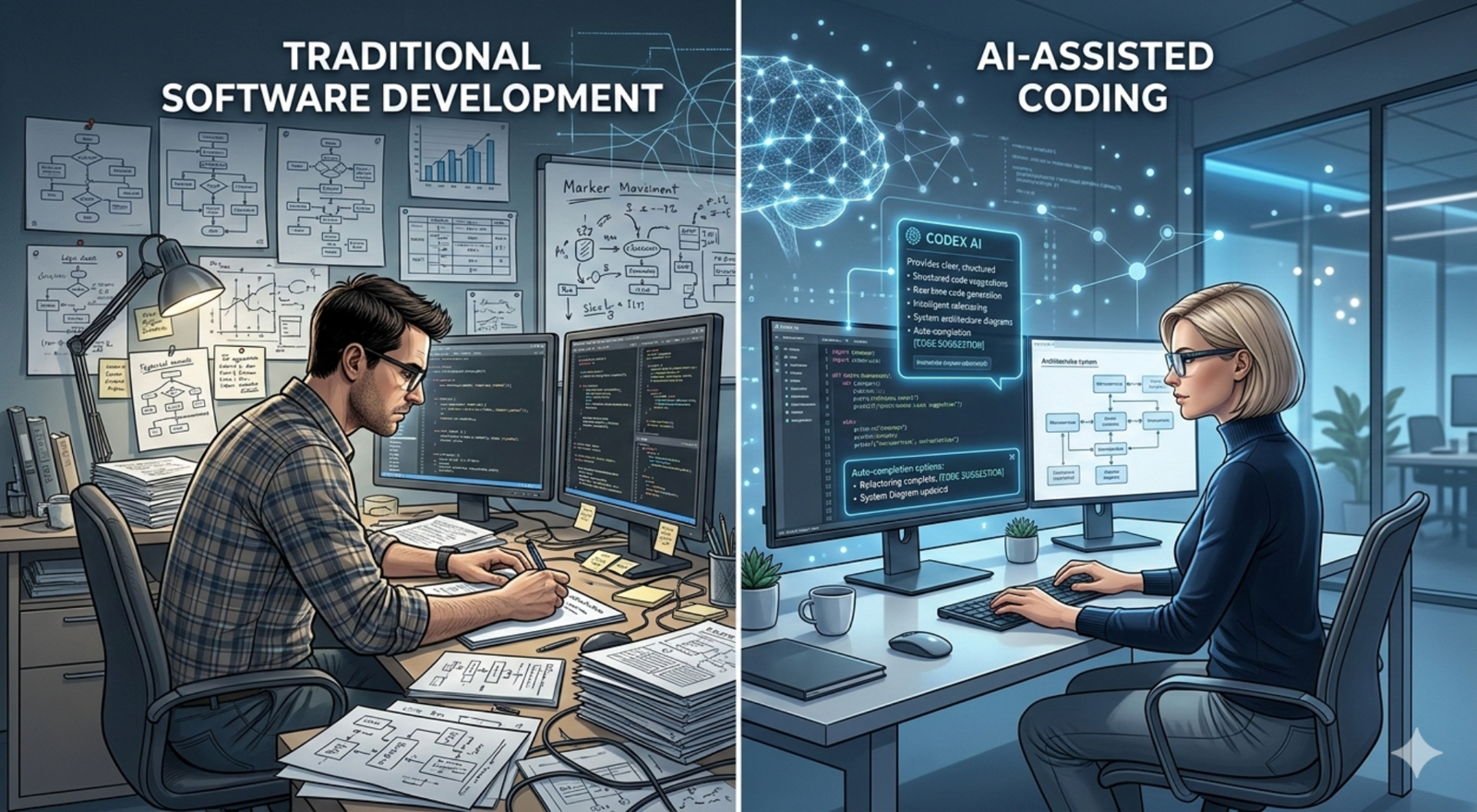
The Structural Shift in Modern Software Development
Software development is undergoing a structural shift. For decades, teams relied on traditional coding practices, manual implementation, structured sprints, and incremental delivery. That model built the modern digital economy.
But expectations have changed. Product teams must ship faster, iterate continuously, and integrate AI-driven capabilities, often without expanding headcount. Backlogs are growing while release cycles are shrinking. The question is no longer "Can we build it?" But how fast can we build, test, and evolve it without compromising quality?
This is where AI-assisted coding becomes strategic. AI-native environments such as Cursor are reshaping how engineers write, refactor, and ship software, turning the comparison between traditional and AI-assisted development into an operational reality rather than a theoretical debate.
What AI-Assisted Coding Actually Is
AI-assisted coding is not automated software creation, nor does it replace engineering judgment. It is a system-level enhancement embedded within the development workflow. By integrating a large language model directly into the development environment, engineers can interact with code using natural language, accelerating implementation, reducing cognitive load, and improving overall productivity. The AI supports the developer; it does not operate independently.
At a functional level, AI-assisted coding:
- Interprets natural language prompts
- Understands repository and file context
- Generates, refactors, and explains code
- Suggests architectural improvements
- Identifies potential issues
The human remains in control, reviewing decisions, validating logic, and maintaining quality standards. The AI acts as a productivity multiplier, augmenting engineering capacity while preserving discipline and oversight.
Explaining Complex Code for Faster Onboarding
Traditional Approach
- A new engineer joins and needs to understand a complex billing workflow.
- The system includes subscription renewals, retries, proration logic, and multiple edge cases.
- The engineer begins by reviewing documentation, which is often outdated or incomplete.
- They depend on senior engineers to explain historical decisions and architectural nuances.
- They spend hours stepping through the codebase to trace conditional logic.
- They manually identify how services, utilities, and dependencies interact.
- This process consumes significant time and senior engineering bandwidth.
Using AI-enabled IDEs
- The engineer highlights the relevant billing module.
- Prompts: “Explain how this billing system processes subscription renewals and edge cases.”
- The system analyzes full file and repository context.
- Generates a structured explanation of the execution flow.
- Breaks down key decision branches and conditional logic.
- Identifies critical dependencies across services and utilities.
- Provides a synthesized, contextual overview of system behavior.
Impact
- Onboarding accelerates significantly.
- Reduced reliance on senior engineers for foundational explanations.
- Knowledge becomes more accessible and distributed.
- Institutional memory is less concentrated in a few individuals.
- Documentation clarity improves organically.
- New engineers gain confidence faster.
- The time for meaningful contribution is shortening.
How AI-Assisted Coding Differs from the Traditional Approach
AI-assisted coding environments such as Cursor, GitHub Copilot, and Claude are reshaping how software is built. In traditional workflows, engineers manually translate requirements into code, search documentation, debug step by step, and refactor line-by-line processes that often depend heavily on individual expertise and time-intensive review cycles.
AI-assisted platforms embed contextual intelligence directly into the development environment. Tools like Cursor provide repository-aware assistance, GitHub Copilot offers real-time code suggestions within editors, and models like Claude help analyze complex systems or explain unfamiliar code.
The shift is not only about speed but also about how developers interact with code. Traditional development is implementation-first, while AI-assisted development is intent-first. Developers describe what they want to build, and AI helps generate, refine, and optimize the code. Engineers remain in control, but the effort required to move from idea to execution is significantly reduced.
How We Help Organizations Build AI-Augmented Engineering Systems
At Tweeny Technologies, we help organizations transition from traditional development models to AI-assisted, automation-first engineering workflows. Our approach goes beyond simply adopting tools; we design structured implementation frameworks that integrate AI coding environments into daily development practices, CI/CD pipelines, and governance processes. We help teams define prompt standards, establish validation guardrails, align AI outputs with architectural principles, and embed measurable productivity metrics into engineering operations.
By integrating AI assistance strategically, our clients experience measurable gains in productivity: reduced development cycle times, faster onboarding of new engineers, improved code consistency, and lower technical debt accumulation. Engineering teams spend less time on repetitive implementation work and more time on problem-solving, innovation, and customer-facing improvements. The result is not just faster coding; it is improved engineering leverage, better resource utilization, and a scalable development model built for long-term competitive advantage.
Conclusion: From Discipline to Leverage
Traditional development built the foundation of modern software: structured, reliable, and grounded in human expertise. That foundation remains essential. However, AI-assisted coding redefines how efficiently software can be created, improved, and scaled. It does not replace engineering discipline; it amplifies it. When organizations integrate AI thoughtfully, balancing automation with governance and oversight, they gain more than speed. They gain the ability to iterate faster, experiment more confidently, and compete with greater agility. In today’s environment, that shift from effort to leverage is not incremental; it is strategic.



Explore more blogs

Building intelligent products, modern web platforms, and custom digital experiences.