.png)
Performance, Scalability, and Security in Modern Web Architecture
Modern Web Architecture: Performance, Scalability & Security
Every technology decision your team makes is, in some form, an architecture decision. How fast your product feels, how gracefully it handles growth, and how resilient it is to attack these are not outcomes of a single sprint. They are the cumulative result of structural choices made throughout the life of your system.
This article offers a clear, practical view of what modern web architecture actually requires across three critical dimensions performance, scalability, and security and where most teams quietly get it wrong.
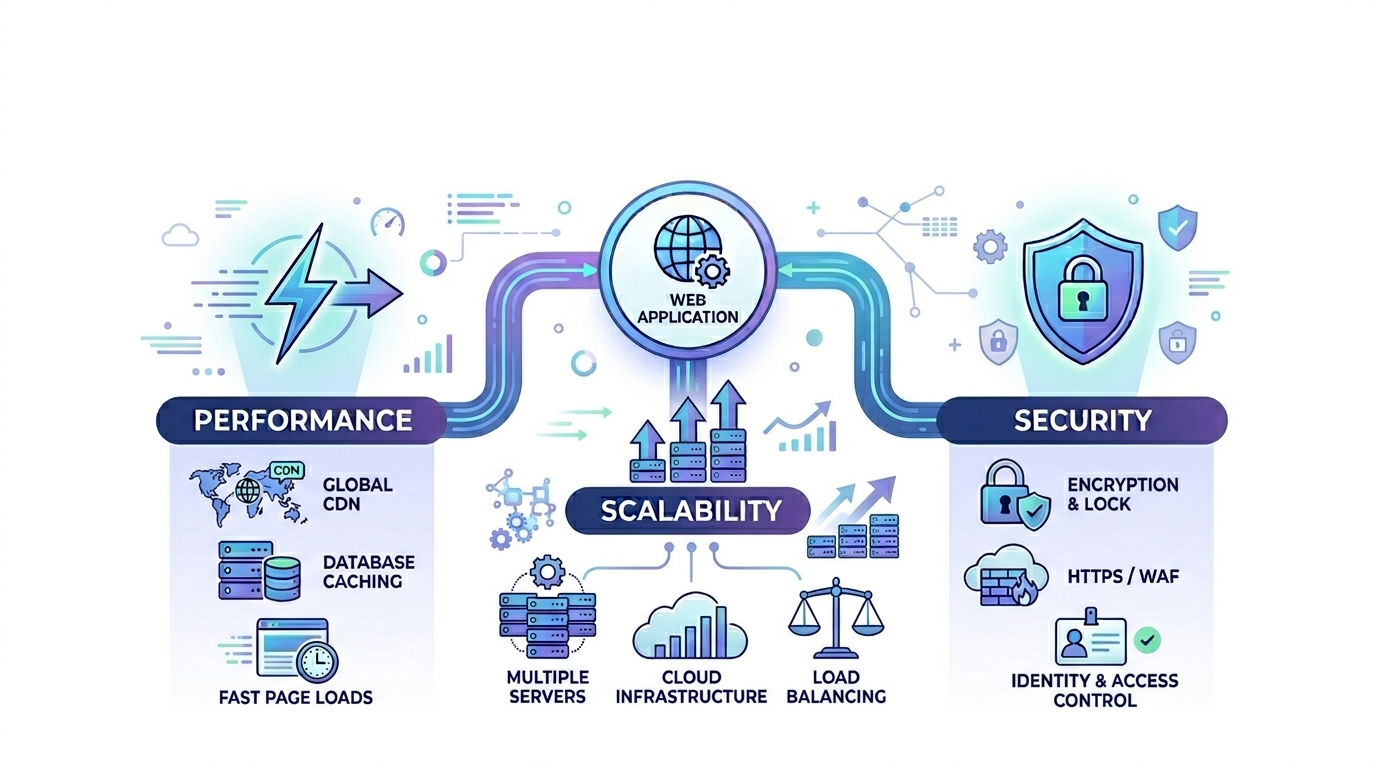
What Is Modern Web Architecture: Components & Design Guide
A web application is a chain: a user does something, a request passes through several layers, something happens, and a response comes back. Most production systems run through five layers:
- Frontend: What users see and interact with. Perceived speed lives here; a slow frontend makes a fast backend irrelevant. Example: React app, mobile UI
- Backend Services: Where business logic runs: authentication, payments, and data processing. Often split into independent services rather than one large application. Example: Node.js APIs, microservices
- Databases and Data Stores: Where data lives, relational databases for transactions, Redis for fast lookups, and queues for background work. Wrong choices here are the most common scaling mistake. Example: PostgreSQL, MongoDB, Redis
- APIs: The connectors between layers and third-party services. How you design them determines how much unnecessary data moves and how tightly services are coupled. Example: GraphQL, webhooks, REST
- Infrastructure: Cloud services, servers, and networking (AWS, GCP, and Azure). These choices define your costs, reliability, and global reach.
A problem in one layer almost always surfaces as a symptom in another. Understanding how they interact is the starting point for every performance, scalability, and security decision.
Web Performance Optimization: Boost Speed & User Experience
Performance is not an engineering vanity metric; it directly affects whether people use your product. The most common mistake is treating it as a backend problem. User-perceived speed is end-to-end: assets, JavaScript, API calls, and rendering all count.
- Caching: The single highest-leverage tool available. Serve static assets from a CDN (Content Delivery Network) so users get them from nearby, not across the world. Cache expensive queries in Redis. Use HTTP cache headers so browsers don't re-download assets they already have.
- Database queries Most production slowdowns start here. A missing index, a full-table scan, or an N+1 query pattern fetching one record and then making 100 more queries to fill in related data can bring a system down under moderate load.
- Asynchronous processing Not everything needs to happen before the user gets a response. Confirmation emails, PDF generation, and CRM syncs move them to a background queue. The user should not wait for work that doesn't affect their immediate result.
- API design If your API returns 50 fields when the client needs 5, you are wasting bandwidth on every request. If a screen requires 3 separate calls to load, you have added 3x the latency. Neither is acceptable at scale.
Scalable Web Architecture: Handle Growth Efficiently
These five decisions, in order, are what separate systems that scale from systems that don't:
- Stateless services first: A service storing session data in memory cannot be copied across multiple servers. Move all state to a shared database or cache, and then you can run 2, 10, or 100 copies of that service without any one of them having stale data.
- Load balancing: Routes traffic across service instances so no single server gets overwhelmed. Watches for unhealthy servers and stops sending them traffic. This is also how you deploy updates without downtime. Example: In 2021, Facebook's six-hour outage wasn't caused by load; it was a routing misconfiguration. But the principle is the same: without load balancing, a single server failure takes down your entire application. With it, traffic is redistributed automatically around unhealthy instances.
- Queues for background work: When your system needs to do something slow, like process an image, send 10,000 emails, or run a report, a queue lets servers handle it at their own pace. Without queues, a traffic spike that triggers heavy background work can cascade into an outage.
- Auto-scaling: Your infrastructure monitors its own load and adds or removes servers automatically. A traffic spike at 2am does not require anyone to wake up.
- Database scaling strategy Your database will almost always be the first bottleneck. Start with read replicas. As you grow, consider sharding or purpose-built stores: a search index for full-text queries and a columnar store for analytics. Plan this before you need it.
Your database will almost always be the first bottleneck. The path looks like this: start with read replicas to offload reporting queries, add a search index for full-text search, and move analytics to a columnar store like BigQuery. Plan the path before you hit the wall.
Web Security Best Practices: Build Secure Apps from Scratch
A vulnerability caught in code review takes an hour to fix. Found after a breach, it costs legal exposure, regulatory fines, and customer trust. Most teams treat security as a checklist at the end of a release. The teams that do it well treat it as a set of defaults built into how they work.
- HTTPS everywhere All traffic is encrypted, and HSTS headers are enforced. This is the foundation; nothing else matters if traffic can be intercepted in transit.
- Web Application Firewall: Cloudflare's WAF blocks billions of malicious requests daily before they reach any application code. SQL injection and cross-site scripting attacks have existed for 25 years; there is no reason to handle them manually when managed rule sets cover them out of the box.
- Authentication and access control: Use OAuth 2.0; do not build your own auth system. Implement role-based access control so users only access what their role permits. An analyst should not have the same database permissions as an admin.
Example: Uber's 2022 breach started with social engineering an employee's credentials. The attacker then moved laterally because internal permissions were too broad. Role-based access control, where an analyst can't access admin functions and an admin in one service can't touch another, limits what any single compromised account can reach.
- Input validation and output encoding: Never trust input from a user, a partner API, or your own frontend. Validate server-side. Encode on output. This one practice prevents the majority of injection attacks that have persisted for twenty years.
- Zero trust between services: Do not assume that because a request comes from inside your infrastructure, it is safe. Each service should authenticate requests from others and access only what it needs. If one service is compromised, zero-trust limits the blast radius.
- Secrets out of your code: API keys and credentials stored in a repository are a leading cause of breaches. If a key is ever accidentally committed, rotate it immediately and assume it has been seen.
Web Architecture Trade-offs: Performance vs Scalability & Cost
None of the above is free. Every improvement adds some combination of complexity, cost, and maintenance. The right approach is not to implement everything; it is to make deliberate choices about what to prioritize and when.
- Caching vs. freshness A cached value is always potentially stale. Design cache expiry per data type. An account balance needs to be current. A product listing can be 5 minutes old.
- Microservices vs. simplicity : Many teams split into microservices too early, adding operational complexity before they have the scale to justify it.
Shopify ran as a monolith for years and scaled to billions in GMV on it. Split a service out only when a specific part of your system genuinely needs independent scaling or deployment.
- Security vs. user experience (UX): Controls that users route around provide negative security value. A password policy so strict that everyone writes their password on a sticky note is worse than a simpler one. Apply friction where stakes are higher, like admin access and payment changes, and reduce it where they are not.
Expert Web Architecture Consulting for Scalable, Secure Applications
At Tweeny Technologies, we help other organizations design web systems that are fast, resilient, and secure, not just at launch but as they grow. Many teams come to us after hitting the same walls: a database that can't keep up, a security gap that could have been prevented, or an architecture that worked early but is buckling under growth.
Our approach is straightforward. We assess where your system stands across performance, scalability, and security, then work layer by layer to fix what's creating risk and holding you back. That means smarter caching, cleaner database design, background queues that handle spikes without firefighting, and security practices embedded into how your team builds, not bolted on at the end.
Conclusion: Building Web Architecture That Scales Without Breaking
The systems that hold up over time are not the most technically sophisticated. They are the ones where someone thought carefully about how the pieces fit together, what would happen under load, and what an attacker would see from the outside. You do not need to solve for 10 million users on day one, but you do need to avoid decisions that make it impossible to get there without a full rebuild.
Review your architecture regularly, not just when something breaks. Ask whether the decisions made six months ago still make sense given where the product is today. That habit, more than any specific tool or pattern, is what good engineering teams have in common.



Explore more blogs




Building intelligent products, modern web platforms, and custom digital experiences.