.png)
From Concept to Scalable Product: A Modern Development Framework
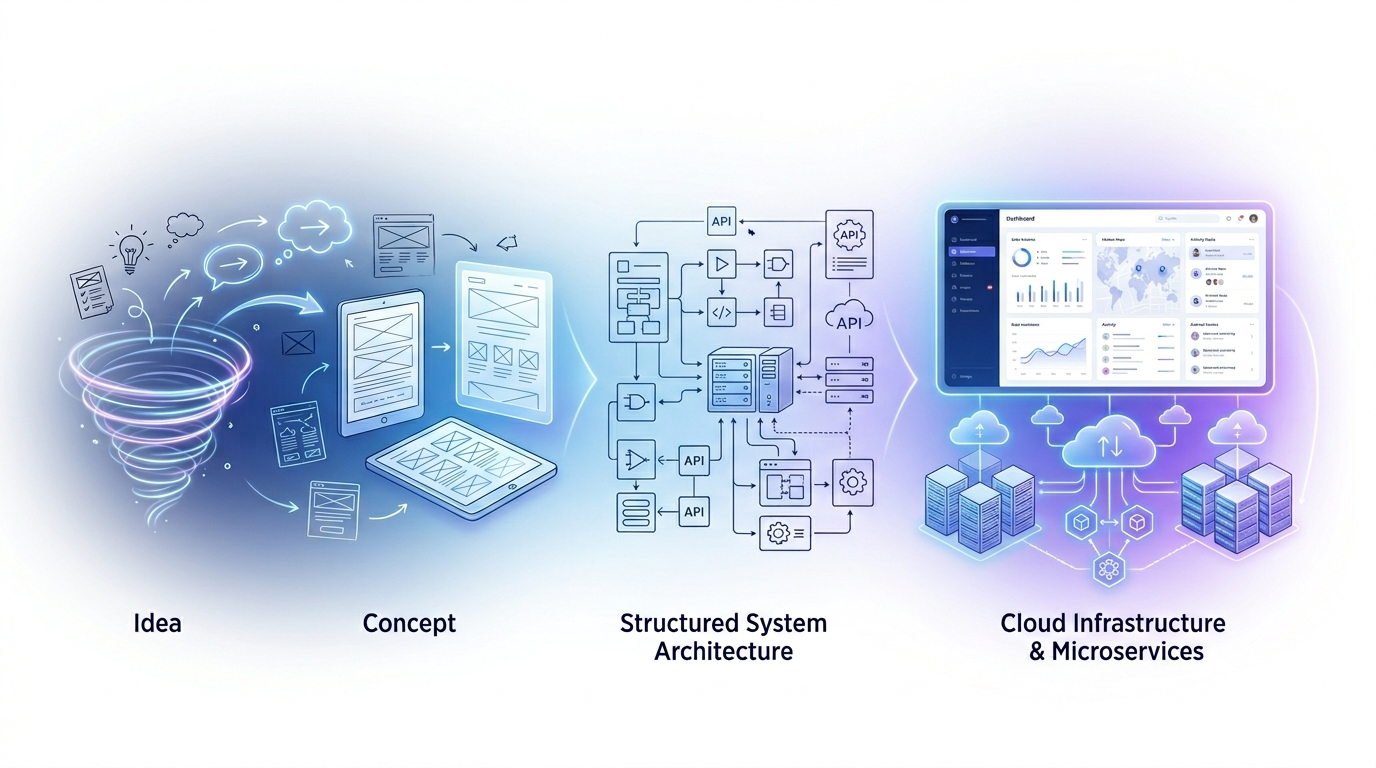
Why Modern Product Development Breaks Without Structure
Most organizations don’t fail for lack of ideas. They fail because their architecture hits a wall of its own making.
We’ve all seen it: a product launches with breakneck speed, but within 18 months, that "fast" development model turns into a liability. Teams are shipping, but they’re also shipping a ticking time bomb of fragmented services, unmanaged technical debt, and constant firefighting.
You aren’t scaling; you’re just stacking weight until the foundation cracks. This is the velocity illusion: the belief that you’re moving fast because you’re pushing code, even as your net progress stalls.
To break this cycle, we move away from linear, manual processes toward a system-level approach:
Concept → Framework → Scale.
The Foundation of Scalable Product Engineering
1. Concept: Beyond the MVP
A concept isn't just a feature request; it’s an architectural commitment. Weak concepts defer complexity to a later date. Strong concepts anticipate it. If you aren't defining your system boundaries and scaling constraints before the first sprint, you aren't building a product; you're building a future refactor.
2. Framework: Your Force Multiplier
The framework is where products either gain leverage or accumulate debt. A modern framework doesn’t just "work." It automates the heavy lifting:
- Event-Driven Architecture (EDA): Decoupling services to prevent cascading failures. This architectural pattern uses events for communication between services, where a producer publishes events to a message broker, and consumers subscribe to those events and react accordingly. This approach provides modularity and keeps the system architecture loosely coupled.
Event-driven systems separate components and keep user-facing paths fast, which is critical for handling massive workloads. For instance, McDonald's food delivery platform utilizes EDA and scales to handle 20,000 orders per second with less than 100 millisecond latency.
It aligns system activity with business-relevant events, enabling event-driven workflows to run only when needed, which helps reduce idle compute usage and aligns cost with value delivered.
- Infrastructure as Code (IaC): Treating your environment as part of your version control. IaC provisions and manages infrastructure (e.g., VMs, networks, databases) using code instead of manual processes like clicking around in cloud consoles. This automation is used to deploy new microservice instances based on demand for quick scaling.
The overwhelming benefits of IaC include reproducibility (infra can be consistently created, destroyed, and recreated across environments), version control (changes are tracked like application code), automation (reduces human error and speeds deployment), and self-documentation (the code shows what infra exists).
- Observability by Design: If a behavior isn't traceable, it’s a liability. We engineer deep autonomous system intelligence into the architecture from the first commit, ensuring that "silent failures" never reach production and your system remains a glass box, not a black box.
3. Scale: Designing for 10x
Scaling isn't a post-launch chore; it's a design constraint. If your system can't handle a 10x load increase without a manual rewrite, it’s not scalable; it’s fragile. We build for adaptive systems that respond to real-time conditions without a single line of human intervention.
The Technical Core: Agentic Engineering
In 2026, the era of manual monitoring and human-gated deployments is over. We implement an agentic infrastructure that manages the system's "metabolism."
- The Synthesis Layer: Don’t just predict bottlenecks; solve them. Our AI-driven pipelines monitor query patterns and autonomously tune database indices or scale cloud resources before performance dips. Implement predictive scaling agents (e.g., using Kubernetes Horizontal Pod Autoscaler) to manage anticipated burst traffic.
An e-commerce platform uses AI to analyze query logs, autonomously triggering a 40% pre-scaling of database connection pools 30 minutes before peak load, preventing potential errors.
- Zero-Trust Governance: Security is policy-as-code. If a feature commit doesn’t meet your compliance guardrails, it doesn't reach staging. No human gatekeeper, no developer frustration, just instant feedback. Utilize policy engines (like Open Policy Agent) to enforce security rules directly in the CI/CD pipeline, reducing human security review time by up to 80%.
For example, a policy rule automatically fails the build if a service attempts to access PII data without the required service-to-service two-factor authentication, enforcing compliance instantly.
- The Self-Correction Layer: When failure happens, the system shouldn't just "alert" a tired engineer at 2 AM; it should recover. Automated rollbacks and drift correction ensure your engineers are sleeping while your infrastructure is healing itself. Automated rollbacks reduce the mean time to recovery (MTTR) from hours (human intervention) to under 5 minutes.
For example, if a newly deployed service version exhibits a 5% latency increase within a defined window, the system automatically triggers a rollback to the last stable commit, maintaining service quality without manual intervention.
This isn't just automation; it’s the shift from reactive firefighting to a system that possesses true architectural intelligence.

Scaling Beyond the Code: Engineering Maturity That Lasts
At Tweeny Technologies, the hardest part of scaling isn't writing code; it’s managing the complexity that arrives right alongside it. We bridge the critical gap between initial concept and global execution, ensuring your ambition doesn't outpace your infrastructure. By architecting automation-first workflows, we transform manual overhead into streamlined efficiency, allowing your teams to deliver release cycles that are not only faster but significantly more resilient under pressure.
We don’t just build products; we build the foundational engineering maturity your team needs to innovate without hitting the "scaling wall." Whether you are navigating the nuances of FinTech or optimizing complex DevOps environments, we provide the technical rigor required to sustain growth. Our approach empowers you to move beyond reactive firefighting, creating a high-performance culture where technical debt is minimized and long-term scalability becomes the baseline.
Conclusion: Building Systems That Scale and Evolve
The path to a scalable product isn't about working harder; it’s about building a framework that does the heavy lifting for you. Successful products aren't defined by their launch velocity; they’re defined by their ability to evolve without losing control.
If your current development cycle feels more like a daily struggle against debt than a streamlined engine, it’s time to change the framework.


Explore more blogs

Building intelligent products, modern web platforms, and custom digital experiences.