.png)
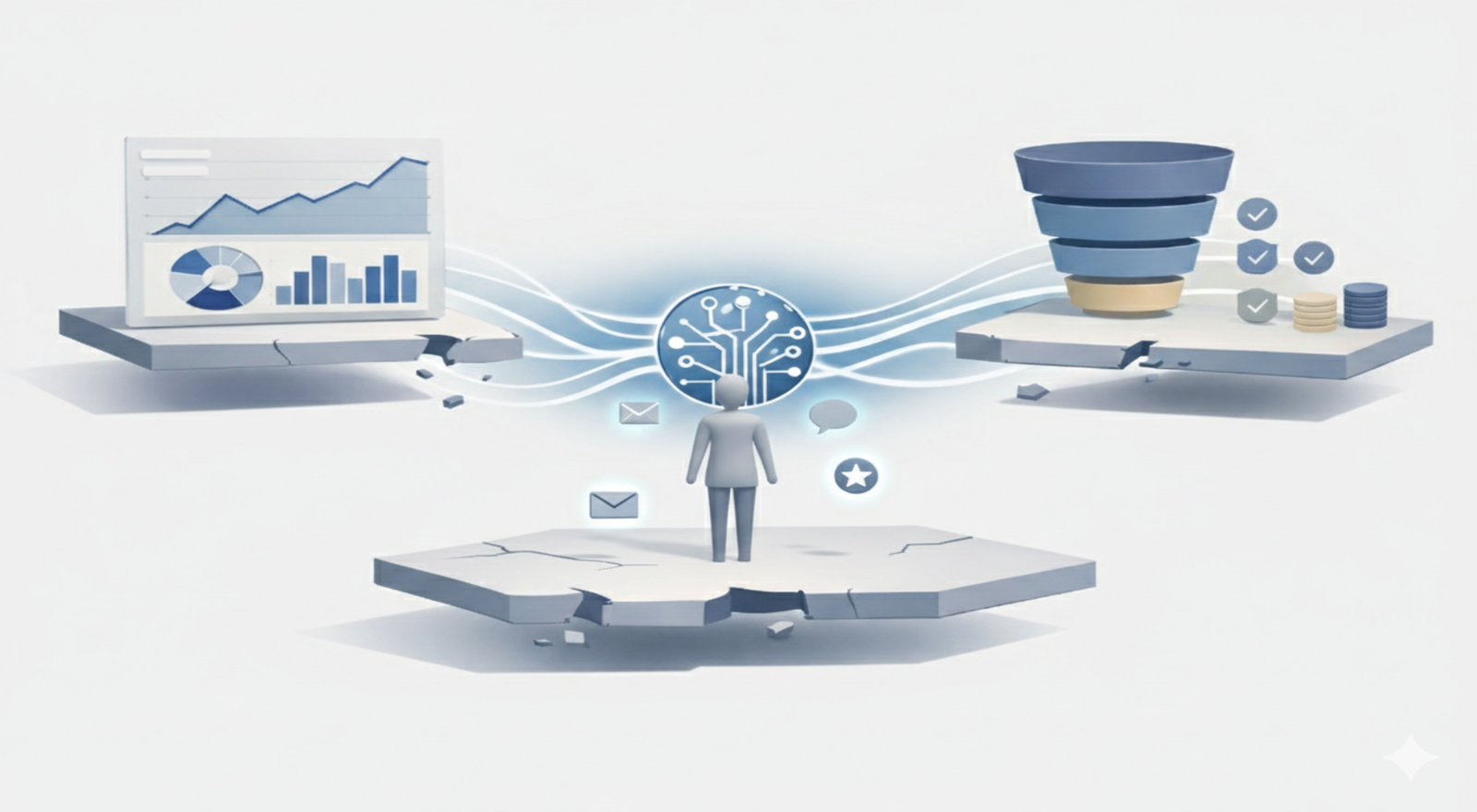
The Hidden Disconnect Between Data, Revenue, and Customer Success
Why Data Advantage No Longer Guarantees Growth
Organizations have never had more data or struggled more to turn it into durable growth. Over the last decade, analytics platforms have matured, dashboards have become standard, and data literacy has expanded well beyond technical teams. Yet for many companies, revenue growth remains unpredictable, and customer success remains difficult to scale.
This gap matters now because the environment has changed. Growth is harder to earn, customer expectations are higher, and the pace of complexity has outgrown the ability of manual coordination to keep up. In this context, data alone is no longer a differentiator.
A subtle but important shift is underway. Competitive advantage is moving away from insight generation toward execution design. Leaders are beginning to recognize that knowing what is happening is far less valuable than having systems that can automatically and reliably respond to it.
The Current Landscape: Fragmented Intelligence, Fragmented Outcomes
Most organizations operate across three loosely connected domains:
- Data, which explains what has already happened
- Revenue operations, focused on pipelines, forecasts, and transactions
- Customer success, driven largely by people, playbooks, and reactive workflows
Individually, these functions often perform well. The problem emerges at the boundaries. Insights are produced but not operationalized. Revenue teams act late because signals of intent surface too slowly. Customer success teams rely on human effort to compensate, which causes scale to stall as headcount becomes the limiting factor.
Traditional operating models assume that people will interpret data, decide what matters, and coordinate the next action. As customer volumes grow and products become more complex, that assumption no longer holds. Human attention simply cannot move fast enough.
Why Automation and AI Are Central, Not Optional
Automation is often framed as an efficiency tool. In reality, its greater value lies in consistency and scale. AI, similarly, is not about novelty; it is about context.
Automation ensures that customers receive timely guidance and intervention without depending on individual vigilance. AI enables those interventions to adapt to real behavior, predicting risk and opportunity instead of relying on static segments or assumptions.
Together, automation and AI create a continuous feedback loop:
“Data informs action → action influences behavior → behavior generates better data.”
Over time, this loop becomes a self-reinforcing system rather than a manual process.
Empirical Impact of AI-Enabled Analytics on Business Performance (2025)
The shift from insight to execution isn’t theoretical; recent 2025 research supports it.
The McKinsey Global AI Survey 2025 shows that organizations embedding AI directly into operational workflows are seeing revenue-related productivity gains of 20–55%. That’s not just improved reporting; it’s measurable performance impact.
At the same time, predictive churn research published in Frontiers in AI (2025) predictive analytics research demonstrates that advanced retention models enable earlier detection of customer risk, allowing teams to intervene before churn materializes. And broader enterprise decision-making studies indicate that roughly “93% of firms using AI within operational workflows report improved clarity and speed in decision-making.”
Yet despite these improvements in retention strategy, forecasting precision, and decision quality, enterprise-wide revenue impact remains uneven.
That gap reveals something important: having advanced analytics and AI tools is not the same as operationalizing them.
Growth does not come from simply seeing more data. It comes from acting on it consistently, automatically, and at scale. The real advantage today isn’t intelligence alone; it’s the ability to orchestrate that intelligence into reliable execution.
How This Changes the Business Impact
For leadership teams, the implications are practical and measurable:
- Scalability: Growth without proportional increases in operational overhead
- Revenue quality: Earlier identification of expansion opportunities and risk
- Customer experience: More consistent value delivery across the lifecycle
- Organizational focus: Less time spent coordinating, more time spent deciding
With every cycle of data and action, the system refines itself, making growth more predictable and less dependent on human intervention.
The Forward View: A Durable Competitive Advantage
As products, markets, and customer journeys continue to grow in complexity, the limits of manual orchestration become increasingly clear. Organizations that close the gap between data and execution build advantages that strengthen over time:
- System-led execution replaces human dependency: growth and customer success no longer rely on individual vigilance or tribal knowledge but on reliable, repeatable systems.
- Earlier detection of opportunity and risk: AI-driven interpretation surfaces intent and friction well before they appear in lagging indicators like churn or pipeline loss.
- Faster organizational response: Automated workflows reduce the delay between signal and action, allowing teams to move at the speed of customer behavior.
- Scalable customer success without linear cost growth: Teams support more customers, more consistently, without adding equivalent headcount.
- Continuous learning loops: Systems become smarter as they ingest more behavioral data, improving decision quality over time.
This is the difference between observing customer behavior and actively shaping successful outcomes.
Operationalizing Data Across Revenue and Customer Success
At Tweeny Technologies, we help organizations bridge the gap between insight and execution by designing automation-first operating systems for revenue and customer success. We work with teams to connect product usage data, behavioral signals, and business context into AI-generated workflows that act in real time, guiding customers toward value, surfacing revenue opportunities, and prioritizing intervention before risk becomes visible.
By shifting execution from manual coordination to system-led decisioning, teams gain leverage. Customer success scales without proportional headcount growth, revenue becomes more predictable, and leadership gains clearer visibility into what truly drives outcomes.
Conclusion: Closing the Gap Between Insight and Impact
The disconnect between data, revenue, and customer success is not the result of insufficient insight or effort. Most organizations already understand their customers better than ever before. The real challenge is structural: data is still treated primarily as something to analyze, rather than something to execute against.
As complexity increases, success will favor teams that design systems where interpretation, decision-making, and action are tightly coupled. In this model, automation and AI are not optional accelerators; they are the mechanisms that make consistency, responsiveness, and scale possible.
Organizations that close this gap will not simply move faster. They will operate with greater clarity, resilience, and leverage. In today’s environment, sustainable growth is no longer driven by knowing more; it is driven by building systems that do more, automatically and intelligently, when it matters most.



Explore more blogs


Building intelligent products, modern web platforms, and custom digital experiences.