.png)
Designing AI-Powered Features That Deliver Real Business Value
The Shift from AI Experiments to Business Outcomes
In recent years, organizations across industries have rapidly adopted artificial intelligence, introducing features such as chatbots, recommendation engines, and automated assistants. While these innovations have improved digital experiences, many AI initiatives still struggle to deliver measurable business impact.
The issue is rarely the technology itself. Modern AI models are powerful and widely accessible. The real challenge lies in how AI is integrated into product design and operational workflows. Too often, AI is added as a surface-level feature rather than embedded into the systems where real decisions and work occur.
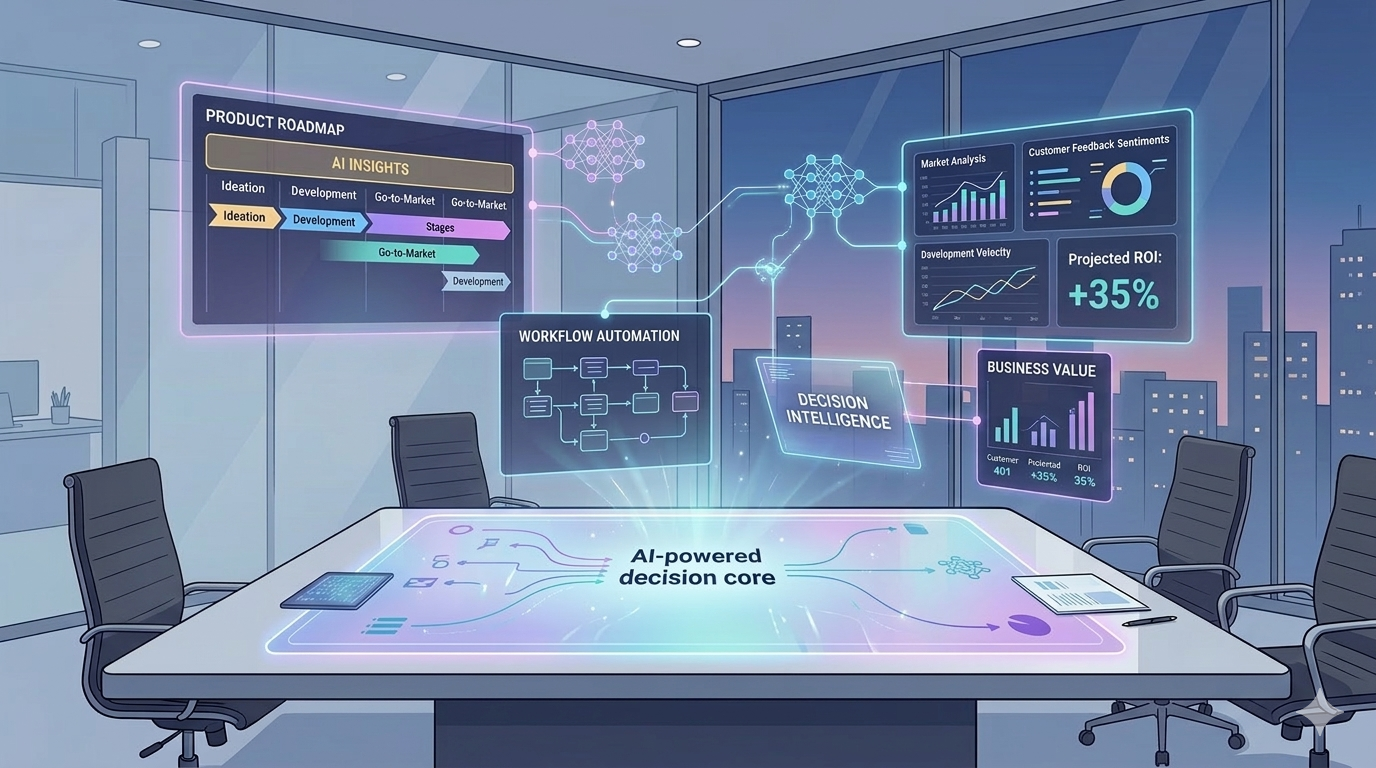
As a result, the focus is shifting. Instead of asking “How can we integrate AI into our product?” business leaders are now asking how AI can automate meaningful work, improve decision-making, and generate measurable value. Delivering on this promise requires designing AI-powered systems that enhance workflows, automate actions, and scale expertise across the organization.
What AI-Powered Product Design Actually Means
Designing AI-powered features is not simply about embedding a machine learning model into an interface. Instead, it requires building systems that connect intelligence, automation, and execution. At a structural level, effective AI-powered features typically operate across four interconnected layers:
- Data Layer: This layer collects structured and unstructured data from users, internal systems, and external sources. Reliable data pipelines are essential for ensuring that AI systems have the context needed to operate effectively.
- Intelligence Layer: AI models analyze data, identify patterns, generate insights, and predict potential outcomes. This layer transforms raw data into actionable intelligence.
- Decision Layer: At this stage, business rules, AI reasoning, or policy frameworks determine what action should be taken based on the insights produced by the model.
- Execution Layer: Finally, automated workflows, APIs, or integrated product systems carry out the action, whether that means triggering a process, assigning a task, or responding to a customer interaction.
When these layers function together, AI evolves from a passive analytical tool into an active driver of operational efficiency and decision-making.
The Strategic Advantage of AI-Driven Product Design
As AI technologies become widely accessible, competitive advantage will not come from simply adopting the technology.
Instead, the real differentiation will come from how effectively organizations embed intelligence into their operational systems.
Companies that successfully design AI-driven products often experience several strategic benefits:
- Faster product innovation cycles through automated insights and decision-making
- Reduced operational costs by eliminating repetitive manual work
- Scalable expertise, allowing organizations to replicate specialized knowledge across teams
- More adaptive customer experiences driven by intelligent systems
In this context, AI becomes more than just a feature; it becomes a multiplier of organizational capability.
Key Principles for Building AI Features That Drive Business Value
- Focus on Workflows First: Start by identifying operational workflows where AI can reduce friction or improve efficiency. The most impactful AI features address repetitive tasks, complex data interpretation, or decision-heavy processes within everyday business operations.
- Automate Actions, Not Just Insights: AI should move beyond generating insights or analytics. Real business value is created when systems can automatically trigger actions such as prioritizing tasks, routing requests, or adjusting processes based on intelligent predictions.
- Integrate AI into Existing Systems: AI features should be embedded directly into the tools and platforms users already rely on. When intelligence appears within the natural workflow, adoption increases and the technology becomes a seamless part of daily operations.
- Enable Human-AI Collaboration: Effective AI systems combine automation with human oversight. Features such as confidence scores, recommendations, and feedback loops allow teams to validate AI decisions while continuously improving model performance.
- Build with Scalable Data Infrastructure: Reliable data pipelines and continuous learning mechanisms are essential. Organizations that invest in strong data foundations enable AI systems to evolve, improve accuracy, and deliver long-term strategic value.
Our Approach to Building AI Solutions That Drive Business Impact
At Tweeny Technologies, we help organizations move beyond AI experimentation and build practical AI-powered solutions that create measurable business outcomes. Our approach focuses on identifying high-impact workflows where automation and intelligent decision-making can deliver real operational value. Instead of simply adding AI features, we design systems that integrate seamlessly with existing products, data pipelines, and business processes.
By combining product strategy, AI engineering, and workflow design, we help our clients automate repetitive tasks, improve decision-making, and scale expertise across teams. The goal is not just to implement AI, but to build intelligent systems that enhance productivity, improve customer experiences, and support long-term business growth.
Conclusion: Designing AI Systems That Drive Real Outcomes
Designing AI-powered features that deliver real business value requires a fundamental shift in how organizations approach product development. Instead of focusing on individual models or isolated AI features, companies must design AI around core workflows and operational processes where real work happens. The true value of AI emerges when it moves beyond generating insights and begins automating decisions and actions, reducing manual effort and accelerating execution.
To achieve this, AI must be embedded directly within product ecosystems so that intelligence appears at the exact moment decisions are made. At the same time, organizations need to treat AI as a long-term operational capability, supported by strong data infrastructure, continuous feedback loops, and human oversight to ensure reliability and improvement over time. Companies that adopt this approach will move beyond experimentation and start building products where intelligence actively drives outcomes. In the coming years, competitive advantage will not come from simply using AI but from designing systems where AI becomes a foundational layer of how work gets done.


Explore more blogs


Building intelligent products, modern web platforms, and custom digital experiences.