.png)
Sustainity Earth
Webflow site for Sustainity: simplifying ESG reporting via a high-performance UI, custom CMS for global standards, and seamless service-driven funnels.
Webflow Development
Website
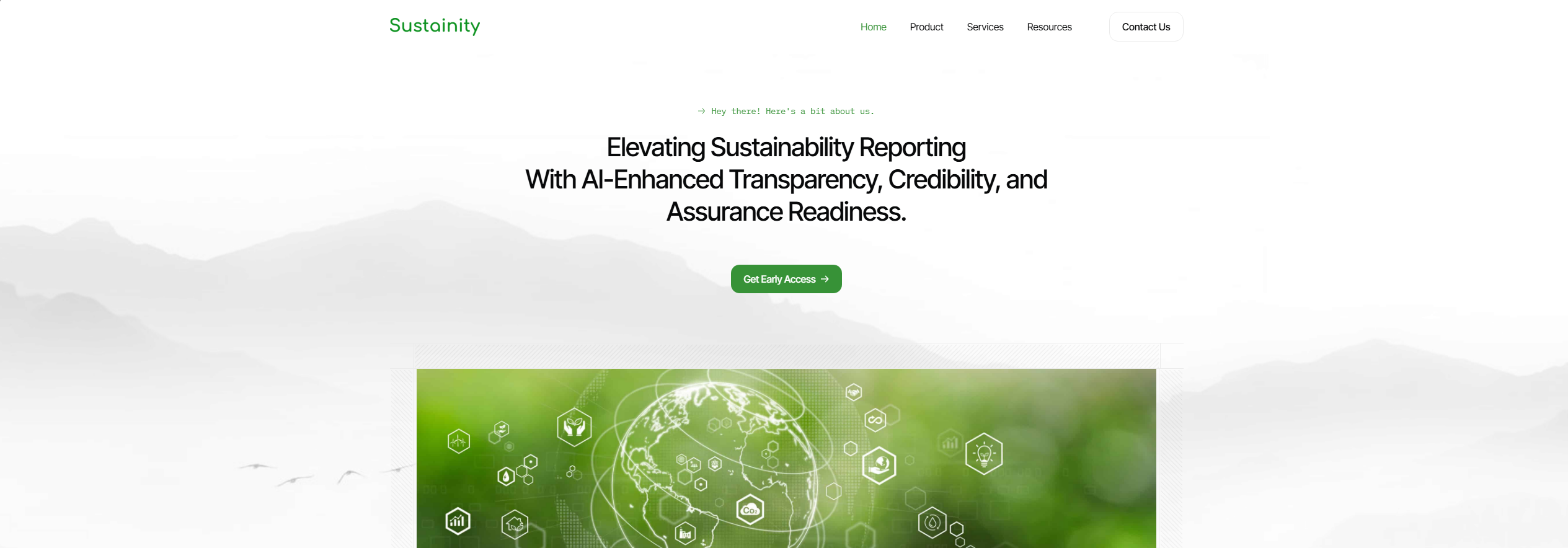

Project Goals
- Establish Tech Credibility: Create a digital presence that positions Sustainity as an intelligent, AI-enhanced workspace for sustainability reporting.
- Simplify Complexity: Design a user interface that makes complex data—like GRI, ISSB, and BRSR standards—feel accessible and actionable.
- Conversion Optimization: Develop a clear funnel for high-intent actions, including "Get Early Access," "Book a Demo," and "Start Free Trial."
- Educational Authority: Build a dedicated resources section to help organizations navigate evolving global climate regulations and guidance documents.
Technical Implementation
- Modern Web Stack: Built on Webflow to enable high-performance animations and a responsive, secure environment.
- AI-Centric UX: Developed a visual language that emphasizes "AI-Enhanced Transparency," using clean layouts to reflect the platform’s ability to turn raw data into audit-ready insights.
- Dynamic CMS: Utilized Webflow CMS to manage a library of Standards, Frameworks, and Regulations, allowing the team to update compliance documentation in real-time.
- E-commerce Integration: Configured checkout flows to handle product and service subscriptions directly through the site.
Challenges & Solutions
- Challenge: Visualizing "Invisible" Impact. Sustainability data can feel abstract to users.
- Solution: Used a "Complete Workspace" design aesthetic with modular blocks to illustrate how data collection, gap analysis, and report generation fit into one end-to-end workflow.
- Challenge: Balancing Automation with Trust.
- Solution: Highlighted the "Mission & Values" section (Impact First, Transparency, Responsibility) to reinforce the human stewardship behind the AI automation.
- Challenge: Rapidly Changing Regulations.
- Solution: Engineered a flexible "Inner Pages" architecture for Guidance Documents, ensuring the site remains a source of truth as climate policies shift globally.
Results & Impact
- Professional Market Positioning: Successfully launched a "Sustainability-as-a-Service" brand that appeals to both corporate compliance teams and ESG consultants.
- Unified Ecosystem: Integrated disparate functions—from materiality assessments to real-time resource tracking—into one cohesive digital journey.
- Scalable Infrastructure: Provided a backend that supports the firm’s vision of managing energy, water, and waste tracking for businesses of any scale.
Conclusion
The Sustainity website is more than a brochure; it is a functional entry point into a climate-resilient future. By blending AI-focused messaging with clean, high-performance web development, the site effectively lowers the barrier to entry for businesses looking to automate their sustainability workflows and lead with climate confidence.
Don’t take our word for it.
See what our past clients say.
“Scaling Success with Team Tweeny”
After struggling with our previous IT partner for nearly a year—facing scaling issues and frustratingly slow development cycles—we made the strategic decision to partner with Team Tweeny. The difference was immediate and transformative. Within weeks, they addressed our scaling challenges and accelerated our development process without sacrificing quality. What truly sets Team Tweeny apart is their ability to understand our business objectives and translate them into effective technical solutions that drive real results.

“Team Tweeny Powers Polo's Launch”
Over the years, we've partnered with Team Tweeny for multiple product development initiatives, from initial brainstorming sessions to MVP development and successful market launches. Their exceptional mobile app expertise was instrumental in helping us develop and launch our app, Polo, in under three months. For any organization looking for reliable, efficient, and innovative IT development partners, I highly recommend Team Tweeny.

“Team Tweeny Transforms Fintech Scaling”
In the fintech space, we need partners who understand both cutting-edge technology and stringent regulatory requirements. After evaluating numerous vendors, we chose Team Tweeny for our core platform rebuild—a decision that proved transformative for our business. Their team's expertise in microservices architecture and API development enabled us to launch new features 60% faster than our previous monolithic approach. For engineering leaders seeking partners who build for scale from day one, I can't recommend Team Tweeny highly enough.

“Team Tweeny Elevates Swackit’s Vision”
As the Co-founder of Swackit, a growing startup in the corporate gifting industry, it was important to find technology partners who truly understand our unique needs.
When we approached Team Tweeny, we had a pressing business challenge: our customers wanted to personalize their corporate gifts with branded elements, but our existing solution was cumbersome and limiting. Team Tweeny not only understood our vision but enhanced it with their technical expertise.

Ready to start working together with us?

Estimate Your Project
At Tweeny Technologies, we offer tailored solutions in product engineering, backend development, web applications, and DevOps.